
By Kim Hong
Inside the glass doors and beyond the pyramid of books, life-sized yellow spoons with tiny handles hang upside down from the ceiling. College and high school students alike roam the book tables beneath the suspended utensils. But at Labyrinth Books on Nassau Street, readers of all ages can be spotted too. “The little kids love the spoons hanging from the ceiling,” said general manager Virginia Harabin. “You see a lot of little kids look up and go, ‘Woah.’”
The spoons aren’t the only way Harabin and her staff at Labyrinth Books weave together a community as strong as a Chinese finger trap. “It’s a matter of keeping up with kids,” Harabin said. “It was the kids who made us have a manga section.”
A must-go for Princeton University students, the indie bookstore has become more than just a family business. Orange and black notebooks are available on discount to Princeton students on a shelf in the lower level, where the store used to sell textbooks as well.
Since the rise of PDFs, the area has shifted its focus to serving as an event space for writers, published or not. “The bookstore is kind of like a gateway and a mediator between the university and the town,” said Harabin, motioning from one side to another.
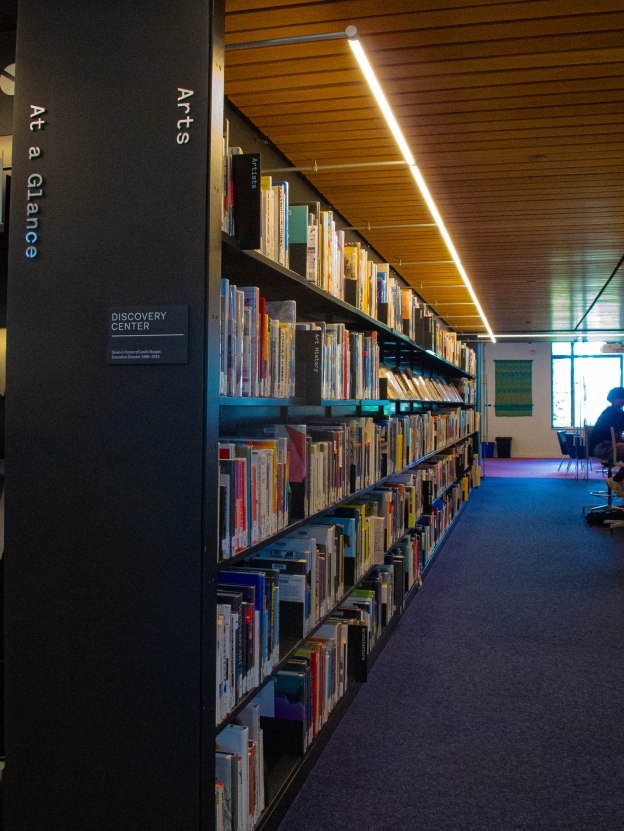
Princeton’s book spaces aren’t just utilized by university students, though. The Princeton Public Library (PPL) serves the diverse town and its many tourists. The library’s accessibility is a point of pride. “I think we have nine world languages represented at the moment physically in terms of books for adults and for children,” said Nora Walsh, PPL’s Adult Services Librarian.
In the aftermath of Covid and amidst the increasingly pervasive use of technology in society, both Labyrinth Books and PPL have taken risks to expand or further invest in their staff and facilities instead of shying away. As a result, both spaces have strengthened how they serve the town’s diverse community.
“There was a mother and two small children. One was three or four, and one was a baby that should have been in the walker, ” said RoMa Johnson, an author and volunteer writing group leader at PPL. “But the mother was carrying the baby, and the walker was filled with books!”
Johnson’s voice rose as she remembered the quirkiness of the sight. “I mean, literally, this high,” RoMa said, laughing and raising her hand a foot or two above the table. She hosts several writer’s workshops in-person and online at PPL, open to anyone who can make it. “There was a man from Iran who was writing stories about his childhood,” she said, her tone filled with wonder and pride. “In the same group, I had a woman from Poland and another woman from China.”
Labyrinth Books’ effort to remain integrated with the Princeton community shows in the intentional way they’ve taken care of their staff and store design. “We even think about the physical location, to make sure the YA section is distinct and apart a little bit, enough from the kid section,” Harabin said. “Because kids and young adults are not the same, and they don’t want to be treated the same.”
After Covid, Labyrinth continued to close doors at 6 PM instead of returning to its pre-pandemic evening hours, said Harabin. As someone who has always wanted to work in a bookstore, she makes sure that Labyrinth’s staff want to be there.
“There are certain things that you do for your staff, maybe that aren’t even the best thing for business, but we have to balance those things,” Harabin said. “There’s no doubt that people who come to the store, either for one visit or who come every day, they get to know the staff. It’s like your bartender, your barista.”
It’s true. Labyrinth’s staff can be seen chatting with visitors about book recommendations, Princeton, or anything else, either between shelves or at the check-out desk, where local artists promote their work on stickers and postcards.
Local writers also get a chance to be spotlighted to the Princeton community. “We want to help them build an audience as they help us build ours,” said Alyssa Kopanyi, the events coordinator for Labyrinth Books.
The tightly-woven relationship between Labyrinth and its patrons have protected the bookstore, allowing its staff to follow their own path, despite what others may say. “We had Mohammed Al-Kurd, who’s a young Palestinian journalist and writer. We had a huge packed room for that,” Harabin said. “There were some people who told us that we shouldn’t have an event like that. They objected on political grounds.”
However, Harabin and Kopanyi’s determination to pour their Labyrinth hearts into Princeton’s ever-shifting cup has only made their community all the more robust, allowing the bookstore and its staff to sustain themselves regardless of how much the community around the town’s book spaces has changed.
As Harabin says: “Nothing stays the same. We don’t stay the same. But it stays interesting because it’s books and it’s people and it’s the life of the mind.”

