Author Archives: princetonsjp

Cheerleaders underpaid and underappreciated

By Jodi Sterling
New York, N.Y. 

When I went to my first football game last week at the Meadowlands, it wasn’t the quarterback rivalries or the roaring crowds that captured my attention. It was the New York Jets Flight Crew cheerleaders.

Their outfits reminded me of the waitress uniforms at Hooters. Well, just with less clothing.

The women wore a white sports bra that contained a long v-neck revealing a golden bra — and cleavage, of course. Continue reading

GMO foods should be labeled

JieYingMeiBy Jie Ying Mei
Queens, N.Y.

The tomato is a simple fruit that is eaten by millions of Americans every year. So what’s the problem?

The problem is that you may have no way of knowing what has gone into that tomato you’re eating. Some tomatoes have been genetically modified to improve taste, delay ripening, tolerate pests and extreme climates.

GMO foods have become increasingly common in agriculture, with the rise of companies like Monsanto. According to the Center for Food Safety (CFS), 64 countries require labeling of genetically engineered foods through consumer “right-to-know” laws.

Continue reading

Cap on A’s hurts Princeton students

Illustration by Justin Park

Illustration by Justin Park

By Eric Macias
Chicago, Ill. 

Students at Princeton University in New Jersey have expressed discontent towards the University’s grade deflation policy that has been in place for a decade.

Established in 2004, Princeton’s system has played a role in the downfall of students’ grade point averages. It caps the number of As given out to students by a specific percentage per individual department.

The attainment of A’s at educational institutions implies that students have demonstrated excellent work, not average work. The implementation of a limit on the number of A’s awarded to students assumes that not every student is capable of excellent work. Therefore, the grade deflation policy embraced by Princeton should not be allowed in academic settings. Continue reading

Children at border should be given a chance

By Diego Pineda
Raleigh, N.C.

Tens of thousands of children from Central America are currently in detention centers around the border area. After traveling thousands of miles — trekking on top of a train known as “La Bestia” (“The Beast”) and crossing the desert —  these innocent children were caught by the United States Border Patrol as they had one foot inside and the other foot outside of making their dreams come true.

Escaping violence, poverty, deficiency of resources and persecution, the children are only seeking a light to the end of their tunnel. This tunnel might be dark and lonely as they walk through a desert that undergoes extremes of hot and cold temperatures. As they make their way through the Central American borders and Mexico, they tend to lack food and shelter. Everywhere they go there are dangerous people who try to sexually abuse them or get them to join gangs. Continue reading

Princetonians express mixed feelings on border crisis

By Vanessa Zamora
Vista, Calif.

As the border crisis in Texas worsens daily, with an average of 155 undocumented children crossing every day, the opinions of Americans have grown more complicated. Recent interviews of Princeton residents confirm the complex and conflicted nature of the crisis.

“It’s not a humanitarian crisis — it’s a safety crisis,” said Steve Beamer, 61, of Princeton. When asked if he thought the children’s reason for crossing the border was valid, he replied, “It’s a good excuse.”

Beamer said that he had no problem with immigration, and that he knows that the United States was built upon immigrants. However, he believes that it should be done through legal means. Continue reading

Princetonians divided on border crisis

By Razia Sultana
Brooklyn, N.Y.

The recent crisis at the Southwestern border of Texas has sparked a dialogue within Princeton. On a recent Saturday, residents offered their perspectives on the controversial topic, adding to an ongoing national conversation.

Since last October, there has been an influx of undocumented immigrants entering the United States. According to the New York Times, nearly 63,000 undocumented minors remain detained in hotel spaces throughout the country. Congress continues to debate possible solutions for this humanitarian crisis. Continue reading

Sympathy, concern for minors at border

By Kaygon Finakin
Bronx, N.Y.

On Aug. 2 canvassing of Princeton residents exposed a range of views on the ongoing immigration crisis along the United States border with Mexico. The sudden influx of unaccompanied Central American children began in October, due to a spike in gang violence in their native countries. Smugglers promise desperate families that children will be able to stay in the U.S. if they cross the border.

Some Princeton residents expressed sympathy for the children.

“The younger kids were forced,” said John Jones, 17, a student. Jones said the U.S. was “somewhat responsible” for these children, and argued they did not make the decision to come over by themselves.

“They’re pretty much in an entirely other world,” he added. “They had no choice.”

Joseph McHale, a newspaper publisher, agreed with that sentiment. “America is a country that looks out for others,” said the 61-year-old.

But others assigned more responsibility to the migrants.

Mike Souciy, 37, suggested that the young refugees should be deported. He said the U.S. does not have the room or resources to support these “unwanted” Central American children.

Souciy implied that this issue has existed for decades, and said he did not blame President Obama for the situation. “It was the predecessors,” he said.

“We could begin to blame those who created the constitution. [They] shouldn’t have made it such a free country,” Souciy said.

According to Souciy, a solution can be found in “a big wall,” and the immigrants “should go somewhere that wants them.”

However, more residents agreed with Rutgers University professor Holly Nelson, who called the border crisis “a disaster.”

“We should be embarrassed,” Nelson said. “This is a humanitarian crisis.”

Facts of Gaza conflict elude many in New York

A demonstrator displays a flag at a gathering for Universal Peace Day, which commemorates the bombing of Hiroshima and Nagasaki, on Aug. 5.

A demonstrator displays a flag at a gathering for Universal Peace Day, which commemorates the bombing of Hiroshima and Nagasaki, on Aug. 5.

By Angela Kim, Amna Nawaz, Nicholas Santiago and Hasani Valdez
with the staff of the Princeton Summer Journal

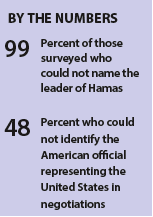
ByTheNumbersNew Yorkers are known for their global-mindedness, diversity and strong opinions. But in a survey conducted by the Princeton Summer Journalism Program last week in New York, a majority of respondents did not know some of the basic facts of the Israeli-Palestinian conflict in Gaza.

A large majority of 410 people interviewed around Union Square on Aug. 5 did not know the name of the leader of Hamas, the political faction which governs Gaza and is regarded as a terrorist group by the United States. Although 58-year-old Khaled Meshaal has run Hamas for the past ten years, 99 percent of those surveyed could not name him. Just three percent of those interviewed were aware that the Hamas leader resides in exile in Qatar.

Of those interviewed, just under 25 percent correctly identified the approximate number of Israeli casualties, which numbered 67 as of Aug. 6, according to BBC world news. (Responses within the range of 47-87 were considered correct answers.) Similarly, just under 25 percent of those polled correctly identified the number of Palestinian casualties within a range of 1300-2300. The number was 1,888 on Aug. 4, according to the Palestinian Center for Human Rights. Continue reading

Proposed pipeline through Princeton draws scrutiny

By Rashid Binnur, Catherina Gioino and Nelly Mendoza

In recent years, awareness of the environmental hazards posed by pipeline projects has grown, driven in part by the possible construction of the controversial Keystone XL pipeline, which would run from Canada to the Gulf of Mexico.

Now there is debate over a proposed pipeline that would pass through Princeton — a 1.3-mile stretch of the partly constructed 10,200-mile Transco pipeline, which would carry natural gas from Texas to New York.

New Jersey Senators Cory Booker and Robert Menendez, along with U.S. Representatives Rush Holt and Frank Pallone, called for an extensive review of the project’s environmental impact last month. A week earlier, Princeton’s town council had passed a resolution asking the federal government to reject the current pipeline plan. Between concerns over environmental damage and human safety, the project has some residents wondering: Is this pipeline a good deal for Princeton? Continue reading

Daring to dream of a brighter future

studentsatthetimes-FullColor-2By the Staff of The Princeton Summer Journal

Ten days ago, we arrived at Princeton University for the start of the Summer Journalism Program. We came from all over the country with different backgrounds and cultures, but we shared a common interest in journalism.

Today, we leave Princeton as friends and as members of the broader SJP family. We have had a once-in-a-lifetime experience and formed long-lasting friendships cemented through long days of workshops and late nights in the newsroom. Continue reading