
For College Athletes, Payment for Name and Likeness Long Overdue

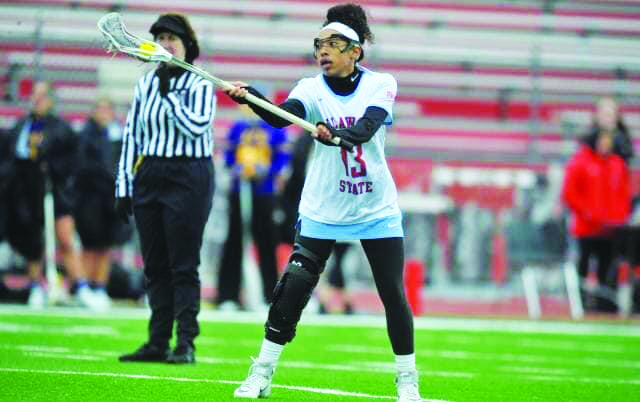
Imani Hill, playing Lacrosse for Delaware State University | Credit: Imani Hill

By Yasmin Mustefa

Federal Way, Wash.

Imani Hill never thought that she would play lacrosse. But her freshman year of high school, Hill’s basketball coach told her that she needed to participate in a spring sport to stay in shape for next season. An hour later, she pulled her out of class to speak with the lacrosse coach. 

“I’m just like, ‘I have no idea what lacrosse is,’” Hill said. But the coach con-vinced Hill to try. “I went out, and it was so interesting to me because of how unfamiliar it was. It was a really challenging task.”

By her junior year, several colleges were observing Hill. She decided to join Delaware State University’s Division I program in the fall of 2015, which she said was the only historically Black college or university (HBCU) at the time with a women’s lacrosse team. In 2019, while attending grad school at Auburn University in Alabama, where she is a current PhD candidate, she switched from player to head coach. 

Although she is no longer a coach for collegiate lacrosse, that breadth of ex-perience gave Hill a distinct perspective on the name, image, and likeness (NIL) laws that multiple states recently passed. The new laws allow college  athletes to use their name, image, or likeness for compensa-tion and prevents colleges and universities from pro-hibiting athletes to do so. 

While Hill acknowledged the “cool opportunities” the NCAA gives athletes, she’s glad players now have money-making opportunities she didn’t. “I think that it’s something that’s necessary  and something that really should have happened a long time ago,” she said.

“As a whole, sometimes we forget that the NCAA is a governing body, and ultimately they are a business. I think that some-times we kind of get that confused with an organization that supports athletes or wants what’s best for athletes.”

As a player, Hill practiced up to 20 hours a week, with additional hours of physical therapy, conditioning, and traveling. Players were given about a $500 stipend every season, she said, but that wasn’t enough to cover off-campus expenses.

Hill’s family lived close to Delaware State, and she remembers them filling up her dorm room with snacks and going home on weekends. “There are a lot of athletes who don’t have those luxuries. So literally their entire dependability is, like, on the university and what the university gives them,” she said. By contrast, the new laws could allow student-athletes to save money, help their families, or buy food, clothes, or school supplies.

At the same time, Hill also believes that the laws will continue to blur the line between college and professional athletes. She’s not sure how she feels about that. “How do we define those lines that let the world know that this person is still a college student before anything else?”

Infographics: Do they have Info?

By: Ebony Riley and Skye-Ali Johnson

Voorhees, NJ and Washington, D.C.

Picture this: It’s a mid-summer day and you unlock your phone to open up Instagram because you’re wondering what’s going on. You come across a post with brightly colored, eye-catch-ing fonts that describe the most current tragic event. This, you realize, is the new trend. 

With the rise of info-graphics, students are left questioning how effective they are in making a  difference. In a recent interview with students from the Princeton Summer Journalism Program (PSJP), students vocalized their opinions on infographics and online activism. 

“You want to follow that up with an action,” says Emi Glass, a 17-year-old high school student from Day-ton, Ohio. Glass believes that, in some cases, online activism can be beneficial and inclusive. But there are steps beyond reposting information on your story that are required to effectu-ate meaningful change.

“OK, I posted this, but what does this actually do for this situation?” asks Huda Tombul, a 16-year-old high school student from New York. She adds that many people post infographics for the sake of posting them, and do not actually care about the information they spread. “Is this actually accurate information? Or did someone simply just write this and everyone went along with it?” Tombul asks. 

“I mean, who isn’t on their phone?” 21-year-old college student Abby Dot-terer admits. Social media is an undeniable facet of daily life. The more people use it to express their concerns or thoughts, the more they begin to question whether or not it is a reliable place to source information.

When asked whether or not we should trust Insta-gram infographics, many interviewees advised caution—there should be individual research done before sharing  information. 

“You need to fact-check them. I don’t think you should trust some random person who posted it,” Glass says. 

“Everyone has their voice. And anyone could say any-thing that could influence other people,” 17-year-old Nhi (Nikki) Huynh from Western Massachusetts says. 

It is evident that social media platforms have be-come a popular place for young individuals to speak their truths, and a place  to spread awareness about topics that interest them on the internet. Sometimes, though, the messages be-hind online activism be-come lost in translation. “Social media activism is al-most like talking to a brick wall,” Dotterer says. 

Do infographics really lack information? “I have seen some that I think are more focused on the visual aesthetic than the quality of the information,” Glass says.

Online activism has taken a turn, and it’s hard to tell whether it is for the better or worse. Are we stuck? Or are we progressing?

No matter how hard we try, it is hard to predict the direction of infograph-ics and digital activism. As Dotterer puts it, “two steps forward, one step backward.” 

Will we overcome this online activism standstill?

By Amber Clay

College Park, Ga.

For years, college ath-letes devoted themselves to their sport—sometimes making millions for their school— with no pay. That is, until the NCAA changed the rules allowing athletes to profit from their name, image, and likeness. 

The NCAA is a billion-dollar business with 460,000 athletes. According to the National Col-lege Players Association, 86 percent of scholarship athletes live below the federal poverty line. That means most athletes don’t have the privilege to only devote time to their sports. These athletes are students, older siblings, mothers, fathers, and providers for their family. 

A former lacrosse player at Delaware State Universi-ty, Imani Hill believes that she and teammates should have been paid because of the amount of time they devoted to their sport. Hill spent 20 hours a week practicing, and when she was not practicing, she was conditioning, or in manda-tory study hall or physical therapy. Hill compared her college sport to a full-time job with no pay. 

While Hill is no longer in college and can’t benefit from the rule change, she said she fears that male athletes will gain more profit from their name, image, and likeness than female athletes. College sports have a history of catering to men’s sports programs not only when it comes to fa-voring them on live television, but also advertising them more heavily. In turn, men’s sports programs bring in more money than women’s sports. This could cause women’s players to lose out on endorsements.

Samari McKinney is a senior at Douglas County High School in Doug-lasville, Georgia. She plays flag football, basketball, and track. She believes that the change of rules will only benefit male athletes. “Honestly, in order to be a female athlete with endorsements you have to look fine,” McKinney said. “I hate that it’s like that, but it’s the truth. At the end of the day, male foot-ball and basketball players are going to benefit, while nothing changes for me.” 

McKinney does, however, think the rule change will help with better representation for underrepresented communities. “I am a member of the LGBTQ community, but many athletes never spoke up for my community,” she said. “I hope with the ability to have endorsements, young athletes will have the opportunity to see themselves represented in sports.”

The NCAA rules have not only affected current collegiate athletes, but youth ath-letes as well. More middle and high school students will be able to have the opportunity to play the sport they love and make an earning from it. While straight male athletes will benefit more, we hope to see a change in the future.

‘Tomorrow War’ is Decent War

By: Eunice Chae

Victorville, Calif.

The Tomorrow War an Amazon Original released in July, enjoyed mixed reviews from both audiences and critics alike. The film boasts Chris Pratt in its starring role as Dan Forester, a former U.S. Army soldier who now works as a high school biology teacher. After fail-ing to get a prestigious job at a science facility, Forester has a semi-midlife crisis and waxes poetic about his life aspirations to his nine-year-old daughter.

During the World Cup, a giant wormhole opens up above the soccer field. A group of soldiers comes through, announcing that they’re from the future. They explain that by the year 2051, aliens have attacked the planet and the human race is virtually extinct. The government sends soldiers into the future to fight, and Dan is drafted.

In the future, the aliens — dubbed the Whitespikes thanks to their sharp teeth, claws and spikes — have overrun the city. Meanwhile, the humans have regular guns and regular bullets which barely do anything to the aliens. You would think that if future engineers had the technology to build a time-traveling device from “chewing gum and chicken wire,” they could have created weapons that were a teensy bit more effective.

When Dan tries to rescue a fallen team-mate, the group is trapped and everyone is killed except for Dan, Charlie (Sam Richardson), and a man named Dorian (Edwin Hodge). Later, Dan meets an older version of his daughter, Muri (Yvonne Strahovski), who develops a toxin for the Whitespikes. Just as the toxin is perfected, the aliens attack the military base. 

Muri is injured, and even though the fate of the world depends on getting the toxin to safety, Dan refuses to leave her. When Muri falls toward a frenzy of Whitespikes, Dan again makes a selfish decision and leaps after her. However, he’s transported into the present in the nick of time.

The movie takes a slightly bizarre turn when Dan, Charlie, Dorian, and Dan’s estranged father, James (J.K. Simmons), find a crashed spaceship. Instead of alerting others at once when they find it, the group traipses in alone. To be clear, humanity depends on killing these aliens, and only they know their location. If they die in the spaceship, the knowledge to save the world dies too.

Whitespikes on board eventually attack, and Dorian sacrifices himself, blowing up the ship while Dan, Charlie, James, and a female Whitespike escape. There’s a pleas-antly subversive scene near the end, when James attempts a self-sacrifice. In a small twist, Dan rescues him before he actually can, and kills the last Whitespike himself.

All in all, if you’re looking for a decently fun action flick with above-average performances of a remarkably selfish protagonist and unfortunately two-dimensional characters, The Tomorrow War fits the bill. Just don’t start squinting too hard at the plot, though, because that’s when it starts to crack under the pressure.

‘Luca’ is Accidental Hit for Disney

By: Mariah Colon

Buffalo, NY

Disney’s Pixar is a controversial topic among film critics due to what many describe as the studio’s fall from grace.  Since the end of the company’s golden g age in 2010, its films have gotten less  traction and for good reason. Recently  the studio has been producing average  children’s films, not the masterpieces  they came to be known for. “Luca,”  their most recent project, is yet another example of this mediocrity. 

“Luca” undoubtedly has made an  impression, but it’s not due to the film being good. Many viewers got at- tached to the relationship between protagonist Luca and his newfound best friend Alberto and the subtle im- plications that the feelings between the two boys were more than platonic. 

Had fans of the film not jumped and made their own narratives about  Luca and Alberto, though, it’s incred- ibly likely that the movie would have  been thrown in the pile of modern,  mediocre Pixar films. The characters are forgettable and hardly fleshed out.  

Luca doesn’t have enough traits to be  considered three-dimensional. He’s a sea  monster in a world of humans—an outcast. We’ve seen this trope countless times, and the film does nothing special with it. Alberto has the basis for an interesting character, but there isn’t enough time given to properly flesh out what makes  him compelling. He’s a young sea creature who was abandoned by his father. The movie seemingly attempts to do the found family trope with him, but it’s so glossed over that it can hardly be considered an important part of the story. Then there’s Giulia, the third protagonist in the film who befriends Luca and Alberto. To be honest, before starting this article, I had to look up her name: that’s how forgettable she is. She’s really only used to develop Luca’s character and fuel some conflict.

Characters aside, the plot itself is boring and rushed. How it manages to be both is beyond me.

So how did “Luca” become so popular? Well, simply put, it was by accident. The idea of Luca and Alberto being outsiders while also being extremely close to each other touched the hearts of many LGBTQ+ viewers. Feeling out of place is common for queer youth, and that’s exactly how the boys felt in human society. On top of that, the way Alberto and Luca interact comes off as more than just a platonic relationship. For example, at one part of the film, Alberto gets so upset with Luca for spending time with Guilia that they get in a fight and Alberto ends up outing himself as a sea monster. Tell me that’s not dripping with metaphor and implications!

When asked about “Luca” possibly being a queer story, though, director Enrico Casarosa said, “I was really keen to talk about a friendship before girlfriends and boyfriends come in to complicate things.”

Essentially, “Luca” wasn’t intended to be an LGBTQ+ film, yet the movie’s queer subtext is the reason it got so popular, despite the movie itself being mediocre.

‘Quiet Place’ Surpassed Expectations

By: Jennifer Alvarado

Phoenix, Ariz.

A movie with nearly no dialogue. You’d be surprised at how your blood runs cold at the sight of it. With a well-known career as an actor, but not as a director, it was easy to be skeptical about John Krasinki’s abilities behind the camera. Nevertheless, he surpassed everyone’s expectations with the horror/thriller movie “A Quiet Place,”  and did it once again with the sequel. 

 In a film bound by the limitations  that come with not being able to make  a sound, it can become easy to rely 

 too heavily on other elements of film- making, but Krasinski uses the perfect  balance of sound, mise-en-scène and  narrative. This, of course, is supplemented by the incredible acting of Emily Blunt, Krasinski, Cillian Murphy,  Noah Jupe and Millicent Simmonds.

The movie, which takes place in a small town, starts with Krasinksi’s character, Lee Abbott, and his deaf  daughter, Regan (Simmonds), walking  to their truck after seeing an unknown  object making its way to Earth. Only  moments after that, we catch our first  glimpse of the terrors in this movie. 

 After some action-packed sequences  featuring the Abbott family struggling  to escape creatures with significantly enhanced hearing abilities and a great number of sharp teeth, we move for-ward in time to day 474, after the tragic events of the first movie transpired. 

Evelyn Abbott (Blunt), along with her three children, Regan, Marcus, and baby Abbott, were forced to continue moving in search of asylum somewhere safe, all while mourning the loss of Lee, who sacri-ficed himself at the end of the first movie.

With the knowledge that Regan’s cochlear implant could produce high-frequency audio that temporarily incapacitates the creatures, the family walks a path surrounded by greenery in every direction. Slow, steady camera movements add to the tension and the constant thought that any sudden noise could alert the creatures to their presence. 

Finally, Regan and a family friend arrive at an island safe from the creatures. Mean-while, Evelyn, Marcus and baby Abbott are at an abandoned steel mAill, trying to fend off the creatures that have made their way into their temporary hiding spot. 

With scenes that display the parallels in the situations the children are in, we see that this entire time, Krasinski was setting the film up to make the kids the heroes, the ones that ultimately use their courage and creative thinking to aid the adults in finding a haven. Whereas in the first movie Krasinski primarily directed his focus to the concept of parents risking and sacrificing everything for their children, he flipped that around and allowed for Simmonds and Jupe to be given the spotlight. 

Lights, Camera, Zoom

By: Layla Hussein

Bronx, NY

BLOOD RUSHING. HEAD POUNDING. The rehearsals, sleepless nights, and vibrant stages consumed Meg Talay, a 29-year-old musician and singer-songwriter, before the premiere of Broadway musical “Hadestown.” 

Talay’s first show was March 11th, 2020. News regarding the pandemic filled the air, giving performers one question: Will Broadway shut down? Despite this, performers were confident the show would go on. Wash your hands, wear a mask, repeat. 

In the same week, 22-year-old Harvard graduate Allison Scharmann was the chair of the arts section in The Harvard Crimson. Life was a consistent routine for Scharmann reporting on arts and culture in Boston, covering local arts-related events on campus, and publishing all online content. “It felt like a space where I could be myself ,” shared Scharmann, a space that could not be reimagined. 

Then, the pandemic happened. 

The arts went virtual. The transition was rocky, with growing concern for one’s health and career. No one knew how long quarantine would be, but artists had to prepare for anything. 

“I was concerned about my health … and my family. It was frightening … when things started to cancel,” Talay said.

Scharmann added, “It was challenging to keep the same ef-ficiency. … On top of that, I don’t get to see my friends every week and share snacks around the table while we edit.” 

Hannah Lemmons, a singer-songwriter based in Los Angeles, was fortunate for the free time she had for songwriting, as well as commissions for original songs and covers during the pandemic. 

“I just have more of a balanced lifestyle overall compared to pre-pandemic. … Now, I have become more productive,” said Lemmons.

Artists around the world, especially artists of color, used their art to express their frustrations by inter-ecting with social justice, sparked by the murder of George Floyd. 

For musicians like Talay, there was an awareness surrounding their identity. As a queer artist, Talay mentioned, “Being visibly queer and politically queer in support of the trans movement and the Black Lives Matter movement has impacted me and how much it means to be who I am publicly.”

The world is slowly transitioning to a state of normalcy in 2021. The future of the arts industry is unknown, but with the lessons learned and new mediums explored from the pandemic, artists are ready for anything headed their way.

‘Black Widow’ Pairs Action and Adventure with Family Drama

By: Esmeralda Garcia-Cisneros

La Grange, N.C.

WHEN “Black Widow” was released on July 9, 2021, it quickly was hailed as one of the best movies in theaters in the past few months. “Black Widow” is a positive return to the movies for Marvel, after months of shuttered theaters, and fans are loving it. Many feel that the movie is long overdue, saying that the Black Widow character should have had a movie ages ago. But it’s safe to say better late than never. 

The movie starts with a family moment with Natasha Romanoff (the Black Widow) and her little sister Yelena playing in the backyard, and it moves to a family dinner with their mom and dad. Then the dad says it is time—but time for what? Well, you then see a scene where the family is escaping from cops and getting into an airplane, which lands in Cuba. Soon, their family life is over, and the two sisters are separated.

Like all the other Marvel movies, “Black Widow” emphasizes family and adventure amid efforts to defeat the evil of the world. Natasha confronts the darker parts of her his-tory when she faces off with the cause of all her pain. Pursued by a force that will stop at nothing to bring her down, Natasha must deal with her broken relationships from long before she became an Avenger. 

This movie offers more understanding of how this character—popularized in previous Marvel films—got to be who she was. The character of Black Widow is mysterious and exciting, and this movie really summarized her perfectly.

Miles Apart, Connected Forever

STAFF EDITORIAL

After five weeks of endless questions with guest speakers, chats about Olivia Rodrigo over Slack, and double-checking if your mic was muted on Zoom, the 2021 cohort of the Princeton Summer Journalism Program (PSJP) completed its second virtual summer. Asking questions by day, and laughing together by night, PSJP students not only broadened their knowledge of journalism, but also created life-long connections in a newfound, online family.

Using digital platforms had its inevitable challenges: internet connectivity issues, navigating time zones, and Zoom fatigue. Many students also juggled family commitments, jobs, internships, and summer classes. Throughout it all, PSJP students flourished, effectively balancing a multitude of tasks.

We were fearless when questioning politicians in virtual press conferences. Students asked hard-hitting questions on topics ranging from immigration to anti-racist education that stunned speakers. We engaged with Princeton professors through
interactive discussions and attended workshops that explored various forms of journalism, from covering food to conspiracy theories. No matter the unpredictable adventure that awaited every week, each Zoom call was a learning experience for both the speaker and student. After each session, students would leave with a new-found understanding of journalism.

As a collective, we learned that journalism is more than just writing, but also a desire to listen and learn. No matter our prior experience with journalism, we all gained an understanding of the power of journalism as a gateway to igniting change. We
were introduced to ideas like Critical Race Theory, drag queens, and the intersection of food and culture. Throughout it all, we learned how to be open-minded and bring creative perspectives into our writing.

Yet the most engaging aspect of the program was the community that kept 40 students across the United States eager to learn. Zoom chats would move a mile a minute, causing joy among students, staff, and guests. Whether it was hilarious remarks or positive affirmations from students, the love and laughs were felt despite the distance.
Between arranging Zoom calls outside of PSJP programming, or creating a petition for a deadline extension, we channeled our empowerment from the program to make our voices heard and create unforgettable memories. On behalf of all PSJP students this
summer, we thank the persistence of the staff and the enthusiasm of our guest speakers. Every lecture and workshop encouraged us to view the world differently with new perspectives. Moving forward, we will use the knowledge we gained from PSJP to not only reimagine the future of journalism, but also to excel in all aspects of life. Miles apart, connected forever.

How Creating Random Videos on TikTok Led to A Viral Sensation

By: Alexsis Tapia Vazquez

Riverdale, MD

Alexa Walkowitz didn’t plan to go viral when they hopped on a TikTok trend.

Known as @sluglexa on the platform, Walkowitz joined TikTok in 2019, enjoying the large vari-ety of content available. They began to post as a creator in the midst of the first pandemic lock-downs that happened in March 2020. Their first videos garnered few views and were largely centered around their treehouse hangouts with their friend.

However, last summer, Walkowitz’s experience with the platform changed when she uploaded a video inspired by a viral Randonautica TikTok trend. In the trend, TikTokers use the Randonautica app as a challenge to generate random coordinates and discover where it takes them. 

In their video, Walkowitz and their friend document their journey into the Californian desert, using the app in the hopes of finding their mom’s lost dog. They come across, instead, a random dog standing alone in the middle of the scary and ominous desert. Shocked at their discovery, Walkowitz and their friend upload-ed the video on TikTok, wanting to share their strange experience with their followers.

Surprisingly to Walkowitz, the video skyrocketed shortly after, earning millions of views per day. Today, the video continues to generate thousands of views and has offered Walkowitz many opportunities to speak about her experience, including on A&E’s show “The Proof is Out There.”

Walkowitz remains confused about the video’s success, saying,“I just kept waking up … seeing [the video] and check-ing the analytics,” said Walkowitz.

However, Walkowitz noticed that their experience with the platform changed when they became a creator. They  spent more hours deliberately coming up with videos to upload rather than actually watching  videos created by others.

“It’s a really different experience when you make them versus when you watch them … more time is spent saving sounds and re-cording things than it is watching things,” said Walkowitz.

Walkowitz also found other obstacles with their newfound role. Followers had high standards and strangers often left nasty and hateful comments that affected Walkowitz’s mental health. They have responded and deleted hateful comments on many occasions. For now, they have temporarily left the platform for the sake of their mental health. 

“Truly people, especially on TikTok, expect the next level of attention,” added Walkowitz, “Accumulating more attention is always really scary, with the good attention comes the bad attention.”

Their return to Tik-Tok or other social media platforms remains dependent on different factors. Just this May, Walkowitz graduated from Williams College and began  their journey looking for employment. They remain unsure about how to navigate their professional life with their online presence.

They admit, “I also don’t want to live in a world where my silly random videos on the internet have anything to do with my professional life.”

Walkowitz has experienced and learned so much as a TikToker. Throughout their experience as an influencer on the platform, the app has influenced them both in positive and negative ways.

“I got a lot of interesting creative inspiration fro Tik Tok,” said Walkowitz, “Despite the fact that it’s kind of a horrible place, it’s kind of the greatest place.”