Category Archives: News

We tried 50 free summer meals across the country, here’s what we found. 

By Clara T., Claire B., Zahra A., JaeHa (Justin) K., Bryan R.V., & Mai E.L., with the staff of the Princeton Summer Journal

SUN Meals, a federal program that provides no-cost meals for kids during the summer, are inconsistent across the country. Are they truly meeting food security needs?

Layers of stacked frozen leftovers saved from dining halls—mashed potatoes, mac and cheese, and salads—in Ziplocs. School lunch plates filled with tan and brown foods, with little to no green in sight. Scrambling to figure out the latest EBT eligibility. Staring at an empty fridge on a hot summer day. Students of all ages, whether K-12 or college, continue to face hunger and a lack of accessible nutritious food, these are just some of the many ways that food insecurity manifests for students and families. 

“The issue goes beyond just someone [having] enough food to meet their calorie needs, fill their stomachs, to ‘are we meeting the nutritional needs of a person?’” said Dr. Lauren Dinour, faculty member at Montclair State University with the Nutrition and Food Studies department. 

Having access to nutritional food helps children develop healthy habits so when they become adults with greater freedom, they have those skills established.  As Mykaila Shannon, the Health Promotions Manager at Princeton University said, “when it gets in early, it gets in deep.” 

A Princeton Summer Journal investigation reveals how SUN Meals—a federal program that provides meals and snacks at no cost at various neighborhood locations—fails to provide nutritious food for children on a nationwide scale. This presents concerns not just for young people during the summer, but is indicative of systemic failures to provide all people easy access to proper nutrition. 

The investigation sampled 65 sites and 50 meals across the United States. For each site reporters visited or contacted the organization and recorded the meals being offered and the state of the site. The Journal found great inconsistencies in the sites and meals across the country. 

A majority of the sites were visited in-person. 51 percent of those served elementary school students, 40 percent families, 20 percent middle school students, and 9 percent high school students. In 20 percent of cases, the sites were empty other than the reporter. 

The large portion of elementary and middle school students could be attributed to the summer camps who often used SUN sites for their programs. In some cases, the presence of only young kids and camps led investigators to experience cautious and confused staff when they tried to access the meals. 14 percent of sites visited had some type of cautious staff,  11 percent appeared understaffed, and 4 percent appeared to have inattentive staff. 

While searching for sites, reporters often found the federal SUN database to be inaccurate and out of date. 10 sites had inaccurate contact information online, or were not contactable for other reasons (such as not including a phone number or email on their website), and even more were excluded from the investigation because the site had closed or didn’t exist. 

While 60% of the sites were “easy to find” in-person, 29 percent of sites had no signage to locate them outside, with 11 percent of them described as “hard to find.” The lack of accurate information and difficulty to access sites, shows how unpredictable SUN sites are, making them an unreliable solution to food security. 

To understand the nutrition of the meals provided at SUN sites, Shannon provides a simple solution—colors. Shannon describes how beige colors often reflect some lack of nutrition. She recommends that students, “throw some things in there that are colorful because colors often, you know, represent some nutrition.” 

As she puts it, colors are an easy, gamified way for kids to be able to say:  “oh, I ate four colors today at lunch. That means I had a good meal.” 

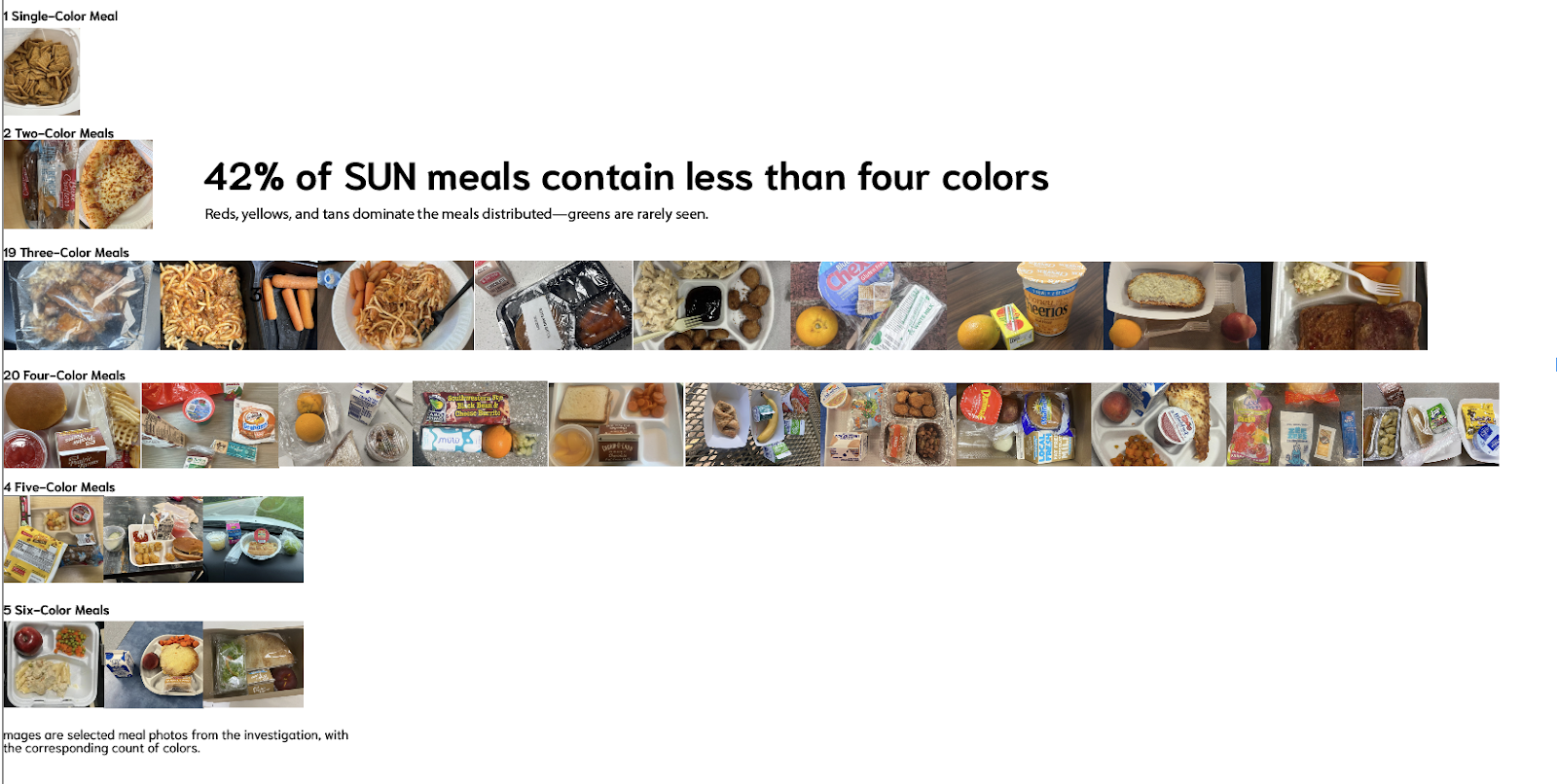
To explore this for SUN sites, the Summer Journal tracked the colors of food items given by summer meal programs: Grain forward items were categorized as tan, meat categorized as brown, mixed fruit cups and juice mixes were categorized as multicolor, milk and chocolate milk were categorized as white and brown respectively,  cheese and egg as yellow, and vegetables and fruits were categorized by type into red, orange, green, blue, and violet categories.

Across all 65 sites, 94% of the meals served had tan foods, meanwhile, only 18% of meals had green foods in them. Moreover, 42% of the summer meals do not contain four colors or more.  
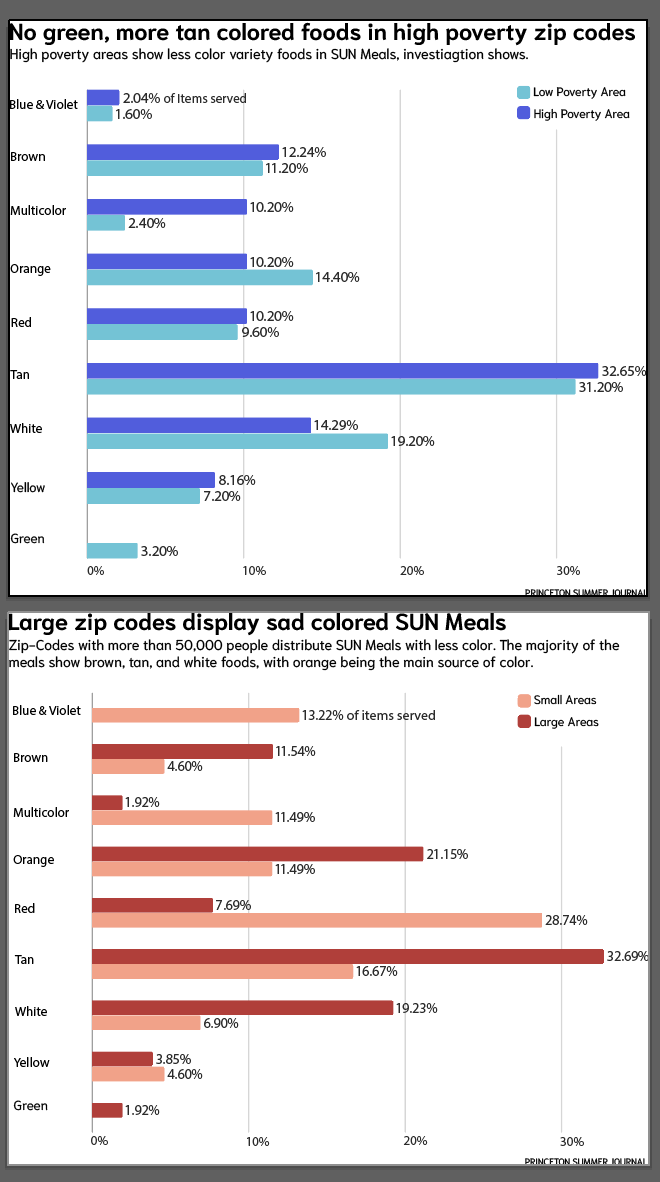
The Summer Journal also analyzed how the colors in summer meals changed depending on the demographics of the population, including, poverty rate, population size, and racial breakdown. 

Findings showed that  areas with 20 percent or more of the population under the federal poverty line had no green items, compared to 3 percent green foods in  lower poverty areas.  Zip codes with more than 50,000 people, provided 32 percent of tan meals, while small zip codes only recorded 28 percent. No significant difference was found between majority white and majority non-white areas, but the five sites sampled in high poverty, majority non-white, large zipcodes only had orange, tan and white foods. 
While some SUN summer meal program sites are successfully providing meals, many have  failed to provide proper nutritious food. On a nationwide scale this unreliability presents concerns for kids without food security.  

The inconsistencies among summer meal sites extend beyond the SUN meal program. Summer EBT and SUN Bucks give low income families $120 per eligible school-age child monthly for grocery benefits. However, as of August 2025, according to USDA, 13 states remain without federal money for the Summer EBT or SUN bucks after rejecting them, effectively leaving millions of eligible children without the benefits. 

“So if we have states that are saying that they’re not going to participate, they’re not going to pay into these programs, then we’re going to have huge disparities in who has access to them across the country,” said Dinour, “and if we make some of these programs like SNAP, for example, have more strict eligibility requirements, then we’re going to have even less people participating”

Dinour explained that when benefits go up, food insecurity goes down. Giving people more money and food means they will have more food to eat. She says food insecurity has had an uptick in 2022 and 2023 and imagines it’s going up as a result of tightening eligibility. 

The solution to these problems begins with destigmatizing food insecurity in our everyday lives.  Ricardo Kairos, a faculty member at Rutgers University specializing in Nutrition says that destigmatization encourages people to seek out resources rather than facing it alone. 

Many Kairos interviewed for his work helping people get benefits, felt they weren’t entitled to get food assistance.They felt the food wasn’t for them and that they shouldn’t take resources from other people. 

On some occasions, a singular word could change a stigma entirely. Mark Dinglasan, the Executive Director of the New Jersey Office of the Food Security Advocate (OFSA), believes that when it comes to mitigating the food insecurity crisis, it is imperative to accurately differentiate between “food security” and “food insecurity.” 

When he first came to his office two years ago, Dinglasan commented that his first focus was on “picking the most holistic and comprehensive definition for food security that I could find.” At the time, his office was titled the Office of Food Insecurity — which Dinglasan was not a fan of. Eventually, Dinglasan chose to follow the definition of food security followed by the United Nations, and renamed his office to be the Office of Food Security. 

Dinglasan believes that food security can only be truly achieved by focusing on helping people, rather than treating them merely as numbers. “Ending hunger has nothing to do with food,” he said. Rather, he believes, the focus should be on helping communities as much as possible. 

Similarly, Chilton rejects the term “food deserts” because it falsely suggests that no food exists in certain areas. Chilton argues that the term “food apartheid” is more fitting because the limited access to healthy, affordable options in grocery stores isn’t an accident, but rather a result of an intentional decision shaped by food systems, zoning laws, public policies, and systematic disparities. Others argue the term “food swamps” for areas that simply have an abundance of non-nutritious food options. 

The failure of distributed meals to meet the dietary restrictions, cultural preferences, and nutritional needs of people is why programs like SNAP and SUN bucks are beneficial, because giving people the money to choose what foods to purchase for themselves and their families can lead to meals better tailored to their needs, unlike school meals and SUN meals.

Still, Chilton argues that rather than relying only on programs like SNAP, which exist because wages are too low, we should raise wages instead. She suggests implementing a universal basic income (UBI) regardless of employment status would ensure nobody goes hungry, everyone has shelter, and people can afford necessities. 

Another part of the solution is finding and supporting initiatives that ensure food gets to those who need it. There are many existing resources and initiatives that remain obscure to many. Free community supported agriculture (CSA) programs offer fresh food to lower income people and are often cheaper than grocery stores. Public insurance provides free nutritionists. Tiaa.org, provides a customized guide explaining what people’s co-pays, deductibles, and insurance particulars are. Planned Parenthood has a teen group that aids nutrition. Schools often have reimbursement programs to provide money for lunch or breakfast.

One initiative, the Food Recovery Network, is a nonprofit led by students with the dual mission of recovering surplus food and ending hunger, repurposing it and providing it to individuals who are food insecure. 

Dinour is the faculty advisor for a chapter on Montclair’s campus, one of few New Jersey schools with a chapter.  Initially, it was a class project by her students intended to address food waste then they began the chapter in 2017. Students essentially repackage safe, edible excess food that would’ve otherwise been thrown away, and place it in a fridge on campus. 

According to Dinour, around hundreds of thousands of pounds of food have been recovered on Montclair’s campus and the number of visits to their fridges increased by around 1,500 visits over the course of the last year, adding up to almost 8,000 visits to the pantry from September to June.

“We’re doing a lot, we can do much more,” Dinour said. “But I don’t know that we’ll ever get to a place where we are eliminating the need for all of our students. And that’s hard to sit with.” 

Methodology

METHODOLOGY

Princeton Summer Journalists selected sites nearby their hometowns to sample. For each site they either visited in-person, or contacted them virtually. For each site the reporters recorded qualitative observations and if possible the content of a meal.  

The Princeton Summer Journal Data Team then compiled all the data reported and tracked qualitative patterns, like how busy the site was, who it served, and how easy it was to find. 

Reporters then looked at meal descriptions and photos to determine the colors provided in each meal.  Colors were grouped into: blue & violet, brown, multicolor, tan, red, orange, yellow, and green. Site demographics data such as the site’s zip code, population size, poverty rate, and population diversity—was joined with the color counts to uncover how the colors of food in each SUN Meal varied between towns with similar populations. 

“We Cannot Protect People From It,” Says Mayor Freda on ICE 

By Grace S.

On June 30, Princeton Mayor Mark Freda attended a press conference with the Princeton Summer Journal, where he discussed recent United States Immigration and Customs Enforcement (ICE) activity in the small New Jersey town. 

“Our police do not work with ICE. We do not support ICE in immigration matters in any way, shape, or form,” he said, expressing his dislike for the federal organization.

“It seems to me that ICE is concentrating on anybody that appears to be Latino. That is their A-number-one target, and so that’s problematic,” Freda said. Of the 15 people taken, he said he was “90-some-percent” sure that at least one had work authorization. “They’re going to work,” he said. “None of them are criminals.” 

Freda went on to discuss what his administration is doing to aid the detainees. One option is for the town to support the proposed New Jersey Immigrant Trust Act, which would protect immigrants and their personal information. The act has faced both pushback and support. 

“The Immigration Trust Act is something the state legislature will hopefully act on at some point,” Freda said. “People are concerned that if we pass the resolution in support of the act, that somehow, ICE and others will pay more attention to Princeton.” 

Freda faced pressure surrounding the legislation at a recent town council meeting. “We had probably about 60 or 70 people show up and were giving us a really hard time,” he said. Freda maintained that the act is a state matter and he is still undecided if he will support it. 

Despite immigration issues being out of his hands on a federal level, Freda still wants to support his constituents, as hard as that may be. 

“Why are we bothering these people? We cannot protect people from it. We just can’t,” he said. “It doesn’t matter. What resolution we pass doesn’t matter. We can’t. Until [things change] at the federal level, all we can do is offer help.”

Princeton Mayor Mark Freda Addresses ICE Raids, Public Discord, and the Fight for Trust

By Jayden W.

Princeton Mayor Mark Freda has officiated weddings, shaken hands at hundreds of community events, and spent decades fighting fires for his hometown, but these past few months have proven some of the most difficult of his career. Not a blaze in a building, but a firestorm of public outcry.

The mayor, who joined Princeton’s volunteer fire department at just 15 years old, grew up in a Catholic household rooted in community service. That foundation shaped him into a leader who takes pride in public service, but the present political climate has tested even his strongest foundational principles.

At last week’s town council meeting, nearly 70 attendees packed the room, demanding answers after a disturbing encounter between community members and the United States Immigration and Customs Enforcement (ICE).

According to Freda, ICE agents stopped a van carrying 15 people to work. The organization was reportedly looking for one individual, but detained everyone onboard, regardless of legal status or criminal history.

“It seems to me that ICE is concentrating on anybody that appears to be Latino,” Freda told the Princeton Summer Journal. He said he was “90-some-percent” sure that at least one person arrested had work authorization. “None of them are criminals,” he said. 

Freda noted that many who attended the council meeting were not Princetonians, but outsiders who were not focused on useful outcomes. “They were more concerned with how they were going to look on those film clips,” Freda said.

At the heart of the debate is the New Jersey Immigrant Trust Act, a proposed law to protect undocumented residents from deportation by restricting cooperation between local law enforcement and ICE. The Princeton town council is considering a resolution to support the act.

“People are concerned that if we pass the resolution, ICE and others will pay more attention to Princeton,” Freda said. “I don’t know if that’s actually true.”

The New Jersey State Legislature has the final call. Despite this tension, Freda remains steadfast in his love for the community that raised him.

“I’ve been here forever,” Freda said. He went on to share that what he wants is for his critics to say: “That guy was okay. I didn’t agree with him all the time, but you know what? He was okay.”

For Freda, the goal isn’t perfection, it’s presence. In a town that often demands both, “okay” might just be the most human standard of all.

Survey Finds Few Schools Adapt To BLM

This story was reported by the staff of The Princeton Summer Journal. The project was led by Ryleigh Mae Emmert, Synai Ferrell, Roxana Martínez, Mmachukwu Osisioma, and Lewis Stahl.

Thomas Stone High School is located about twenty-five miles south-east of Washington, D.C., in Charles County, Md. Roughly 1,100 students are enrolled there, most of them African-American. After nationwide Black Lives Matter protests erupted in the spring of 2020, following a spate of high-profile police killings of African-Americans, students and faculty at Thomas Stone wondered how the school would address themes of racial injustice. “I have had three teachers talk about race in my whole experience at Thomas Stone: one world history teacher, one chorus teacher, and one English teacher,” said Tah’Kiyah Coleman, 17, a 12th grader at Thomas Stone, in an interview with the Princeton Summer Journal. “I do think they sugarcoat things to make it seem that they are not as racially unjust as they are,” she added. Coleman was addressing a question countless others would pose around the country: Would schools continue teaching the same curriculums, or make changes inspired by the Black Lives Matter movement?

At Thomas Stone, it turned out, nothing much changed. “We were in the virtual environment and were cautioned about teaching certain things, because students were at home and parent/guardians could hear what was being discussed and could take them out of context,” Niyati Green, an English teacher at Thomas Stone, told the PSJ. “I was not discouraged, but was warned that this virtual platform was not the best time to push the envelope .” Ultimately, Thomas Stone’s principal confirmed, no school-wide curriculum changes were implemented, though an “educational equity” task force was created in October 2020 to provide students with “essential academic, social, emotional and economic resources.” 

This summer, the PSJ sent survey questions to 42 high schools or school districts across the country to form a picture of how American schools are addressing race in history, literature, and other subjects. The institutions surveyed ranged from a large public school in Brooklyn, N.Y. to a charter school in Houston, Texas, to a small high school in rural western Tennessee. Representatives from 17 schools or districts replied. The schools that refused to answer may have done so out of caution, as race in the classroom has recently become a third-rail in American politics. In response to the uprisings of 2020, countless schools around the country began to assign recent texts about the history and legacy of American racism, such as The New York Times’s “1619 Project,” and Ibram X. Kendi’s “How to Be an Anti-Racist.” In response, according to the education site Chalk-beat, 28 mostly conservative-leaning states have proposed or passed legislation this year seeking to restrict the teaching of Critical Race Theory, a contested school of thought that centers the teaching of structural or systemic racism.

Among the schools surveyed by the PSJ, however, change was the exception: Just four reported that courses had been added or altered to address topics central to the Black Lives Matter movement. In Philadelphia, a charter school added a course called “Intro to Criminal Justice.” In Phoenix, a large school district offered three new courses exploring African-American, Mexican-American, and Native American perspectives. In the northern California city of Brentwood, an African-American history class was added. In a Brownsville, Texas charter school, an eighth grade social studies class was altered to incorporate themes of social justice.

There are varying reasons other schools did not make changes to classroom instruction. Several majority-minority charter schools argued they had been founded on a mission of inclusivity and didn’t require significant changes. Traditional public schools in Massachusetts and Maine had diversified their syllabi in the years running up to 2020. A school in Tennessee, meanwhile, responded that it has been hamstrung from making changes by the recent statewide ban on Critical Race Theory. Respondents from other school districts cited bureaucracy or budgetary limitations.

Nikolai Vitti, Detroit’s public schools superintendent, was one of the respondents who felt his school district was ahead of the curve on race-conscious learning, before the protests of 2020. “Our district has always been very intentional in teaching history from multiple perspectives” and elevating “the voices of those who have been most marginalized and oppressed,” he told the PSJ. Antonio Cano, the principal of La Joya High School, located in south Texas, said there had been no curriculum changes at his school, but added, “I am sure if students were to start a conversation relating to race, protests, or Critical Race Theory, our teachers will make time to acknowledge their questions and have a discussion within the class.” (This summer, Texas passed a bill seeking to ban elements of Critical Race Theory in public schools.)  

At Bioscience High School in Phoenix, Ariz., teachers have recently begun diversifying the curriculum by assigning reading materials such as “Just Mercy,” lawyer Bryan Stevenson’s memoir of fighting wrongful convictions and cruel prison sentences, or Trevor Noah’s “Born a Crime,” about the author’s upbringing in apartheid South Africa. Holly Batsell, the school’s principal, worries that Arizona’s own recent bill restricting certain teachings around race—which fines school districts $5,000 per violation—will impede their efforts. But it is unclear if such books would run afoul of the state’s new laws, which do not address which reading materials may be assigned. More narrowly, the bill attempts to ban the teaching that any one person, by virtue of their race, ethnicity, or sex, is “inherently superior” or “inherently racist, sexist, or oppressive,” among other provisions. (So-called anti-CRT laws are likely to face legal challenges.) 

Teachers or administrators at the vast majority of the schools surveyed seemed comfortable with race-conscious pedagogy. But it was generally individual teachers, rather than districts, who had the flexibility to introduce new reading materials in the classroom. “As we returned to school after the summer of 2020, at least in my high school, to my dismay, there was little mention of race whatsoever,” said Dave Brooks, an AP Language and Composition teacher at Lewiston High School in Maine, where the majority of students are caucuasian.

Still, Brooks didn’t shy away from assigning texts about the uglier facets of U.S. his-tory, something he said students responded well to. “The idea that white students are so fragile that they can’t bear the uncomfortable feelings that surface when they find out the truth about redlining, mass incarceration, Christopher Columbus, or anti-Black stereotypes in the media is not only ridiculous, but dangerous,” he said. “Instead, they often express gratitude for discussing things honestly and openly.” 

The PSJ’s questions about Critical Race Theory generated mixed responses. Perhaps because there is disagreement about what the once-obscure academic term means, even some progressive educators seemed hesitant to be associated with it. Joseph Peters, who teaches AP History at Midwood High School in New York City, seemed to regard the term as an epithet more than anything else. “Critical Race Theory is a label that people are using in bad faith to try and push a sanitized view of American history,” he told the PSJ. “But American history is messy. It hasn’t been one long march towards progress and prosperity for all Americans.” However schools wind up addressing race in America, it is hard to argue that even the most well-intentioned schools won’t continue to reflect—even symbolically — the country’s complex legacies of injustice.

Thomas Stone, the namesake of the high school in Maryland, is best known as a signer of the Declaration of Independence , and a member of Mary-land’s Senate. He also presided over a plantation, on which he kept roughly 25 enslaved people in servitude. “In my high school career, most of what I read was from the European male view, and I saw how they viewed their place and existence in the world,” said Green, the English Teacher at Thomas Stone. “That was the only perspective I got. It is important to teach various perspectives with Eurocentric views, but also marginalized views.”

School Sports Put Students At COVID Risk

volleyballPxfuel

This story was reported by the staff of The Princeton Summer Journal and written by Kayla Bey, Jariel Christopher, Melanie Paredes, and Daniel Sanchez.

Summer F., 17, is a high school senior in West Baton Rouge, Louisiana, where she plays varsity volleyball. In March, Louisiana was stricken with one of the earliest and worst U.S. outbreaks of COVID-19, forcing the shutdown of classroom learning and youth sports. But months passed, cases subsided, and by early June the state had okayed the resumption of practices for fall sports. When Summer returned to volleyball practice, however, she felt her school, Port Allen High, might be courting disaster. “Most [athletes] decided to wear masks, but it didn’t last long,” she said. “It’s sometimes hot in the gym and with workouts it’s hard to breathe.”

Several regulations were in place, including prepractice temperature checks and a prohibition on locker room access. But the school, Summer suggested, was partly relying on students to police themselves, asking them to report any virus symptoms or contact with infected individuals. In July and August, cases again began to rise in Louisiana, which now has the highest per-capita infection rate in the country. Volleyball practice continued three times a week, as scheduled.

Port Allen High is following the re-opening guidelines set in June by the Louisiana High School Athletic Association (LHSAA). But the regulations may not be addressing major drivers of the virus. Cloth face masks are encouraged for coaches, but are not recommended for athletes engaging in “high-intensity aerobic activity.” Perhaps more troublingly, the LHSAA has has not prohibited teams from congregating in enclosed indoor facilities, from “meeting rooms” to gymnasiums. COVID-19 is thought to
spread primarily through airborne particles in poorly ventilated spaces.

According to Port Allen principal James Jackson, “two to three” student athletes have
recently tested positive for the novel coronavirus. But he defends the school’s protocols. “We never had an outbreak on any team,” he told The Princeton Summer Journal. This, he said, suggests the infections were “due to some type of gathering that they may have had outside of school.”

The situation at Port Allen High School is a microcosm of America’s unruly and improvised approach to safely resuming high school athletics.

In July, the Summer Journal conducted a survey of 33 school districts’ sports reopening plans, polling schools from California to Rhode Island. The results varied wildly.
Schools in Montgomery County, Maryland canceled summer practices and fall sports, as did the state of New Mexico. But in Chicago, Illinois, Orange City, Florida, and Tahlequah, Oklahoma, summer practices or conditioning drills continued. Some districts, such as Boston, Massachusetts, called off summer programming but pledged to resume competition in September. School districts were almost evenly split between those that held and cancelled summer practices—though districts in the Northeast,
where the virus hit early, tended to have more restrictions than elsewhere.

The survey may be most telling for what districts didn’t know. Many indicated that coaches would be wearing face coverings, but most were non-committal about how
athletes were meant to wear masks or socially-distance in team settings. The school district encompassing Orlando, Florida provided a detailed presentation about its summer practice protocol. Several weeks later, amid sharply rising coro-
navirus cases, the district postponed all practices until the end of August. Few districts stated with any clarity how fall competitions would be conducted safely, if at all. If anything, the survey reflected the Frankenstein monster that is America’s patchwork response to the pandemic.

While the COVID-19 fatality rate remains extremely low for minors, the resumption of classroom instruction and organized sports could spread the virus to coaches, teachers, and family members. Unlike professional sports teams, which have rigorous testing protocols, most high schools have virtually no way of detecting asymptomatic transmission between students.

For now, Summer is deciding to play volleyball, despite her anxieties. “I feel as if they do not care about our safety, even though there are some precautions put in place,” she said, citing her district’s decision to re-open.

“Most students who play sports are choosing to go to school in August because sports is all they have. For some, it’s their senior year. Who doesn’t want to play sports their senior year?”

On the night of July 16, the Gwinnett County Board of Education convened outside of Atlanta, Georgia. Though the county had the second-most COVID-19 infections in the state, the school district would resume in-person learning the following month. Just one board member, Everton Blair Jr., voiced his disapproval. After he spoke and as cameras continued to roll, Chairwoman Louise Radloff muttered, “I could strangle him.”

Radloff, who is white, later called her comment “out of order,” and apologized to Blair, who is Black. The subject of re-opening high school sports in Georgia, where football is close to a religion, has been no less charged.

Early in the summer, the Georgia High School Association released a strict re-opening protocol. Locker rooms were off-limits and group sizes were limited. But on July 22, with football season looming, the GHSA relaxed the rules. Locker rooms were opened and
athletes could huddle in unlimited number. Asked about the district’s latest protocols, Gwinnett County Assistant Superintendent Reuben Gresham told the Summer Journal, “It is not feasible for student athletes to social distance.”

As it turns out, it may not be feasible to relax standards either. On July 29, the Atlanta Journal-Constitution reported that 655 positive cases had been shared with the GHSA,
more than double the number on file two weeks earlier.

By August, Georgia had cancelled summer football scrimmages. It’s anyone’s guess if most districts will play football in September.

“The decisions necessitated by the current pandemic are literally changing almost daily,” said Steve Figueroa, Director of Media Relations for GHSA. “What we believed would be the case a month or even a week ago has often proven to be quite different in the present.”

As states scramble to re-start the school year, there appears to be an inverse correlation between high coronavirus rates and postponements.

Some of the states with the highest infection rates in the country, such as Georgia, Alabama, and Mississippi, say they are proceeding with fall sports.

Meanwhile, some of the states with the lowest rates, such as Oregon and Colorado, have postponed them until 2021. (Some of the hardest-hit states are also some of the most
enthusiastic about high school football.)

School districts committed to gridiron clashes under “Friday night lights” may consider heeding the Centers for Disease Control. Players are at especially high risk for transmission, the CDC warns, during “full competition between teams from different geographic areas.”

But for schools that play it safe, and postpone sports, will there be unintended consequences?

“Swimming has been my life,” said 17-year-old Michael F., a senior at West Boca Raton Community High School. Ranked 25th in the state of Florida and 422nd in the nation, he is one of the best at his craft. Last year, he started generating interest from recruiters from Georgia Tech, The College of Wooster, and a number of other schools.

But what will happen to that interest—and the scholarships that could come with it—if sports don’t resume?

The Florida High School Athletic Association has released three options for returning to
sports, but Palm Beach County has not specified which they will choose.

If sports don’t resume, “recruiting will be harder than ever,” said Monte Chapman, who coaches track and field at West Boca Raton. “There will be no way of approximating how much an athlete has or has not improved.”

In New York City, school officials have similar concerns. Ciana DeBellis is an assistant principal at the Fordham Leadership Academy in the Bronx. “We have students that were going to college on scholarships,” she told the Summer Journal. “I’m not really sure how that is going to work.”

On August 9, New York Governor Andrew Cuomo announced that New York City—like Chicago, Philadelphia, and other major cities—would be reopening its public schools for in-person instruction. But high school sports in the Big Apple, for better or for worse, would remain indefinitely postponed.

Candidate Partly Defends Trump ‘Kung Flu’ Remark

trump

President Trump’s repeated references to the coronavirus as the “kung flu” have drawn broad political backlash as a racist slur against Asian Americans. (Photo Credit: Sgt. Dana M. Clarke)

By Andrea Plascencia and Lia Opperman

Flower Mound, Tex. and Galloway, N.J.

Alan Swain, a Republican running to represent North Carolina’s 2nd Congressional District, tore into controversial issues including police brutality and immigration at a press conference with The Princeton Summer Journal.

Swain shared his views: shaming the abuse of power by many officers, such as the ones
who killed George Floyd, and calling for a “complete revamping” of police unions.

Although police unions are typically opposed to reform, he believes that it is necessary in
order to weed out the “bad apples” in the force.

“There needs to be a better process and a reset of what we’re allowing police unions to do,” Swain said.

However, Swain said he was opposed to completely dismantling current forces. “How do you restart a police force? We need the police force, and I, Alan Swain, fully support backing the blue,” Swain said. He advocated for a different tactic to combat police brutality, stating that police unions “should receive additional support and new funding that can be put towards training programs to make them better.”

Swain, who expressed concern about illegal immigration, spoke in opposition to sanctuary cities, chain migration, visa overstays and the Deferred Action for Childhood Arrivals (DACA) program.

“We’re long overdue for immigration reform,” Swain said. “That’s probably the biggest thing … You have to register in this country is all I’m saying.”

Although his philosophy of “trying to help” immigrants lead better lives in America was
a recurring theme, Swain’s position was unclear. At one point, he referenced a plan to dissolve DACA, but soon after voiced his desire to “bring them in [and] put them in the process” of legalization, possibly through the allocation of green cards.

Swain also expressed support for immigration reform. “We shouldn’t have [them] living in the shadows in sanctuary cities,” he said.

Swain added, though, that he was opposed to sanctuary cities and undocumented immigrants who don’t “follow federal law.”

Though Swain has never run for office before, he cited his 26 years of experience in the U.S. Army, including his service in leadership roles on the Army Staff and Joint Chiefs of Staff.

He also talked about his work in the White House under Presidents Bill Clinton and George W. Bush as executive officer to the White House Director of National Drug Control Policy.

Swain also expressed the urgency of the return of students to school this fall under the ongoing COVID-19 pandemic, indicating his dislike for digital learning.

“We’re not getting enough guidance,” Swain said. “Each state gets to decide how they want to [go back]. … Two months ago, [everyone said] ‘Oh, well, we’ll worry about that in the fall.’ [But] we have children starting [school] at the beginning of August here in the state of North Carolina.”

“They’re right around the corner,” Swain said. “We’ve got to do something.”

::::::::::::::::::::::::::::::::::::::::::::::::::::::::::::::::::::::::::::::::::::::::::::::::::::::::::::::::::::::::::::::::::::::

By Naziea Fruits, Sarah Furtado, and Kuftu Said

Cleveland, Ohio, Vero Beach, Fla. and Aurora, Colo.

swain

Army veteran Alan Swain is running to represent North Carolina’s 2nd District in Congress.

Republican congressional candidate Alan Swain—a Japanese American and president of the North Carolina Asian American Coalition—partially defended President Donald Trump’s description of COVID-19 as the “kung flu” and the “Chinese virus” at a press con-
ference with The Princeton Summer Journal.

“We don’t like the fact that he would probably use those kinds of words, but he was just talking about where the origin was,” Swain said. “I’ve actually called it the China flu, too, or the Wuhan flu.”

Trump’s characterization of the virus, the spread of which he blamed on the Chinese government, has been widely condemned as law enforcement and human rights officials report a surge in reports of harassment towards Asian Americans.

“A lot of people went crazy about it,” said Swain, an Army veteran who is running to rep-
resent North Carolina’s 2nd District. “There have been concerns that there could be repercussions against the Asian American community.

Being of Asian descent, I have not seen any around me.”

Swain’s campaign aligns with Trump in other areas, which may make his election an uphill battle in the majority-Democrat district.

In the wide-ranging press conference, Swain also discussed police funding and border control. His stances reflected his self-proclaimed “law and order” ideology. “I, Alan Swain, fully support backing the blue,” he said.

“Everybody wants to defund the police,” he continued. “But Alan Swain’s position is that
I don’t think we need to defund the police; I believe we need to fund it.” Swain said that training police to de-escalate tense and potentially dangerous situations would be more effective than sending social workers to them, as some reformers have suggested.

Swain’s politics on immigration were less reflective of the national party. Swain said he was in favor of helping people in the Deferred Action for Childhood Arrivals program, perhaps by giving them green cards. Otherwise, he generally supported stricter immigration controls, including building a border wall and cracking down on immigrants who have overstayed visas.

“That’s why President Trump says they come over the border and they think they’re coming to a picnic,” Swain said. “If you go to Iran and you overstay a visa, you know
what they do to you—they kill you.”

Griffin Says Schools Should Reopen

By Anne Tchuindje, Myanna Nash, and Daniel Sanchez

Washington, D.C., Chicago, Ill. and Boca Raton, Fl.

At a recent press conference with The Princeton Summer Journal, Republican congressional candidate Sheila Griffin spoke to reporters from The Princeton Summer
Journalism Program.

Born and raised in Pinellas County, in Florida’s 13th Congressional District, Griffin became a Republican at age 18. In 2012, Griffin became involved with the Florida Bar’s Executive Committee for Labor and Employment. She found her life’s calling in politics. If she wins the Republican primary, she will face incumbent Charlie Crist, former governor of Florida.

Griffin spoke about some of the most controversial issues of the day: race, the coronavirus, and returning to in-person instruction in public schools.

Challenging students’ questions about systemic racism in America, Griffin—who is Black—instead advocated for a “color-blind” approach to race.

“There’s only one race and that is the human race,” she said, when asked about ways to reduce systemic racism against people of color.

The candidate also dismissed racism’s role in the increased prevalence of COVID-19 among African Americans in the district where she is running. Though Pinellas County
is overwhelmingly white, Black residents account for approximately 17 percent of the reported COVID-19 cases in the county.

Griffin attributed this to the recent increase in testing in Black communities. “When COVID first hit Pinellas County, it was in all-white neighborhoods. Right now, most of the testing is done in African American neighborhoods,” she said.

Passionate about education, Griffin spent considerable time talking about coronavirus-related school closures. “Elementary schools should never have closed in the first place,”
said Griffin, adding that “there simply isn’t enough science that proves that younger children could be affected by the virus.”

Although health officials are still researching how children are impacted, the Centers for Disease Control and Prevention have said that children can indeed become infected
and spread the virus.

With summer slowly coming to an end, school officials are now struggling to find a safe way to reopen schools and hold classes in person. Griffin said not reopening schools will do more harm than good, but that parents should be able to make their own decisions.

“It should be up to the parents, not local officials, to decide whether their child goes back to school or not,” she said. “Parents know their child best.”

Griffin Says Pandemic Response Overblown

By Aigner Settles and Brianne LaBare

Pennsauken, N.J. and Orlando, FL.

As new COVID-19 cases in Florida topped 10,000 per day, 13th District congressional candidate Sheila Griffin argued in a press conference with The Princeton Summer
Journal that her state’s response to the pandemic has been overblown.

Despite the increase in coronavirus cases in her state, Griffin—one of five candidates competing for a spot on the ballot against incumbent Democrat Charlie Crist—told reporters she believes that schools should be reopened immediately.

“When you start saying that somehow or another there’s no transmission or
likelihood [of catching the virus] for those who are under the age of 12, then I
don’t understand why we even closed the schools,” Griffin said.

Griffin argued that school closures will affect underprivileged youth who don’t have access to the technology needed for remote learning. “The big impediment will not
be for those children who already have what they need,” she said. “The impediment will be for all the children who will be left behind because they do not [have the resources necessary to succeed].”

Current plans in Griffin’s district provide varying options for families. “Most of our communities here have three choices. Their children can work totally online. Their children can come to school for two days and still work online. Or they can come full-time. Those are parental decisions that are being [put] up by the school board,” she said.

Griffin also emphasized the importance of parents having the final say regarding their child’s education, despite the increasing number of cases and guidance from public health experts to keep schools closed. “I never transfer responsibility that belongs to parents to anyone in government unless the parents are abusive,” she said.

Palzewicz Rejects ‘Defunding’ Police

By Paola Ruiz and Kwanza Prince

East Boston, Mass. and New York, N.Y.

At a recent press conference, Wisconsin Democratic congressional candidate Tom Palzewicz said he does not believe in “defunding the police,” but instead supports what he called “investment and reinvestment” to other social services.

“I think a lot of the dollars need to be moved from our policing system and reinvested into our mental health and a whole bunch of other areas,” he said.

Palzewicz, who is running to replace the retiring Republican Rep. Jim Sensenbrenner of Wisconsin’s 5th District, said police are too often called to treat issues they are not trained to address. “The way I describe this is: Our police force shouldn’t have to be
the one that gets called for everything that happens in our society,” he said.

One in four deaths that result from police encounters are individuals with mental health conditions, according to a report from the Treatment Advocacy Center. If funds were in-
vested in programs well-versed in these issues, he said, that would provide callers with an alternative to the police, and the fatality rate would decrease.

Palzewicz, a Navy veteran, ran against and lost to longtime Rep. Sensenbrenner in 2018 with only 38 percent of the vote. With Sensenbrenner retiring, Palzewicz has a clearer path to office, though the district is reliably red.

In an effort not to alienate more conservative members of his district, Palzewicz objects to the terminology “defunding the police,” saying, “it doesn’t necessarily solve the problem.” Yet his strategy of “reinvestment” sounds similar to most calls for defunding, in that he would move money spent on police activities to other government services while stripping police departments of their military-grade weapons.

“I think mental health is a huge issue in this country that has absolutely no dollars dedicated to it,” Palzewicz said.

“In Wisconsin, we spend more money on prisons than on education, and that tells you about where our priorities are, and our priorities need to change on that,” he added.

Biden’s Advantage: He’s Not Trump

bidenFormer Vice President Joe Biden has failed to draw sustained excitement among younger voters. (Photo credit: Adam Fagen)

By Perla Duran and Crystyna Barnes

Newark, N.J. and Elm City, N.C.

Joe Biden may have a young person problem.

In recent interviews, four teenagers from the Princeton Summer Journalism Program said they don’t approve of the presumptive Democratic nominee’s policies, especially his resistance to universal health care. They were disturbed by allegations that he inappropriately touched women or made them feel uncomfortable. They felt that he wasn’t reliable or modern enough, but said they would vote for him despite these
reservations.

Anne Tchuindje lives in Washington, D.C., and Alyssa Ultreras in Oakland, California. Both are 17. In deciding whom to support, they said, a candidate’s authenticity is the most important factor. Alexa Figueroa, 17, of Brentwood, Maryland, and Stephanie Garcia, 16, of New York City, agreed, adding that they’re not confident that Biden will uphold the policies he claims to support.

For example, Biden said he wants to pay educators more and modernize schools. About this, Ultreras wondered: “Is everything you’re emphasizing really going to happen?”

They also feared Biden was cynically trying to reach a specific demographic: people of color. Tchuindje mentioned a recent interview on the popular radio show “The Breakfast
Club,” in which Biden said, “if you have a problem figuring out whether you’re for me or
Trump, then you ain’t Black.”

To Ultreras, this attitude is exactly what Biden needs to work on. In a society where people of color face a lot of backlash, she said, “he knows that voters are in a tough position, especially Democrats, where [he’s] your only option. Therefore, like, you’re going to have to pick [him] because you don’t want Trump.”

Biden is making Black people feel either obligated to vote for him, Ultreras explained, or guilty if they don’t.

When asked what other candidates they liked, three students named Sen. Bernie Sanders, the democratic socialist U.S. senator from Vermont, who dropped out of the race in April. They said he was a candidate they could rely on to uphold the promises he had
made, as illustrated by his past activism: marching for civil rights in the 1960s and getting arrested for protesting discrimination against Black people in the Chicago school system. The teens also mentioned Sanders’ unwavering support for a government-run “Medicare for all” system.

“I’m disappointed that it got to the point where we have to pick between the lesser of two evils,” Tchuindje said. But she and Ultreras said Biden’s election would halt the current administration’s harmful health care and environmental policies. In that sense, they said, not voting for Biden would be negligent—even dangerous.