Category Archives: Uncategorized

DREAMers Band Together To Build Awareness, Find Allies

United We Dream

By Yarlin Morales
Brooklyn, N.Y.

Everyone wants the American Dream, whether they want to admit it or not. “DREAMers,” undocu-mented Americans who came to the United States before turning 17 and have legal protections under  the Deferred Action for Child-hood Arrivals (DACA) program, have found ways to support each other to achieve their own version of the American Dream through non-for-profit organizations like America’s Voice, United We Dream and Define American.

America’s Voice is an organization whose mission is to put America’s eleven million undocumented immigrants on a full path to citizenship by changing the political climate. Zachary Mueller, a digital communications manager at America’s Voice, says that it aims “to be a front door to the immigrants rights movement for folks that may or may not have any personal connections to immigrants.” To do this, he says America’s Voice tries “to drown a lot of the policy stuff and a lot of the confusing language that  can tend to get into the weeds.” Their main goal is to help stop xenophobic language before it starts, making it easier for immi-grants to tell their stories. With over 800,000 members, United We Dream is the largest immigrant  youth-led network in the country, according to José Muñoz, the organization’s national communications manager. The organization aims to ensure that the voices of their members, who are directly impacted by immigration policy, are heard across the media by pitching stories to reporters, training members, and  tracking the news. 

Some DREAMers have created chapters of orga-nizations in universities to help students covered by DACA. Marco Gonza-lez Blancas and Salvador Chavero Arellano, both recent Duke University graduates, served on the board of their campus’s Define America chapter. They were freshmen when then-President Trump dismantled DACA on September 5, 2017—a date Arellano says he will never forget. “That was when a lot of us—you know, freshman, sophomore, junior, seniors—got together, and we said something needs to be done. We need to fight.”

Define American’s “mission is to change the narra-tive of immigration in the United States, both legal and undocumented,” says Gonzalez. Through informing the Duke student body, they were able to create better allies. The group created an Undocumented Awareness Week with edu-cational and social events. They asked students to give up their student ID, “which literally gives them access to every building on cam-pus and allows them to buy food and all those things, [so] they could kind of ex-perience what it meant to be undocumented,” Gonzalez.  DREAMers have gone above and beyond to build awareness and allies. In doing so, they hope to find a pathway to their own American Dream: the dream of citizenship.
Students Aim To ‘Rewrite The Narrative’ About DREAMers

By Joyce Kim
La Cañada, Calif.

On September 5, 2017, a rainy Tuesday in Durham, North Carolina, Marco Gonzalez Blancas and Salvador Chavero Arellano, then freshman at Duke University, heard the news: DACA would be dismantled.

The Trump Administration’s announcement that it would end the Deferred Action for Childhood Arrivals (DACA) program left nearly 800,000 “DREAMers”— young people who had entered the country un-lawfully as children—at risk of losing the legal protection granted to them by the program, which allowed them to defer deportation in renewable two-year periods, as well as apply for a driver’s license, social security number, and work permit.

“I remember the date exactly,” Arellano re-called. “That was when a lot of us—you know, freshman, sophomore, junior, seniors—got together, and we said something needs to be done. We need to fight.”

The students started Duke University’s chapter of Define American, an organization that “uses the power of narrative to humanize conversations about immigrants.” The newly-founded chapter included undocumented and DACA students, TPS (temporary protected status) students, and citizens who were allies. That year, the group lobbied the U.S. Congress to urge their representatives to keep the program.

“I really wanted to have more allies coming into the chapter,” said Gonzalez, who served as co-president of Duke’s chapter. “I think a lot of people, even at Duke, hadn’t met an undocumented person or DACA person. Or maybe they had, but those people that they had encountered throughout life hadn’t told them because they were afraid that they were going to be treated differently. So we took it as our mission to also inform and educate people more on topics re-lated to immigration.” The chapter’s initia-tives included educational and social events, such as dedicating a week to un-documented awareness, or tabling at the plaza on campus and asking students to give up their student ID for a period of time in order to simulate the experience of being undocumented. Gonzalez and Arellano say they received support from Duke’s administration. Days after Trump’s DACA decision, the president of Duke “told us that the institution would be behind us,” said Arellano. The administration funded the chapter’s trips to D.C., gave students access to Duke’s law clinic for individual assistance with renewing their DACA status and alerted students if Immigration and Customs Enforcement (ICE) was in the area, among other services. They also allowed students who didn’t qualify for work-study to receive grants and financial aid.

Despite Duke’s institutional support of the undocumented, Arellano says not all of the staff at Duke were well versed in the problems facing students like him. When he sought counseling at Duke’s Counseling & Psychological Services (CAPS) after his parents had to go back to Mexico, Arrelano recalls, “I remember talking about my experiences and my status, and the person [at CAPS] did not know how to help me. They were like, ‘Oh, why didn’t you just apply for citizenship?’ I think there was a huge limitation during the first half of my experience there.”

Since then, however, Define American’s chapter has done trainings for Duke administrators on how to support undocu-mented students, and Gonzalez and Arellano say that there has been an exponential change for the better. 

Even after all they’ve done, Gonzalez and Arellano don’t plan to stop working to improve conditions for America’s undocumented, whether or not they qualify for DACA.

“I think we need to fight for as many people as we can and rewrite the narrative that you need to be a perfect immigrant in order to belong here,” said Gonzalez. “We don’t stop the fight just because we get our papers.”

As Teens Flock To Online Activism, New Challenges For Mental Health

By Nhi Huynh and Emi Glass
Worcester, Mass. and Kettering, Ohio

Racism has always been prevalent in American society and institutions. In May of 2020, national attention turned to combating police brutality after the murder of George Floyd. The video footage of Floyd’s death, along with the tense political climate associated with the pandemic, sparked some of the largest protests in American history. 

Around the same time, many conservative leaders began to refer to COVID-19 as the “China virus,” despite this being overtly racist rhetoric. Asian-Americans felt the devastating effects of this discrimi-nation, evidenced by a drastic rise in hate crimes. Protests swept the nation again in spring of 2021, in re-sponse to a tragic series of shootings in Atlanta, where six Asian women were killed. 

Due to risks associated with large gatherings during COVID-19, protesters took to both the streets and social media to gather support for a multitude of justice movements, such as Black Lives Matter and Stop Asian Hate. As these movements gained traction over the past year, young people emerged at the fore-front. Youth organized and led pro-tests in their communities, but their activism didn’t stop there. 

Young people across the country also amplified their voices online, using apps like Instagram, Snapchat, and Twitter to spread information about issues they care about and en-courage others to take action. Youth especially see the value in sharing their opinions on serious matters on-line and using their digital platforms to inform the masses. 

“Everyone can share what they think and feel. I feel like it has escalated, it has brought more light to issues that wouldn’t have gotten a lot of atten-tion,” said Julia, 17. 

However, as issues like systemic racism, the Israel-Palestine conflict, and police violence trend online, teens often report feeling pressured, or seeing others being pressured, into posting about issues they aren’t entirely familiar with. 

Tryphena, 17, recounts feeling pressure from peers to post about a conflict she wasn’t completely edu-cated on. 

“Some of my friends say things in their stories that are like ‘if you don’t post this then it means you don’t care,’ ” she said. “I’m just not sure that I’m the right person to speak out about this right now because I’m just not fully informed.” 

The negative effects of online activism on mental health don’t stop at peer pressure. As conversations surrounding COVID-19 death rates, police brutality, and the Israel-Pales-tine conflict gained widespread at-tention, discussion of tragic events often led to graphic and upsetting images in online spaces, sometimes without any warning. Constant ex-posure to violence and disturbing images, even when it’s online, has been proven to have negative effects on mental and physical wellbeing. Elina, 17, explained how the con-stant exposure to negative news im-pacted her: “When covid started and [the media] were saying all the death rates, it honestly caused me to turn off my phone.”

As the world faces the second year of the pandemic, it’s clear that on-line activism isn’t going anywhere, at least not in the foreseeable future. Young people will continue to be politically active on social media, which makes it imperative to find a balance between speaking out on important issues and taking care of oneself. With so much of young peo-ple’s lives being spent on the inter-net, it’s necessary to be able to take a break from online responsibilities periodically. In fact, taking breaks from social media when needed has been proven to have positive health impacts, such as improving quality of sleep and reducing anxiety. 

If you begin to feel stressed and fatigued by the onslaught of negative news, taking a break from social media could be a beneficial decision. Implementing time limits on certain apps, turning off notifications, and scheduling time away from screens can all help manage social media-induced stress. 

Regina, 16, considers herself to be an online activist. She shared advice for others her age who feel over-whelmed and stressed by politics on social media. 

“It comes down to your limitations. … It’s OK to realize that you’re going to need time off an app. It doesn’t mean that you’re a bad person.”

Teens Adapt To Rise In Online Activism

By Regina Roberts and Tryphena Awuah
Alexandria, Va. and Columbus, Ohio

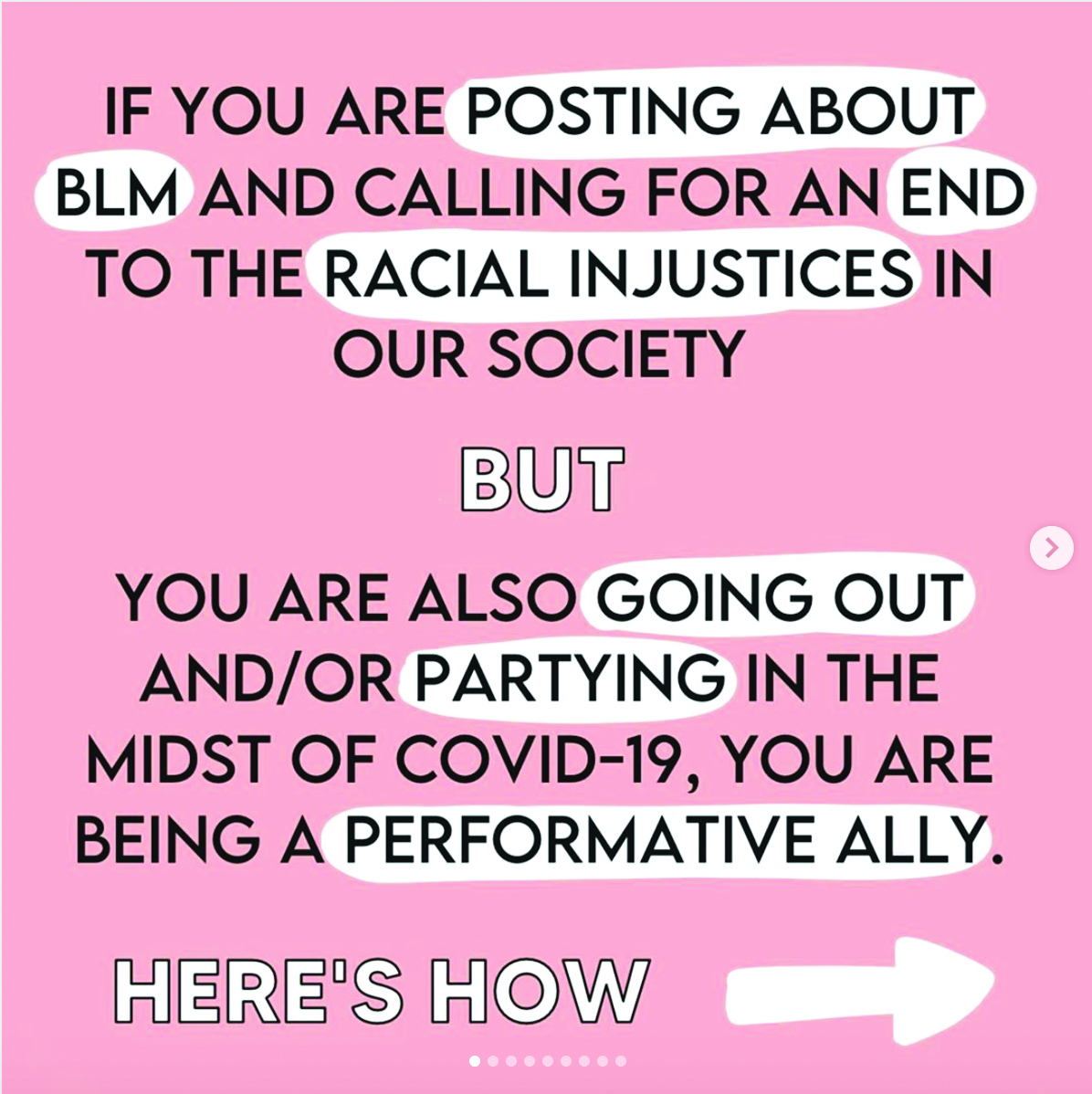
Before social media, an activist was of-ten thought of as a protester or as an active participant in an organization. But social media has given all of its users a platform in which to voice their opinions, changing our perception of what an activist is. Instagram infographics have grown increasingly popular as a way to speak out against issues and bring awareness to peers. 

“Within my community, it has become more of a norm to post about issues you feel passionate about,” said Joyce Kim, 17, of La Cañada, Calif. “Personally, I used to be intimidated by activism but the pandemic and Instagram made me realize that you can participate in small ways.” This accessibility is part of the appeal of online activism, which al-lows everyone to readily communicate with their audience. Alexsis Tapia, 16, from River-dale, Md., said that social media activism “combats the stigma of adolescents not knowing enough to get involved and has al-lowed them to speak out.”

Because many users may only hear one perspective, they can easily be exposed to misinformation, as we have seen with claims of election fraud in 2020. This makes fact-checking essential. But the practice can be exhausting, with the flow of endless information making some, like Baby Cornish, 17, of Frederick, Md., want to “forego social media altogether.”

On Instagram, it’s all about the aesthetic: colors, fonts, and even the song playing in the background of a post. “Insta-gram has molded activism in an aesthetically pleasing type of way,” said Les-lie Nevarez, 18. Nevarez, who is from Brownsville, Texas, says that the actual information is often sec-ondary to eye-catching, bite-sized infographics, which contribute to the rise of performative activ-ism and make the harsh realities of the world seem like trends. “Before I post something on social media I make sure of two things: that it’s kind and informative,” she said. 

What really happens after we post? How can we know if we impacted someone at all? While on-line activism can be an easy starting point, Nevarez feels the real change comes from offline activism. Her city, Brownsville, has been hesitant in accepting the LGBTQ+ community, but it does have an organization that created a pride flag in June 2020 to place on its welcome sign. The flag only lasted a day before someone took it down and replaced it with “no LGBTQ” in spray paint.  This June, those who created the flag protested and organized events to reinstate it. Their efforts were successful and the flag remains on the welcome sign.

“If it hadn’t been for social media and those in-dividuals per-sisting,” Neva-rez said, “we wouldn’t have reached mem-bers of the community to create change.” Social media can also bol-ster local and nat ionw ide movement s , such as Black Lives Matter and Stop Asian Hate. These social justic initiatives have been amplified by social media and have brought about awareness across the country. Online activism has been a valu-able medium for activist organizations, although Nevarez believes that it alone can only accomplish so much.

News reaches members of the younger generation through their Instagram feeds faster than their television screens. With this overflow of information on global, national, and local issues, some social media users feel pressured not only to keep up, but to repost and spread awareness to appear in-formed. 

For teenagers like Kim, the pressure to post on social media is about keeping her audience informed on issues that do not receive extensive news coverage. In March, following the Atlanta spa shootings, Kim said that she was disheartened by the lack of awareness among her followers on social media. Many, she noticed,  glossed over the issue or ignored it alto-gether. During this time, she felt pressure to post. “If I don’t voice my opinion on this,” she recalled thinking, “then who will?” Posting about it online, she said, “has helped me find my voice as an advocate.”

Year After Floyd Death, Police Reform Remains Elusive Goal For Both Sides

By Haja Isha Bah
Philadelphia, Pa.

 “Get off of him! It’s time to get off of him!”  shouted Kevin Lawrence  at the video that played  on his wife’s phone.

It was about 8 pm  in Texas, Lawrence’s  home state. He was in  his gym shorts and a t- shirt watching TV in his bedroom when suddenly  his wife came in, held out her phone in front  of him, and said “watch  this video.” His relaxing  evening would then turn  into one full of rage. The  video showed footage of Minneapolis police  officer Derek Chauvin  kneeling on the neck of  George Floyd until Floyd  died. 

Lawrence was upset  that a man had been  killed, but he also was  disappointed in Chauvin.  As a former police of-ficer, he saw Chauvin’s actions as “a viable con-trol technique taught by most police depart-ments” for moments where an officer needed to gain control of a situ-ation. But Lawrence says Chauvin remained on Floyd for far too long. “There’s a care that po-lice officers have, and it was being ignored in the situation,” he says. “The impression I was getting from the look on that officer’s face was that he just didn’t care, and that’s what bothered me about it.”  

Since 2010, Lawrence has been the executive director of the Texas Mu-nicipal Police Association (TMPA), which provides  legal protection, political lobbying, and training for officers across Texas. TMPA’s mission is “to turn Law enforcement into a true profession,” Lawrence says, “to provide the citizens of Texas with the best possible police services through both education and representation.”

So to see police murder a man without any re-morse was embarrassing to Lawrence. As a former officer and a representative of officers across Texas, he was upset by Chauvin making life more difficult for cops: “900,000 other law enforcement officers across this country, they’re all  gonna be judged based on [his actions].”

One of the main fac-tors that Lawrence be-lieves contributed to Floyd’s death was a lack of training. Lawrence says in Minneapolis, “some officers had been trained one way and other of-ficers whose trainings were outdated and they had not been updated; they had not retrained on new policies.” TMPA reached out to agencies to ensure that training standards were up to date and that all officers were being trained prop-erly on every policy. This would, in Lawrence’s opinion, prevent officers from making the same “mistake” as Chauvin. 

Across the country, on Princeton Universi-ty’s campus in New Jer-sey, Gina Feliz saw the Chauvin video too. Like Lawrence, Feliz was re-laxing in her room, “not really expecting much to come of [her] summer.” Feliz opened social media, expecting more Covid-related news, only to be met with the tragic death of a Black man. Uncomfortable with the idea of sharing footage depicting police brutal-ity, Feliz made the conscious decision to not watch the video.  

Feliz was already in-volved in Students for Prison Education, Abo-lition, and Reform (SPEAR), a student group run through Princeton’s Pace Center for Civic En-gagement. “We activate, agitate, and advocate against the carceral state in all forms,” she says, by engaging in what the group’s website describes as “anti-carceral campus activism, legislative advo-cacy, community educa-tion, and direct engage-ment with currently and formerly incarcerated peers.” 

Unlike Lawrence, Feliz believes simply reform-ing policies and trainings won’t change anything; police brutality will con-tinue as if these reforms never existed. What Law-rence calls solutions, Fel-iz considers “non-reformist reforms.” She points out that more than 1,000 people are killed by po-lice each year, many of them in jurisdictions that have already imple-mented changes like the ones Lawrence describes. “On face value, you think that they might help,” she says. “At the same time, they are restoring legitimacy in the police as a whole because peo-ple see that something’s happening and they ac-cept that things will get better from there.” 

George Floyd’s death affected many lives across the country and shaped many decisions that have changed America in big and small ways. Officers feel compelled to stand up for their colleagues, while activists are pushed towards police abolition. A year after protesters filled the streets, Floyd’s death has only intensified many Americans’ feelings about policing and reform. 

Floyd’s Death Spurs New Era Of Instagram Activism

By Francesca Mirthil and Jorge Espinoza

Everett, Mass. and El Monte, Calif.

@NEETIPATELL ON INSTAGRAM

Politics. What is the first thing that comes to mind when you hear that word? Is it suits? Washington D.C.? More than likely, it might be adults. Why? Well, for one, politics used to be something that one had to immerse themselves in, and older people had the ability to easily access and discuss their political viewpoints. If you were a teenager, you had no real way of commu-nicating your opinions. 

But now, with a cell phone, a downloadable app, and a cell tower, teens have access to political conversations.

The American Academy of Child and Adolescent Psy-chiatry reported that 90 per-cent of surveyed teens aged 13-17 have used social me-dia at least once; 51 percent reported using it at least once a day. This means that the majority of teens use social media and that the amount of teen-to-teen in-teractions have multiplied. These interactions vary per site, but Instagram is an app of particular interest. On Instagram, social justice and political advocacy have dominated user feeds. But, that is not what Instagram was designed to be.

So what happened? March 2020. As we transitioned our lives to fit inside four walls, social media was a primary source of communication. That was until the death of George Floyd in May of 2020, which spurred a social justice outcry and major social media move-ment.

“All [of] that takes an effect on you,” said Lay-la Brooks, 16, “especially since we were at home and I was in my room all day playing the same video of Black men getting killed by police officers.”

Floyd’s death caused peo-ple to protest, even in the middle of a pandemic, but not everyone did so physi-cally. Many used their social media platforms to make their voices heard. They began following accounts, resharing posts, and designing their own infographics. Now, a year later, many are reckoning with the effec-tiveness of these actions.

For one, social media advocacy was viewed as passive. On Instagram, users are given the chance to fol-low and be followed. Naturally, a user likely follows and is followed by those who share their opinions. This limits the potential for ideas to be challenged. Info-graphics and other content then become useless, regard-less of the information pres-ent within them. 

Roxana Martínez, 17, does not fully agree with the idea of the social media echo chamber. Martinez es-timates that 40 percent of the material she interacts with includes contrasting ideas.

Another problem with social media activism is “cancel culture.” Teenagers have expressed that they feel an obligation to speak about politics.

“I felt like I had to post something. Everyone was like, ‘you’re not support-ing or you’re not spread-ing information,’” said Marshalee Mclean, 16. Marginalized individuals also feel pressure to speak out about issues corre-lated to their race simply because society demands it. “They’ll start to look at me when we’re talk-ing about immigration rights,” said Yarlin Morales, 16. “It’s almost like, I’m forced to do it or like [it’s] my responsibility.”

In Pandemic, Drag Goes Online to Virtual Stage

Vivica C. Coxx

By Jada Jackson
Queens, N.Y.

“It was a lip-syncing competition, and everyone dared me to go as Macy Gray … basically with my natural hair, I like tied it back, I shaved, and I went out there and I performed the song called ‘I Try.’ And I got second place out of ten acts as a solo performer, lip-synching a boring song, and I really made it work.” 

This was the first time Vivica C. Coxx was able to dip her toes into the glorious and liberating world of drag. The drag queen and drag house matriarch had her first show at just 17 years old in her high school, North Carolina School of Science and Mathematics. This was the moment that Coxx was launched into a community full of love. Coxx was granted an opportunity of a lifetime. “[O]ne day I was sitting in an establishment, a bar. On my way to go… the owner of the establishment asked me if I knew any local queens who could open from Manila Luzon from RuPaul’s drag race. I’m over here with 10 years of amateur experience, I’m bold, why not say I can do it. They asked to see some pictures of me, I showed them a photo from Halloween … They said let’s do it … It was like this perfect storm for someone to step up. And I did.” The crowd loved her. She exceeded everyone’s expectations, including her own. “There’s this moment from that night, where you see that I realized this is what I was supposed to do.” That’s what the Drag community is about—freedom and self-expression.

Gay Bars like Roscoe’s Tavern, which opened on April 1, 1987. It was one of the first in Boystown, Chicago which helped create an LGBTQ neighborhood on the Northside of Chicago. At the time, it was rare to find a place where LG-BTQ people could be them-selves in public. Roscoe’s was bold to keep windows open to the streets. Today this isn’t important but at the time, “every other business was known for having their windows bro-ken out on the regular,” said Shawn Hazen, the Marketing & Special Events Manager for Roscoe’s Tavern. “When we started 30 plus years ago … we wanted people to be encouraged to you know … feel comfortable being an out queer person.” Roscoe’s was a place where people would feel safe to enjoy themselves.

Bars like Roscoe’s have been a refuge for Queer people for generations. It was a spiritual rejuvenation session. “[D]rag is church. A lot of people, they go to church  …  You go on Sunday, and you get your soul filled,” Coxx says to explain what drag is. Drag queens are the beacons of light for many in the darkness that this harsh world has created for those in the LGBTQ community.

That’s how it was before COVID-19 shut everything down. Without places to host drag shows, queens got creative. They weren’t discouraged by the pandemic, Coxx said, “for most drag performers everything didn’t fully shut down … I actually per-formed a lot during the pandemic, all from the comfort of my home.” Coxx enjoyed being able to put on a show without the physical constraints of a corset, heels, and foam padding. She embraced the change of scenery with her natural flair and extravagance. 

“However, there were times where I would be performing in my room and it was completely silent. I didn’t know if they were enjoying it … Could you imagine that?” Coxx asked. It changed what drag was about. The sense of family was left in the chat, no longer was she on a big stage with bright lights, where she felt, “this is home.” Now she was actually alone.

“COVID-19 was a very isolating experience … I spent a year and a half basically alone.” Despite it all, she survived and is still flourishing. Coxx recently performed her first in-person drag show performing as if everything was never shut down. Coxx, like many drag queens, and bars like Roscoe’s Tavern, adapted to the situation and were able to make it through. The community built before COVID was one of family, togetherness, and love for each other. That community has shown that it will remain whether virtually or in-person for years to come.

Retired Army Colonel Seeks To Upset GOP’s Grasp On Safe Seat In Ohio House Race

By Elina Sadeghian and Synai Ferrell

Healdsburg, Calif. and Waldorf, Md.

Editor’s Note: This piece was reported and written before the Aug. 3 primary. Greg Betts was defeated in that race by Allison Russo.

On July 15, 2021, Greg Betts, a 53-year-old Democratic congressional candidate for Ohio’s 15th District, participated in a press conference held by students of the Princeton Summer Journalism Program. There, he discussed his policies on healthcare, civil and voting rights, cli-mate change, and infra-structure. 

Betts is a retired U.S Army colonel who served for 30 years. He is running against fellow Democrat Al-lison Russo, a sitting mem-ber of the Ohio General Assembly. The winner of their Aug 3 primary race will face the Republican nominee to succeed retiring GOP Congressman Steve Stivers, who was represented the district since 2011, in a special election.

Betts said he was inspired to run for a congressional seat in Ohio because of its history of gerrymandering and unfair electoral politics. Ohio Republicans have designed the state’s redistricting map to keep their party in office, which violates voters’ constitutional rights. Betts, a strong believer in the Constitution, hopes to dismantle gerry-mandering and influence fair elections to ensure all Americans have equal protection under the law. 

Betts has his shortcom-ings as a new politician; however, his experience as a military colonel has prepared him to navigate government policies and has provided him with leadership skills. His passion to serve the coun-try also motivates him. “Although my military service is complete, my service to this state and nation is not complete,” he said. In reference to his initiatives, a student asked how he would pro-tect the rights of workers who will be out of jobs as he battles to rid the nation of corporations producing greenhouse gas emissions. In his re-sponse, he was honest and open about consulting with experts before tak-ing further action. Betts also faced questions on his infrastruc-ture policy. Betts’s goals for infrastruc-ture include transitioning to clean en-ergy to create jobs, investing in civil projects to repair roads, bridges, rail lines, airports and seaports, and replacing all lead pipes in America so everyone has access to clean water. When asked how he would maintain equity through these ini-tiatives—especially when one considers America’s history of rehousing mar-ginalized groups under the guise of infrastruc-tural improvement—Bet-ts again noted that he would defer to expert opinion.

Betts’s policies—such as funding child care, raising the minimum wage, investing in public infrastructure, decreasing the cost of college, and making healthcare widely accessi-ble, among others—appeal to most Democrats.

GOP’s Ciattarelli Touts Plan To Lower Property Taxes If Elected Governor

Former New Jersey state Assemblyman Jack Ciattarelli is announced he’s running for governor while at the John F. Kennedy Elementary School in Raritan. Tuesday, January 21, 2020. (Aristide Economopoulos | NJ Advance Media)

Layla Brooks and Lewis Stahl

Bay City, Mich. and Brooklyn, N.Y.

New Jersey faces the issue of high  taxes for homeowners, and Republican gubernatorial nominee Jack  Ciattarelli has a plan to lower them. 

Ciattarelli, a former state assemblyman and small business owner,  wants to lower taxes through a  thorough revision of the school  funding formula. He would also  redefine “local fair share,” motivating towns and districts to  regionalize, end home improvement-based property tax raises,  and—regardless of the homeowner’s income or length of residency—freeze property taxes when a homeowner turns 65.

 “The property taxes are sky- high,” said Stami Williams, Ciattarelli’s communications director.  Of the current structure, she said, “Everybody is suffering from it, and it doesn’t matter what part of the state [or] who you are.” 

According to a report this year by WalletHub, property taxes in New Jersey are the highest in the nation, with an effective real estate tax rate at 2.47 percent. (Property taxes are collected locally in New Jersey, so each county’s tax rate differs.) 

According to Ciattarelli’s campaign website, “New Jersey can and should be a place where our residents can afford to live and work for generations. As Governor, I will lower your property taxes through comprehensive re-form of our broken school funding formula – a system where 60 percent of state aid goes to just 5 percent of the districts is unsustainable.” This plan has racked up statewide sup-port because school funding among districts remains disproportionate. New Jersey has many similar, small districts, “some rich and some poor, with persistent tax capacity and funding disparities between them,” according to a report for the New jersey Policy Perspective, a nonpartisan think tank.

Asked how Ciattarelli’s team plans to accomplish this goal without compromising the education of at-risk students, Williams said,  “a lot of what [Ciattarelli] is trying to do is rebuild the school funding formula because there is a lot of disparity between where people live, what they’re pay-ing, and the cost for each student.” 

Williams Crafts Candidate’s SocialMedia To Appeal To Young Voters

Stami Williams

By Aryam Haile and Huda Tombul

Stone Mountain, Ga. and Brooklyn, N.Y.

In a press conference on July 15, students from the Princeton  Summer Journalism Program interviewed Stami Williams, the communications director for New Jersey GOP gubernatorial  candidate, Jack Ciattarelli. 

Originally from Stone Mountain, Georgia, Williams’s job consists of creating and maintaining Ciattarelli’s image on the campaign. The current governor of  New Jersey, Democrat Phil Murphy, has a considerable advantage  in New Jersey, where there are  over a million more registered Democrats than Republicans. De-spite this advantage, however, no Democratic governor has won a  second term in the last four decades. To win, Ciattarelli must  win over Democratic voters. Williams told the students at the  Princeton Summer Journalism  Program that in Ciattarelli’s previous years as an assemblyman,  he ran in Democratic districts so  that he could form a relationship with those voters. During the campaign, Williams said, Ciattarelli has visited communities that Republicans traditionally don’t go to. “He appeals to people by being honest and speaks about issues that are actually important,” she said.

In her role as communications director, Williams, who is 29, has focused on Ciattarelli’s social media strategy to appeal to younger voters, a strategy that she admit-ted Democrats are usually better at. “Democrats traditionally crush us with social media engagement,” she said. “It’s really important to stay focused on mastering the social media platforms that you have.” 

The students asked Williams about her personal experience working on Ciattarelli’s campaign. She characterized it as a safe space for a woman in a male-dominated field. Williams is also passionate about Ciattarelli’s pol-icy goal to reduce property taxes in New Jersey. Williams noted that many people in New Jersey suffer due to these taxes and oftentimes have to move away. Some of these people include her parents. “My parents are unable to move to New Jersey to be closer to me due to the unreasonable property taxes,” she said.

Candidate Ciattarelli is also a big supporter of law enforcement. During the Black Lives Matter movement, tensions between law enforcement and minority Americans were very high, raising the amount of distrust Americans have towards the police. Accord-ing to Williams, Ciattarelli is committed to easing this tension by listening to both sides. “The plan is to have more community involvement, it’s to engage communities of color and have open-ended discussions,” she said.

As a young woman, Williams’s career in politics is still new, but in the long road ahead, she plans on hopefully changing New Jersey and helping the people who have had their wishes ignored by previous leaders.