Category Archives: Uncategorized

Social Media’s Unintended Effects

By Alibek Asanbaev
Vernon Hills, Ill.

IN MODERN society, almost everyone has a social media account, in large part because people have FOMO, or “fear of missing out.” This fear causes people to keep mindlessly checking social media apps like Instagram, Snapchat, Twitter, TikTok, and Facebook in order to stay informed about what their friends are doing. People also use these apps in order to interact with friends, family, and even strangers. But often, people use social media simply because they want to be entertained and pass time when they are bored.

But despite its important role in our lives in the 21st century, social media is detrimental to our lives overall. It negatively impacts our mental health, personal relationships, and happiness.

While many people say they enjoy social media, it tends to elicit many nega-tive feelings that are harmful to mental health. A study conducted by University of Pennsylvania psychologist Melissa G. Hunt found that greater usage of social media apps increases feelings of loneli-ness and depression. Conversely, “using less social media than you normally would leads to significant decreases in both depression and loneliness.” Al-though social media apps are intended to help users feel more connected with each other, they actually cause users to feel isolated and unhappy. 

Humans are social creatures who have a natural need for real-world, face-to-face interactions in order to feel happy. Social media isn’t a replacement for that real connection. According to HelpGuide.org, a nonprofit mental health website, social interaction “requires in-person contact with others to trigger the hormones that alleviate stress and make you feel hap-pier, healthier, and more positive.” These hormones are not triggered by staring at a screen or talking through the phone.

It’s also important to realize that people tend to only post the best parts of their lives online. Everyone on social media wants to depict themselves as being attractive, rich, and happy. When other people see these kinds of posts, though, they often feel a sense of envy that they don’t live the dream life that they assume others are experiencing. Yet the very same people who try to portray themselves as having those enviable lives are likely experiencing anxiety and depression of their own. Social media causes everyone to feel bad about themselves when they assume that others are living a better life than them. Overall, social media is a giant public facade that masks private despair.

To be clear, I’m not suggesting that people should quit using social media altogether. It is true that social media is a useful tool for spreading valuable information, and an easy way to interact with people. Learning about important news and becoming friends has never been easier thanks to social media, and apps can catalyze change by rallying many people together to fight for a cause they all believe in. Social media also enables people to share their opinions and perspectives, which is an integral part of democracy.

Social media has its positives but, for the most part, it is full of unrealistic, useless, time-wasting, and harmful qualities. Our culture thrives on staying informed and constantly seeking pleasure, but while social media is a powerful tool for gaining essential knowledge, it becomes futile, and even detrimental, when used exces-sively and for the wrong reasons.

America’s History of Erasing History

By Eunice Choi
Fresno, Calif.

Many often say, “The past is the past.” So why study history? Through history, we can learn how past societies have changed and evolved based on the blueprint of our actions and mis-takes. Understanding previous accounts of history is essential. But many in the United States seem to think that our students shouldn’t learn about America’s history with depth and breadth. 

In American schools, history is being left behind and erased. As schools increasingly pro-mote STEM disciplines and states lack in providing enough support for the pedagogy, many students are stifled from learning history. According to a study conducted by the Southern Poverty Law Center in 2017, a mere 8 percent of high school seniors surveyed were able to pinpoint slavery as the principal motive of the Civil War.  Research from the SPLC further reveals that more than 90 percent of teachers are “comfortable” with teaching the history of slavery, and 40 percent of teachers believe that states do not provide sufficient support to this instruction. A whopping 58 percent of teachers find textbooks inadequate for teaching. 

Not only is our education system at fault in teaching the course, there is also a tendency to simplify and distort certain events and timelines of the past by “whitewashing” the material. In Texas,  a 2015 state-adopted textbook referred to enslaved people as “immigrant workers.” It was not until 2018 when the Texas State Board of Education revised the curriculum to finally highlight that slavery was the primary cause of the Civil War. Even though Texas did the right thing by revising their curriculum in 2018, it’s a case of two steps forward, one step back. In July, the Texas Senate passed a bill to remove requirements that schools teach specific writings from Martin Luther King, Jr., Susan B. Anthony, and Cesar Chavez. 

Of course, it’s not easy to learn about the oppression of marginalized communities in the classrooms. But these events are an imperative part of America’s history. Its continuation can have far-reaching consequences, too. We choose to continue to oppress minority communities with the perpetuation of historical myth-making. The only way we can learn and eventually move on from the past is if we accept the truth and reflect on our mistakes to foster a better society from these bygone days. And it starts with education.

Students are constantly told that the truth can set us free. Then why do countless in-structors, parents, and officials find it challenging to accept the truth? This educational malpractice isn’t history, it’s a false narrative. Students must understand how the present ties back to the history of the United States in order to become better citizens and scholars. Historical accuracy is needed, and this flawed mindset must be fixed now.

Blast Off, Bezos!

By Leslie Nevarez
Brownsville, Texas

KIM SHIFLET, NASA

ON APRIL 12, 1961, Soviet cosmonaut Yuri Alekseyevich Gagarin became the first human to ever travel into space. Eight years later, during the Richard Nixon presidency, Apollo 11 allowed Neil Armstrong to become the first person to land on the moon. In July 2021, two renowned billionaires—Richard Branson and Jeffrey Bezos—rode into the mere surface of space for a total of about 12 minutes combined. While an alarming number of Americans are losing their jobs and barely making ends meet, Branson and Bezos got the spot-light they needed to get richer.

On July 11, 2021—just eight days before Bezos’ trip—Branson, the founder of Virgin Galactic, became the first-ever to fly into space using a rocket he helped fund. Branson lifted off from Truth or Consequences, New Mexico along with two pilots and three crewmates and experienced around eight minutes of weightlessness. 

During the 52nd anniversary of the Apollo 11 moon landing, Bezos also went into space and experienced weightlessness for roughly 4 minutes. Bezos, along with three crew members, lifted off from West Texas on the Blue Origin flight, according to CBS News. 

In the ten days that have passed since the billionaires took field trips to space, I could not help but think that there was an even bigger message that rich people (like Branson and Bezos) wanted to send to the rest of the country and even the world. Is flying into space what power looks like to them? Is this a way for the rich to gloat? Or is this the continuation of the infamous Space Wars: Billionaire Edition? 

In 2020, the United States lost 20.6 million jobs in March alone, when COVID-19 was declared a global pandemic by the World Health Organization (WHO). Yet in the midst of it all, Bezos, former CEO of Amazon, had a revenue of $386 billion according to Bloomberg’s Billionaires Index, with a total net worth increase of $73 billion. Similarly, Branson had a net worth in-crease of $1.3 billion since July of 2020.

While millions of individuals had to adapt to survive a global pandemic without a stable income, the rich kept getting richer. While Branson’s trip to space cost him $841 million, Bezos spent around $5.5 billion to get the astronaut experience for 4 minutes. This kind of money could have been put to better use back on Earth, such as helping the world get vaccinated against COVID-19, giving financial assistance to those who lost a job during the peak of the pan-demic, or even helping fund education. But such generosity wasn’t shown by the people who could afford to give it. 

The takeaway is simple. The once-metaphorical phrase of “sky-rocketing” income has become literal for billionaires. Sadly, showcasing their wealth while millions of others struggle is the most integral aspect of this “mission.”

Is Social Media Doing More Harm Than Good?

By Julia Francisco
Los Angeles, Calif.

WE ALL know social media can be helpful, but is it possible that it is doing more harm than good? Posts and likes con-nect people by the minute around the globe through platforms like Instagram, Facebook, TikTok, and Twitter. These platforms can bring business, awareness, connections, and even acceptance. Yet they can also cause manipulation, toxic-ity, and mental health problems.  

Social media users range across all ages: kids, teens, and adults. With unchecked content posted around the clock, it is no surprise that misinformation circulates widely across platforms, across the country and across the world. It may not seem like a big deal, but when impressionable audiences start to believe and share the information they come across on social media without fact-checking, our collective knowledge is tainted. 

Many times, misleading information centers public figures. When enough angry people have liked, commented, and shared the information, users collaborate to “cancel” the person. “Cancel culture,” as it’s called, shuns people from society and allows for them to be publicly “dragged” and harassed by the users on these platforms. It is seen as a form of justice, but is it really justice or just bullying?

Social media is also a performative space, where people are made to believe that they have to appear flawless in front of their audience. Many social media feeds include dance routines, selfies and makeup trends. These posts may seem harmless, but when users—especially young people—are constantly re-minded of what they don’t have, it can take a toll on their mental health. Many start to compare them-selves to celebrities and influencers. They wonder why their bodies aren’t shaped like an hourglass, or why their skin doesn’t look perfect. Others value themselves only by the number of followers and likes they’ve accumulated, and some deal with trolls and hateful comments. Numerous users do find a community of acceptance online, but many also find a world of toxicity. 

Although social media was de-signed to keep people connected, with all the lies, hate, envy, and dismay it produces, social media has actually brought disconnection to the world. We have to remind ourselves that social media is just a show, and that we are perfectly imperfect beings. I do not mean to advocate for the deletion of social media, but simply to encourage the occasional reprieve. Consider this a reminder to take breaks from the cyber world to protect yourself and your mental health. 

Stop Web Filtering in Schools

By Aryam Haile
Stone Mountain, Ga.

Grown-ups, envision this: You’re in high school. It’s 2020 and your school has gone virtual. You’re in a Zoom call for U.S. History, and your teacher assigns you to watch a short video on the Great Depression. They send the link in the chat. As soon as you press the link, a red message appears on your screen saying: “Web-site blocked.” In the digital age, many schools have given their students laptops and tablets for online school work. To keep their students safe from mature content, many schools have also implemented website filters on these devices. While shielding students from pornography is important, schools need more precise filters.

Many students have voiced their frustrations on the extensive web-blocking that has prevented them from accessing the information they need to complete as-signments. What good is providing these devices to students if they can’t use them to their full extent?

A vast number of schools use web blocking software that can’t differentiate be-tween inappropriate web-sites and normal content that has no business being blocked. Web filter software uses keywords to determine whether a website is inappropriate, and the simplistic overuse of key-words is doing more damage than good. Schools should lower the number of keywords they consider to be inappropriate. This will allow students to access important, non-harmful websites.

Some may argue that the blockage and filtering of websites are to keep students safe. While websites con-taining pornography should be blocked, schools need to be more careful in how they assess what content is considered mature for students. Giving students access to technology was supposed to increase learn-ing access; extensive web-filtering only acts as another barrier to students and their online education. 

Keep HBCUs Black

By Marshalee Mclean
Bronx, N.Y.

“This place is sacred … and if white people just start coming in here, I feel disrespected, completely,” said a Black Morehouse student in Vice’s video “Being White at a Historically Black College.” The context of the video is an age-old question that only resurfaces in the mainstream occasionally, but sparks heat-ed debate: Should white people attend HBCUs? 

The answer is simple: No, they shouldn’t. 

Historically Black colleges and universities are described as institutions “established to serve the educational needs of Black Americans” by the U.S. Department of Education. Before the inception of HBCUs, Black students were notoriously denied admission to post-secondary institutions. Schools like Fisk, Hampton, Howard, Spelman, and Morehouse were among the first Black private institutions to educate in a racially segregated society. Through time, these institutions evolved into more than sites of learning; they became safe spaces for Black people to be their complete, authentic selves. But now, like almost everything Black owned or populated, they are under attack.

Bluefield, Lincoln, Gadsden, and St. Philips are just a few examples of HBCUs that have majority white populations. Spaces made by Black people, for Black people, full of Black history, culture and pride now have less than half Black student populations. 

This invasion of Black spaces is all too familiar. From houses in Black neighborhoods, to Black-owned mom and pop shops, to clothes and music, society will stop at nothing to gentrify and oppress Black America.

Non-Black people believe that by attending HB-CUs they are furthering an ethos of anti-racism, but the opposite is the case. Coming into Black spaces doesn’t dismantle racism, it perpetuates it by conceiving of it as an individual, rather than a systemic, problem. The myth of racism being solely individual continues to halt true progress toward the destruction of  institutions that profit off oppression. 

Your white liberalism will not save us. 

Attending an HBCU as a white individual, learning about Black history, trying to radicalize yourself, doesn’t compare to the realities of being Black. Try to “understand” us all you want, you will never be us, your privilege still stands. Part of being an ally comes with acknowledgement of privilege. Don’t use said privilege to invade what was, and still is, meant for us. 

These sacred Black spaces aren’t for you.

Pandemic Boosts Pet Adoptions

By Alyana Santillana
Brentwood, Calif.

Jake, a Jindo-terrier adopted by Laura Wager during the COVID-19 pandemic. | Credit: Laura Wagner

The COVID-19 pandemic hit fast and hard. In a matter of days, the entire world left their ordinary routines for a mandated stay-at-home order. Months of confinement inevitably took their toll on the masses. As a result, people found emotional support and companionship in man’s best friends: pets.

Laura Wagner, of Prospect Lefferts Gardens in Brooklyn, was fortunate enough to adopt a Jindo-terrier mix named Jake at the start of the pandemic. “It took until May until we actually got our dog. It was five weeks of applying for a dog and not getting one, and getting our hopes up,” Wagner said.

While the process of adopting her furry friend was long, the wait was well worth it. “Spending a lot of time with Jake probably helped us bond,” she said. “It provided a real structure for my physical life and that has really helped my mental health, as well as a structure  of things to do, because he’s so cute and so fun to be around, so that was nice as well.”

As life slowly begins its return to normalcy, Wagner and her family are in the process of helping Jake adjust to a post-pandemic routine. One of the steps is getting Jake used to be-ing alone in her apartment. “We’re working with a trainer on this thing called guaranteed departures, where you leave for like 10 minutes and come back, in-creasing the amount of time each day so that the dog gets used to knowing that when you leave, you’ll be back,” she said.

While Jake has become a valued member of Wagner’s family, the same cannot be said for many pets who were returned to stores or shelters as people began returning to their normal lives. “We saw a big spike in animal sales, but not any of the animal products. … Animals were being surrendered because people just didn’t know how to care for them any-more. A lot of the animals were being abused,” said Cynthia Salazar, a guest experience specialist at a PetCo location in Texas. “When everything opened up, we started seeing a lot of surrenders as a lot of people were coming back to their jobs,” she added.

While the lockdown undeniably changed the course of our lives and habits, the same goes for the ones we turned to for support.

Simmons Runs For Stamford Mayor

By: Baby Cornish & Selena Moore

Frederick, Md. and Detroit, Mich.

Caroline Simmons

At the forefront of Caroline Simmons’s bid to become mayor of Stamford, Connecticut, is a topic that has dominated the nation-al conversation in recent months: public health.  

“This is everything from mothers facing mental health issues and stressors that relate to environmental injustice, and also the adverse health effects we see from air pollution,” Simmons said in a July press conference with The Princeton Summer Journal. As a mother herself, Simmons said, she particularly cares about combating environmental injustices that contribute to adverse pregnancy outcomes, such as preterm birth.

According to Simmons, a Democrat, infrastructure is crucial to her agenda of achieving environmental and economic justice, and as mayor, she would have “shovel-ready projects” lined up. She said she plans to work with Connecticut’s Department of Energy and Environmental Protection to secure state and federal funding. “I would have a Stamford plan to combat climate change and re-build our infrastructure in a more sustainable way,” Simmons said.

Elected as a state law-maker in 2014, Simmons challenged incumbent Mayor David Martin for the Democratic nomination, resulting in her endorsement by Stamford’s Democratic City Committee by two votes, 21-19. Despite Martin’s loss, he can force a primary by gathering 5 percent of the city’s registered Democrats’ signatures. No Republican has announced a campaign for mayor, the Stamford Advocate reported, though former New York Mets manager Bobby Valentine is running as an unaffiliated candidate. 

As the threat of the COVID-19 pandemic recedes, Simmons said she hopes to grow Stamford’s population. Prior to the pandemic, she said, the city was losing residents to New York and Boston, but as the country shifted to remote work, Stamford began to see an influx of young people from those very cities.  

However, this disproportionately white demo-graphic of remote workers could harm Stamford’s diversity. The city is roughly half-white, a quarter Latino, 14 percent Black, and 9 percent Asian. “Another one of my priorities,” Sim-mons said, “is to continue to support that vibrancy and diversity that we have in Stamford and making  sure that we’re a welcoming city.”

Amid nationwide protests demanding an end to police brutality, Simmons called for strengthening police-community relations. “It means recruiting police officers from the neighborhoods that they’re serving,” she said. She also emphasized the need for officers to forge trust with communities of color who’ve “been targeted and unfairly burdened with police hostility for years.” 

Will these ideas prove enough for Simmons to become Stamford’s first female mayor? That question is one voters will likely have to answer on November 2.

For College Athletes, Payment for Name and Likeness Long Overdue

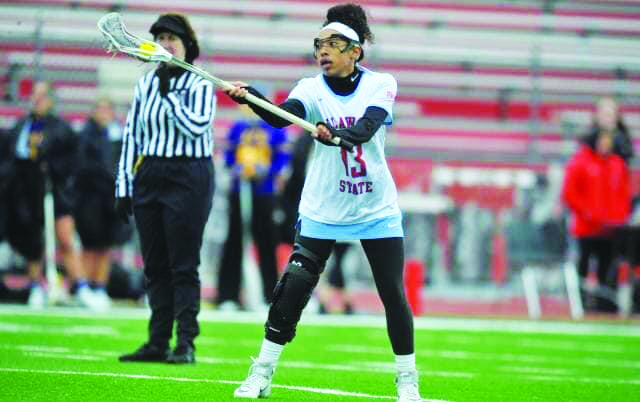
Imani Hill, playing Lacrosse for Delaware State University | Credit: Imani Hill

By Yasmin Mustefa

Federal Way, Wash.

Imani Hill never thought that she would play lacrosse. But her freshman year of high school, Hill’s basketball coach told her that she needed to participate in a spring sport to stay in shape for next season. An hour later, she pulled her out of class to speak with the lacrosse coach. 

“I’m just like, ‘I have no idea what lacrosse is,’” Hill said. But the coach con-vinced Hill to try. “I went out, and it was so interesting to me because of how unfamiliar it was. It was a really challenging task.”

By her junior year, several colleges were observing Hill. She decided to join Delaware State University’s Division I program in the fall of 2015, which she said was the only historically Black college or university (HBCU) at the time with a women’s lacrosse team. In 2019, while attending grad school at Auburn University in Alabama, where she is a current PhD candidate, she switched from player to head coach. 

Although she is no longer a coach for collegiate lacrosse, that breadth of ex-perience gave Hill a distinct perspective on the name, image, and likeness (NIL) laws that multiple states recently passed. The new laws allow college  athletes to use their name, image, or likeness for compensa-tion and prevents colleges and universities from pro-hibiting athletes to do so. 

While Hill acknowledged the “cool opportunities” the NCAA gives athletes, she’s glad players now have money-making opportunities she didn’t. “I think that it’s something that’s necessary  and something that really should have happened a long time ago,” she said.

“As a whole, sometimes we forget that the NCAA is a governing body, and ultimately they are a business. I think that some-times we kind of get that confused with an organization that supports athletes or wants what’s best for athletes.”

As a player, Hill practiced up to 20 hours a week, with additional hours of physical therapy, conditioning, and traveling. Players were given about a $500 stipend every season, she said, but that wasn’t enough to cover off-campus expenses.

Hill’s family lived close to Delaware State, and she remembers them filling up her dorm room with snacks and going home on weekends. “There are a lot of athletes who don’t have those luxuries. So literally their entire dependability is, like, on the university and what the university gives them,” she said. By contrast, the new laws could allow student-athletes to save money, help their families, or buy food, clothes, or school supplies.

At the same time, Hill also believes that the laws will continue to blur the line between college and professional athletes. She’s not sure how she feels about that. “How do we define those lines that let the world know that this person is still a college student before anything else?”

Infographics: Do they have Info?

By: Ebony Riley and Skye-Ali Johnson

Voorhees, NJ and Washington, D.C.

Picture this: It’s a mid-summer day and you unlock your phone to open up Instagram because you’re wondering what’s going on. You come across a post with brightly colored, eye-catch-ing fonts that describe the most current tragic event. This, you realize, is the new trend. 

With the rise of info-graphics, students are left questioning how effective they are in making a  difference. In a recent interview with students from the Princeton Summer Journalism Program (PSJP), students vocalized their opinions on infographics and online activism. 

“You want to follow that up with an action,” says Emi Glass, a 17-year-old high school student from Day-ton, Ohio. Glass believes that, in some cases, online activism can be beneficial and inclusive. But there are steps beyond reposting information on your story that are required to effectu-ate meaningful change.

“OK, I posted this, but what does this actually do for this situation?” asks Huda Tombul, a 16-year-old high school student from New York. She adds that many people post infographics for the sake of posting them, and do not actually care about the information they spread. “Is this actually accurate information? Or did someone simply just write this and everyone went along with it?” Tombul asks. 

“I mean, who isn’t on their phone?” 21-year-old college student Abby Dot-terer admits. Social media is an undeniable facet of daily life. The more people use it to express their concerns or thoughts, the more they begin to question whether or not it is a reliable place to source information.

When asked whether or not we should trust Insta-gram infographics, many interviewees advised caution—there should be individual research done before sharing  information. 

“You need to fact-check them. I don’t think you should trust some random person who posted it,” Glass says. 

“Everyone has their voice. And anyone could say any-thing that could influence other people,” 17-year-old Nhi (Nikki) Huynh from Western Massachusetts says. 

It is evident that social media platforms have be-come a popular place for young individuals to speak their truths, and a place  to spread awareness about topics that interest them on the internet. Sometimes, though, the messages be-hind online activism be-come lost in translation. “Social media activism is al-most like talking to a brick wall,” Dotterer says. 

Do infographics really lack information? “I have seen some that I think are more focused on the visual aesthetic than the quality of the information,” Glass says.

Online activism has taken a turn, and it’s hard to tell whether it is for the better or worse. Are we stuck? Or are we progressing?

No matter how hard we try, it is hard to predict the direction of infograph-ics and digital activism. As Dotterer puts it, “two steps forward, one step backward.” 

Will we overcome this online activism standstill?