Tag Archives: Culture

TikTok, Fetishization, and the Weaponized ‘Oxford Study’

By Yullianne L.

Picture this: you’re a young Asian woman on TikTok, vlogging GRWMs and lip-syncing to songs. Everyone is supportive of your platform—until you show your white boyfriend.

Suddenly, your comment section is flooded with one phrase: “Oxford study.”

The phrase refers to an academic study out of Oxford University that examined how TV advertisements shaped perceptions of romantic relationships between white men and Asian women. The study concluded that Asian women are disproportionately sexualized and objectified—but it’s been misquoted online to claim that Asian women “prefer” white men.

That so-called “finding” has taken on a life of its own on social media.

This trend—an oversimplification at best and a dangerous distortion at worst—shows how the degradation and racialization of Asian women is normalized on TikTok.

The Oxford study didn’t prove desire or preference. It revealed patterns shaped by algorithmic suggestion and historical power dynamics. It showed how Asian women are often reduced to tropes of being submissive or exotic. These narratives didn’t emerge overnight—they’re rooted in media portrayals and colonial histories.

Nowhere is this more misleading than on TikTok, where the narrative has morphed into a toxic trend. Videos featuring Asian women and white men often go viral—not in celebration of love, but because they reinforce the tired “white savior/exotic Asian girlfriend” trope.

The comments that follow push these toxic narratives even further, turning actual people into caricatures for clout.

This dynamic is baked into the platform itself: TikTok’s algorithm rewards content that conforms to stereotypes while burying or punishing content that challenges racial or gendered norms. Meanwhile, Asian women who speak out against this fetishization are often labeled ungrateful, angry, or divisive.

The “Oxford study” has been weaponized to justify the very thing it tried to condemn: the ongoing objectification of Asian women, valued only through a white lens.

We need to call this out for what it is—not “preference,” but another face of misogyny, wrapped in pseudoscience and likes.

The Blueprint

By SeMya H.

Today’s trends are reused, repurposed—and most importantly, appropriated. Whether it’s “slay,” “tea,” or “period,” current slang is almost always credited to chronically online Gen Zers. The origin of these terms is lost in the assumption that they’re generational rather than cultural—but that simply isn’t true.

Black people have a dialect that directly reflects our background. These words and phrases are being stolen daily. So what happens when our language gets colonized?

The language formed in Black communities has had a significant impact on the way the world speaks. Phrases we grew up with and used within our circles are now seen as mainstream.

Black identity has been turned into a marketplace—something for everyone to shop from freely. But when the African-American community leans into our culture, it’s perceived differently than when others dip into it. The way we present ourselves has long been associated with derogatory terms like “thuggish”—until non-Black people conveniently discover the style.

Appropriation isn’t the only problem. The sting of blatant theft is only made worse by poor imitation. When African-American culture is repackaged, the result is a watered-down version: edges rebranded as “sticky bangs,” bonnets renamed “sleeping caps.”

One group particularly affected is Black women. Their contributions have always been overlooked and underappreciated. From long acrylic nails to statement hoop earrings, Black women have influenced fashion and style for generations. The constant disregard for these women—and the fact that they are responsible for the popularization of styles still worn today—has created a stigma around self-expression in our community.

Nareasha Willis, founder of the former brand Black Vogue, said it best:
“Ghetto until proven fashionable.”

This quote captures both the criticism inflicted on the Black community and the shift that happens once our style is misappropriated.

While we may not be able to reclaim every “jacked” style, we can give credit to the originators.

There are Black creators and businesses across the globe who represent and celebrate Black culture with integrity. There are also influencers whose unique creations deserve the same support their white counterparts receive.

The biggest trend today?
Still not recognizing Black contributions.

Superman Didn’t Dress to Impress: Costume Misses the Mark in DC’s New Take

By Claire B.

When DC released the first official image of David Corenswet in costume as Superman, it immediately made headlines. The reaction? Mixed. The general consensus: he looks tired. Not “the-world-depends-on-me” tired—just sleep-deprived. And while the grim facial expression might reflect the tone of the upcoming film, the real problem lies in something else: the suit.

The outfit consists of textured spandex, muted colors, and a stretch waistband. Not only does it fail to stand out—it doesn’t feel like Superman. His original red, blue, and yellow suit was iconic: bright, bold, and unmistakable. Over the years, fans have praised the clean color scheme and cape. The classic version didn’t need exaggerated textures or overdone designs to prove its point. It simply worked.

This new version, though? It looks like it belongs in a Zack Snyder movie.

Director James Gunn has promised a different take, but based on this first image, it seems like DC is still leaning into the gritty realism it’s been known for in the past decade. It’s not something the franchise needs. After all, costume design plays a huge role in shaping how audiences view characters.

Compare this look to other superheroes: Iron Man’s costume makes him look modern, high-tech, and powerful. Batman’s sleek suit enhances his image as a stealthy, strategic fighter. Captain America’s red, white, and blue gear reflects patriotism and leadership. But Superman’s new look? It just feels… tired.

Costume design is more than aesthetics—it sends a message. A character’s clothing can signal their values, origin, and even their emotional state. With a character as iconic as Superman, it’s crucial to get it right.

Maybe the full film will offer more context. Maybe the outfit will make sense on screen. But for now, Superman’s new suit doesn’t elevate the character—it deflates him.

“Bad Shabbos” Is Actually Bad: A Comedy That Misses Its Mark

By Jiondae D.

The laws of Shabbat argue that if one is not bedridden, even minor medications should be prohibited. While this violates Shabbat rules, nothing is worse than betraying the Ten Commandments—arguably in the worst way: murder.

These conflicting ideas collide in Daniel Robbins’ film Bad Shabbos.

After joining his girlfriend’s family for Shabbat dinner, Benjamin’s fate is sealed the moment he reveals his colitis diagnosis—and makes a few offhand comments to his girlfriend’s brother, Adam. Soon after, Adam drugs him with laxatives.

Despite losing Benjamin early on, his death fails to create suspense. Instead, it becomes an excuse to launch into a series of underwhelming scenes that make the moment feel almost comedic.

The film takes place in an Upper West Side apartment in New York City, home to Mr. and Mrs. Gelfland and their youngest son, Adam. They invite their two older children and their partners to celebrate Shabbat dinner. Roughly 20 minutes in, Benjamin drinks laxatives. After a comical struggle with his pants and a race to the toilet, he slips, hits his head, and passes away—off-screen, in the bathroom.

Typically, a film’s climax occurs about 90% of the way through. But in Bad Shabbos, Benjamin’s death happens so quickly and chaotically that the rest of the film struggles to find purpose. Audiences don’t pay over twenty dollars to watch a twenty-minute movie, and unfortunately, the remaining runtime becomes a collection of scenes that are more mediocre than meaningful. The cat’s unhinged behavior and wasted food do little to elevate the tone.

Even more jarring is the hypocrisy on display. The Jewish parents mock their daughter for using a car during Shabbat while their son—who killed a guest—is shielded from consequences. This contradiction darkens the already uneven tone of the film.

And just when it seems the chaos is over, the future in-laws arrive. What should be an opportunity for dramatic tension turns into another shallow gag. Glaring looks from the mother and spilled soup are played for laughs, but it’s not as funny as the filmmakers may have hoped. Instead, it feels like filler—lacking imagination and failing to build on earlier scenes that had at least a little more personality.

Benjamin’s death becomes less important with every scene. What could’ve grounded the film in something dark and compelling instead becomes tasteless. This isn’t just an ordinary Shabbat.

It’s the epitome of carelessness.

“Bad Shabbos”, Good Movie: A Chaotic Dinner Worth Watching

By David R.

Director Daniel Robbins’ tour de force, Bad Shabbos begins with the end. Two elderly Jewish men stroll down a New York City street at night. One begins telling a joke. The punchline? A corpse plummets from a nearby building, landing in front of them. The film then rewinds to tell the story of the night preceding this event.

David and Meg, portrayed by Jon Bass and Meghan Leathers respectively, are an interfaith couple engaged to be married. Unfortunately, there are a few problems for the young lovers.

The first issue is Meg’s parents, conservative Catholics from Wisconsin, who—while never stating it outright—are clearly displeased with Meg’s conversion to Judaism. Another issue is David’s mother, whose passive-aggressive remarks toward Meg create tension in their relationship.

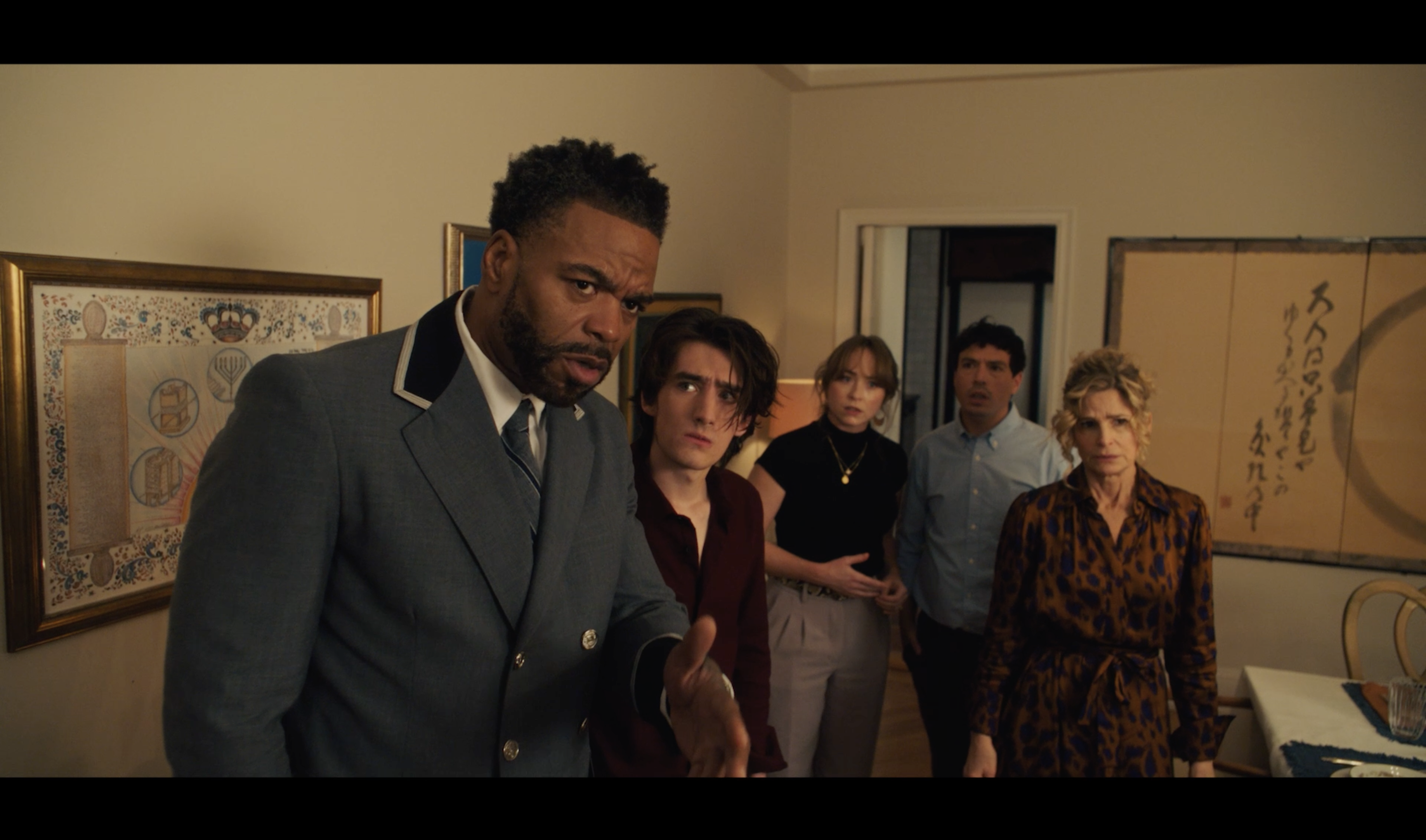
These concerns come to a head on the night of Shabbos—the weekly Jewish day of rest from Friday sunset to Saturday sunset. While Meg gives Judaism her best effort, David’s mother (played by Kyra Sedgwick) is slow to accept her. In spite of her better judgment, Meg invites her staunchly religious parents to Shabbos dinner.

Upon arriving at the apartment, the audience is introduced to David’s screw-up brother, Adam (Theo Taplitz). Taplitz’s performance is wickedly delightful. His character is sharply written, offering a thoughtful and provocative satire of toxic masculinity. Taplitz’s acting, combined with clever writing by Robbins and Zack Weiner, keeps the audience riveted whenever Adam appears.

Other notable characters include David’s sardonic sister Abby (Milana Vayntrub), Abby’s philandering boyfriend Benjamin (Ashley Zukerman), David’s eccentric father Richard (David Paymer), the charismatic doorman Jordan (played by rapper Cliff “Method Man” Smith Jr.), and Meg’s stiff parents (John Bedford Lloyd and Catherine Curtin). Every actor adds something memorable, with Lloyd and Curtin portraying unintentionally bigoted parents in a grounded yet hilarious way.

Early in the evening, Benjamin and Adam begin to clash. After enduring one too many sarcastic remarks, Adam slips laxatives into Benjamin’s drink—unaware that Benjamin has colitis. In a frantic attempt to reach the bathroom, Benjamin slips, fatally hitting his head. What follows is a hilarious scramble to hide the body, roping the entire family into an increasingly absurd cover-up.

My one complaint? The twist was a bit predictable. As soon as Benjamin was introduced, I suspected he was the corpse from the opening scene (no character that unlikable escapes punishment). Still, the execution was funny, and the moment remained an effective plot device.

Finally, what I appreciated most was the sincerity of the film. Many comedies that center on American subcultures tend to satirize or undermine the communities they depict. Bad Shabbos, however, is better described as a celebration of Jewish-American life. From the reprise of “Bum Biddy” from Adam Sandler’s Eight Crazy Nights to the heartfelt speech by David’s sister Abby, the film honors Jewish culture and finds humor in the most unlikely places.

Princeton boasts dueling acai options

By Daniela Vivas

Arlando, FL

The acai craze is nationwide, and Princeton is no exception. A few steps away from the Princeton University campus are two popular acai bowl eateries, both family-run businesses owned by working moms who used to have 9-to-5 jobs.

Haydee Kapetanakis, 49, co-owns Frutta Bowls, on Nassau Street, with her husband, George, but she previously worked in human resources at a pharmaceutical company. She and her kids, who are 12 and 9, first tried acai four years ago and loved it. The store, which Kapetanakis calls their “little baby,” opened its doors in March. She’s very proud of providing jobs for 22 local residents.

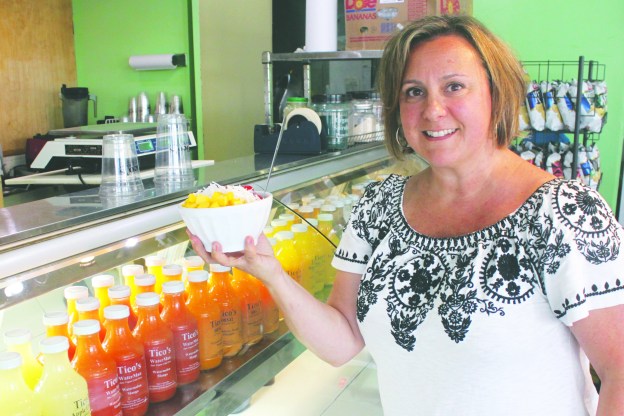
A short distance away from Frutta Bowls is another well-known local business called Tico’s, which started in 2006 as the dream of a Costa Rican man and became the life of a whole family. Renee De Bernard, 48, co-owns the eatery with her husband, Ammel.

Tico’s started as a Latin food restaurant known for their tacos, burritos, quesadillas, and salads. De Bernard kept her day job, in accounting, until Tico’s was established enough for her to quit. When one of her customers introduced her to acai bowls two years ago, she added it to the menu. The superfood eventually became so popular that the kitchen ran out of space, and the couple decided to shrink the food choices on their menu.

Being part of the community for 12 years requires a lot of time and effort. De Bernard, her husband, and their two sons, 15 and 11, participate every Saturday in the West Windsor Community Farmers’ Market. At the market, the family offers acai bowls, smoothies, and juices from a food truck. It’s a way for the family to promote their business while staying involved in the community. In addition to the weekly market and their regular customers, the owners rely on their sons’ social-media skills to help them spread the word on Instagram and Facebook.

Despite two different initial approaches—Frutta Bowls jumped right into the acai trend, while Tico’s evolved from a Latin food restaurant—both businesses incorporate similar formulas for success: community outreach, family, and acai.

Acai craze comes to Princeton

By Fernando Cienfuegos and Aurora Rivera

Azusa, CA and Los Angeles, CA

Hidden on the corner of Witherspoon and Spring streets in Princeton is a small juice bar that brings Latin American flavor to Central Jersey. Inside Tico’s, co-founder Renee De Bernard serves up healthy juices and acai bowls.

“I think it’s amazing that we’ve become such an integral part of this community,” De Bernard said.

She wasn’t always in the acai business. When she and her husband, Ammel, first bought the restaurant, then called Moondoggie Café, in 2006, she worked as an accountant while her husband ran the business. (They changed the name to Tico’s, the nickname for a Costa Rican—Ammel grew up there—shortly after taking over Moondoggie.) In the beginning, the family found it was difficult to balance work and a home life. But as soon as the business was able to keep the family afloat, De Bernard decided to leave her job in order to take care of her kids and help her husband live out his dream of running a successful business.

“When we decided we were going to open this business, we knew it was not going to be easy,” De Bernard said. “To make it work, we needed to put in the hours.”

With two sons, 11 and 15, the De Bernards take turns opening and closing the juice bar throughout the day.

Two years ago, De Bernard decided to serve up the newest trend: acai bowls. But when it comes to acai, Princetonians have options. Down the block from Tico’s is Frutta Bowls, the newest of the acai bowl vendors on Nassau Street.

“It’s a craze right now!” owner Haydee Kapetanakis said. Frutta Bowls, founded in New Jersey in 2016 and now operating in 14 states, opened its Princeton location this year.

Like De Bernard, Kapetanakis wasn’t always in the food business. Kapetanakis spent the past 30 years in human resources working for a pharmaceutical company. Her husband, George, works in the medical field doing cardiovascular studies, giving the family a decorated background in the wellness business. They previously owned kickboxing gyms, adding on to their résumes in the health and wellness field, and are now pursuing the food industry, trying to figure it out along the way.

Since opening five months ago, Frutta Bowls has tried to reach out to Princetonians through different fundraising events and community activities. Kapetanakis wants to continue emphasizing community outreach, but she also wants to prioritize her life outside of acai.

“I wanted some flexibility with my family,” Kapetanakis said about her former job, where she said she worked demanding hours. “I needed that balance. I want to make sure that I’m there for my kids.”