The heartbeat of Princeton started in a U-Store parking lot.
For five years, Barry Weisfield bounced between flea markets and college towns, selling records and vinyl from orange crates in his Chevy van. After rolling into Princeton, his van became a community staple, drawing keen ears to the Princeton University Store.
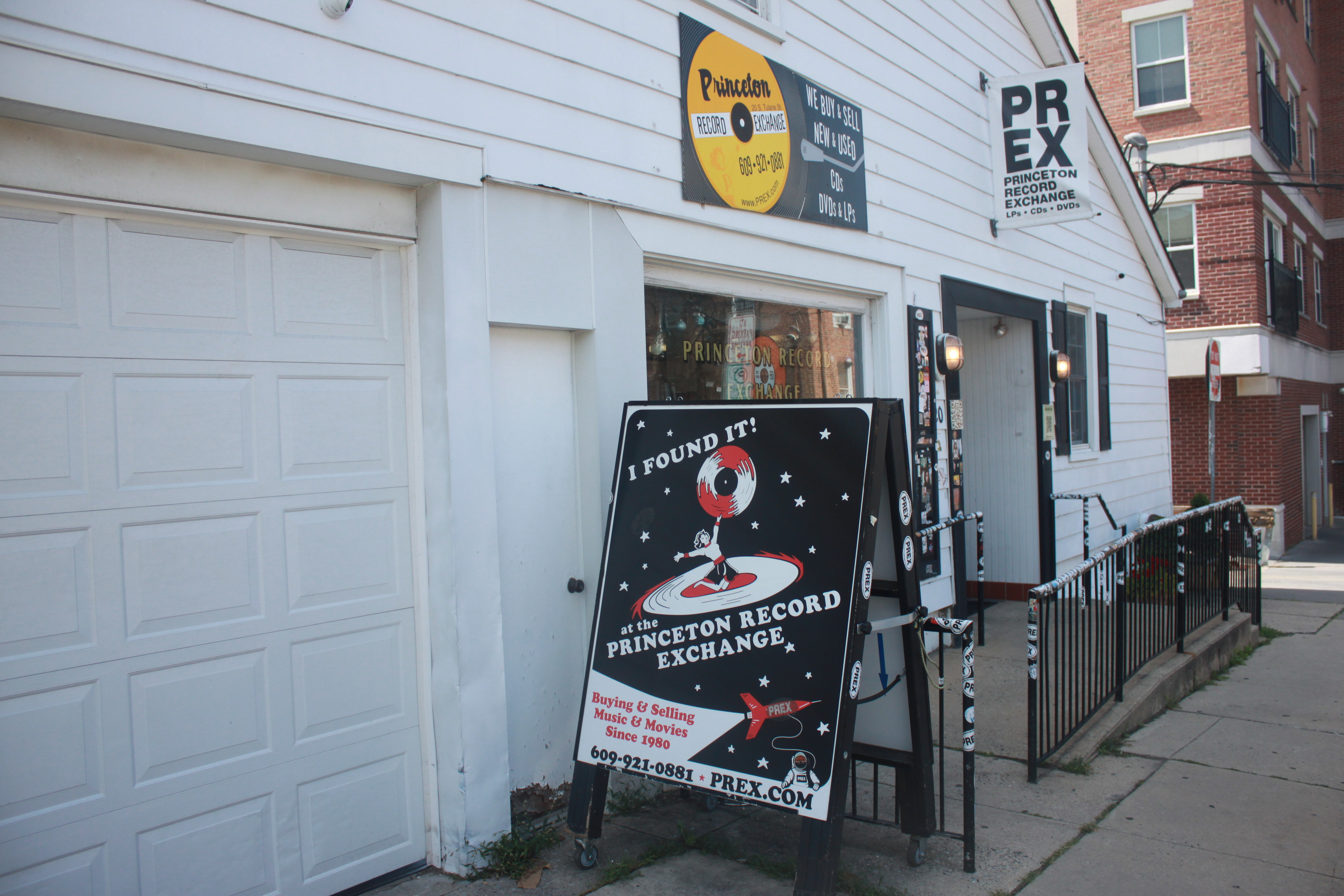
Always on the road, Weisfield laid his heart on Princeton’s streets and couldn’t leave it behind. In 1980, he parked his roots for good, opening the Princeton Record Exchange Store (PREX) on South Tulane Street, a charming cobblestone path off Nassau Street.
Princeton’s location—neatly between New York and Philadelphia—played a role in his decision, offering prime potential for customers. But it was Weisfield’s devotion to customer service that made PREX stand out. He believed the staff should cater to the community, rather than the other way around.
Unlike big-box retailers, PREX emphasizes connection. Staff aren’t just told to sell records—they’re there to make everyone feel welcome, whether first-timers or long-time collectors. Questions are met with enthusiasm, record requests are taken seriously, and the space is decorated for comfort rather than flash.
When Jon Lambert took over in 2015, after years as general manager and close friend to Weisfield, he kept that ethos while adding his own touches. Inside, handwritten canary-yellow tags label the genres, and DIY record dividers keep the vibe simple and accessible.
Overlapping LCD record covers, Vanity Fair spreads of Randy Newman, Ozzy Osbourne concert posters, and artful band collages give the convenience-store–styled building a lived-in charm.
Lambert’s goal is clear: make people want to stay. And they do.
“You know, if you have a business, they [Google] tell you the average length of stay, for people in that organization, and we’re about an hour,” Lambert says with reserved pride. “I think that really speaks to how much people enjoy being there as an event.”
His attention doesn’t stop at décor or inventory—it extends to his hiring.
“I’m pretty picky about picking,” Lambert jokes. He’s less concerned with stacked resumes in the arts and more focused on personality, lived experiences, and values that align with PREX’s mission: to be courteous, kind, and obliging.
He asks potential hires questions like: “What does integrity mean to you?” “How do you live your life?” and “Is it an internal code of ethics or external?”
Lambert sees his staff as an extension of PREX’s promise to Princeton’s community, even when he’s not there. “Those are the things I care about,” he concludes.
Just around the corner, another independent business echoes that sentiment. Labyrinth Books, co-founded by Virginia Harabin, Pete and Cliff Simms, and the late Dorothea von Moltke, serves as a haven for Princeton’s book lovers.
“It’s a place for travelers, it’s a place for locals,” Harabin says.
Labyrinth intentionally sought a large footprint to serve as both a bookstore and a gathering place—though Harabin admits that decision “might have cost [them] a little something in terms of warmth.” Still, thoughtful touches—a cluster of chairs here, a soft rug there, fairy lights strung from the basement ceiling—create cozy pockets for connection.
“I hope that before too long we’ll be able to do something like put a carpet on this floor,” Harabin reflects. “Maybe a different kind of seating area with some softer chairs. I’m emphasizing change and development.”
Warmth at Labyrinth doesn’t just come from décor, but also from decorum. Like at PREX, the staff help create a hub where curiosity meets enthusiasm. Customers openly approach staff, make requests, and linger for informal conversation.
“Somebody comes in and says, ‘Do you have this?’ I look it up; I don’t have it. But I want to have it. I should have it,” Harabin says. “I’m gonna get one for you, but I’m gonna get one for the store too.”
While one caters to sound and the other to story, Princeton Record Exchange and Labyrinth Books share a philosophy: go beyond inventory and revenue. They resist the transactional coldness of big-box commerce, instead valuing personality, conversation, and time spent.
In a town shaped by prestige and tourism, these independent businesses are grounded in cobblestone charm and built on meaningful exchanges. They are more than local commerce—they are the essence of local care, beating steadily under every path.
By Clara T., Claire B., Zahra A., JaeHa (Justin) K., Bryan R.V., & Mai E.L., with the staff of the Princeton Summer Journal
SUN Meals, a federal program that provides no-cost meals for kids during the summer, are inconsistent across the country. Are they truly meeting food security needs?
Layers of stacked frozen leftovers saved from dining halls—mashed potatoes, mac and cheese, and salads—in Ziplocs. School lunch plates filled with tan and brown foods, with little to no green in sight. Scrambling to figure out the latest EBT eligibility. Staring at an empty fridge on a hot summer day. Students of all ages, whether K-12 or college, continue to face hunger and a lack of accessible nutritious food, these are just some of the many ways that food insecurity manifests for students and families.
“The issue goes beyond just someone [having] enough food to meet their calorie needs, fill their stomachs, to ‘are we meeting the nutritional needs of a person?’” said Dr. Lauren Dinour, faculty member at Montclair State University with the Nutrition and Food Studies department.
Having access to nutritional food helps children develop healthy habits so when they become adults with greater freedom, they have those skills established. As Mykaila Shannon, the Health Promotions Manager at Princeton University said, “when it gets in early, it gets in deep.”
A Princeton Summer Journal investigation reveals how SUN Meals—a federal program that provides meals and snacks at no cost at various neighborhood locations—fails to provide nutritious food for children on a nationwide scale. This presents concerns not just for young people during the summer, but is indicative of systemic failures to provide all people easy access to proper nutrition.
The investigation sampled 65 sites and 50 meals across the United States. For each site reporters visited or contacted the organization and recorded the meals being offered and the state of the site. The Journal found great inconsistencies in the sites and meals across the country.
A majority of the sites were visited in-person. 51 percent of those served elementary school students, 40 percent families, 20 percent middle school students, and 9 percent high school students. In 20 percent of cases, the sites were empty other than the reporter.
The large portion of elementary and middle school students could be attributed to the summer camps who often used SUN sites for their programs. In some cases, the presence of only young kids and camps led investigators to experience cautious and confused staff when they tried to access the meals. 14 percent of sites visited had some type of cautious staff, 11 percent appeared understaffed, and 4 percent appeared to have inattentive staff.
While searching for sites, reporters often found the federal SUN database to be inaccurate and out of date. 10 sites had inaccurate contact information online, or were not contactable for other reasons (such as not including a phone number or email on their website), and even more were excluded from the investigation because the site had closed or didn’t exist.
While 60% of the sites were “easy to find” in-person, 29 percent of sites had no signage to locate them outside, with 11 percent of them described as “hard to find.” The lack of accurate information and difficulty to access sites, shows how unpredictable SUN sites are, making them an unreliable solution to food security.
To understand the nutrition of the meals provided at SUN sites, Shannon provides a simple solution—colors. Shannon describes how beige colors often reflect some lack of nutrition. She recommends that students, “throw some things in there that are colorful because colors often, you know, represent some nutrition.”
As she puts it, colors are an easy, gamified way for kids to be able to say: “oh, I ate four colors today at lunch. That means I had a good meal.”
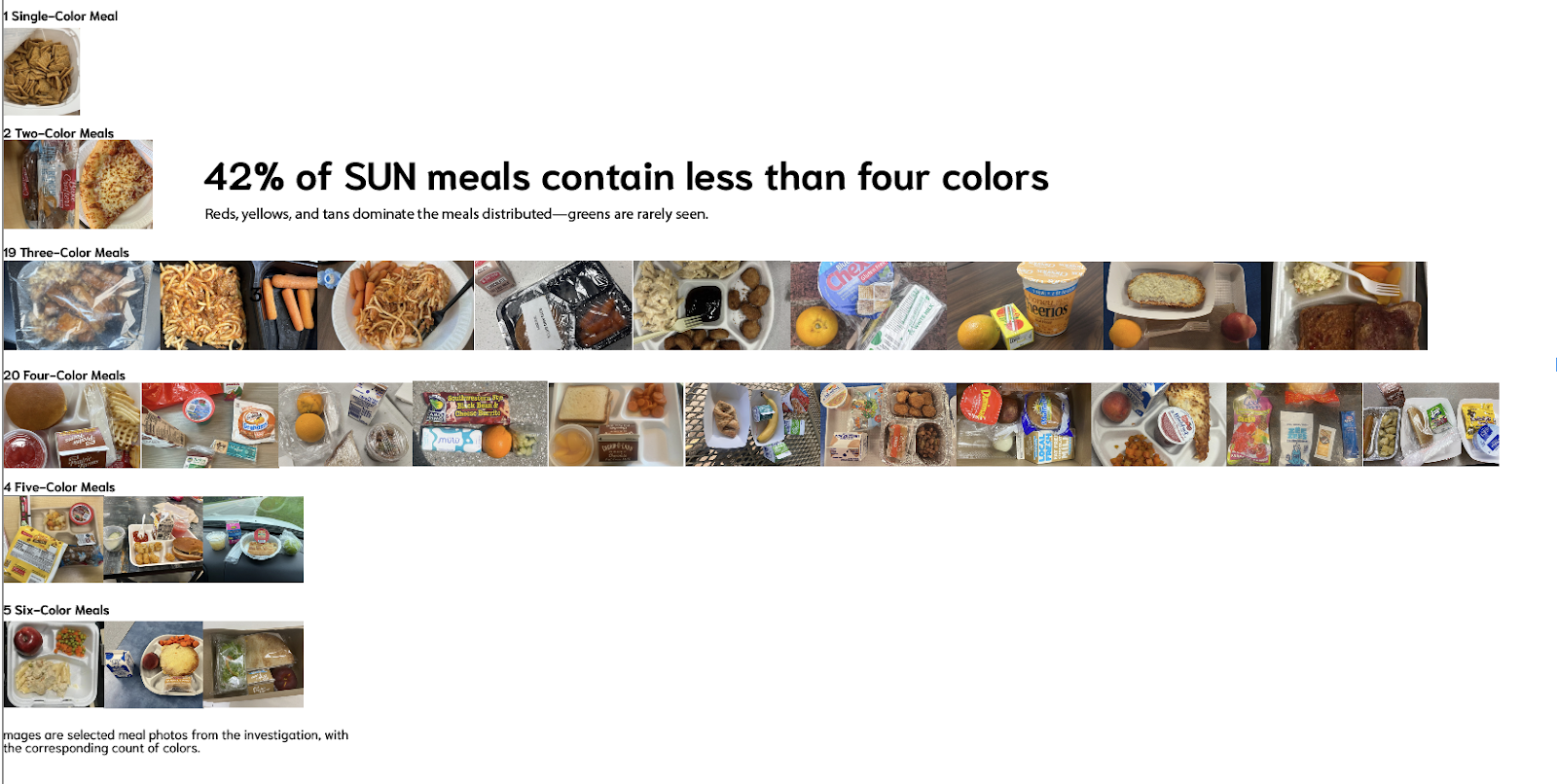
To explore this for SUN sites, the Summer Journal tracked the colors of food items given by summer meal programs: Grain forward items were categorized as tan, meat categorized as brown, mixed fruit cups and juice mixes were categorized as multicolor, milk and chocolate milk were categorized as white and brown respectively, cheese and egg as yellow, and vegetables and fruits were categorized by type into red, orange, green, blue, and violet categories.
Across all 65 sites, 94% of the meals served had tan foods, meanwhile, only 18% of meals had green foods in them. Moreover, 42% of the summer meals do not contain four colors or more.
The Summer Journal also analyzed how the colors in summer meals changed depending on the demographics of the population, including, poverty rate, population size, and racial breakdown.
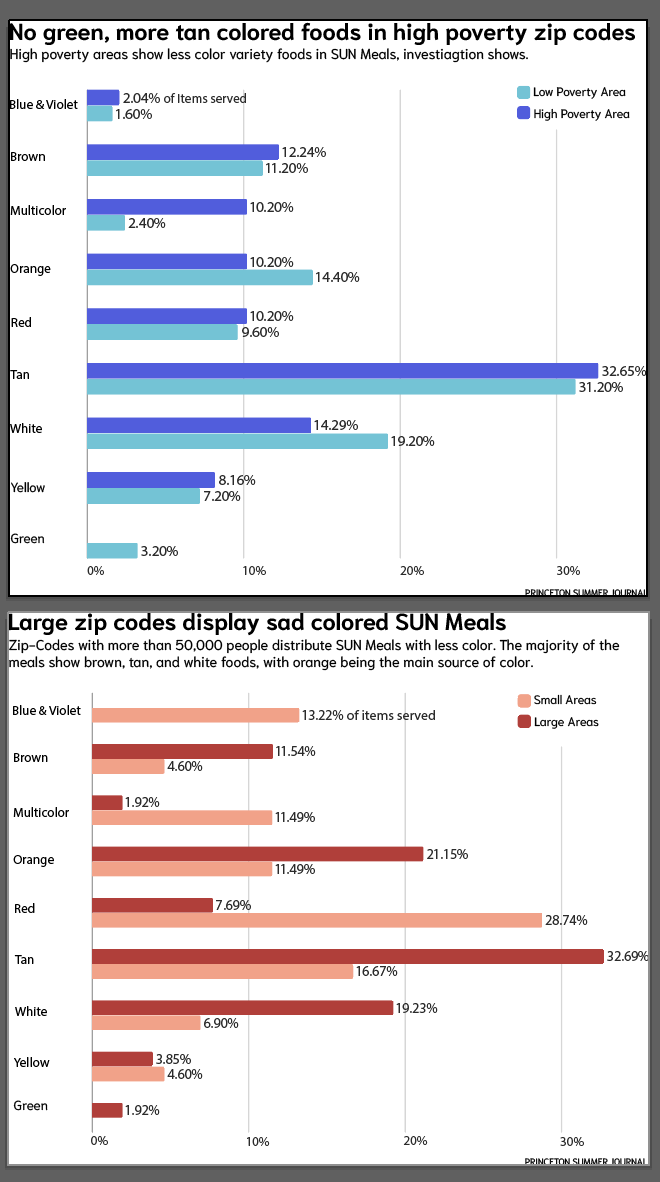
Findings showed that areas with 20 percent or more of the population under the federal poverty line had no green items, compared to 3 percent green foods in lower poverty areas. Zip codes with more than 50,000 people, provided 32 percent of tan meals, while small zip codes only recorded 28 percent. No significant difference was found between majority white and majority non-white areas, but the five sites sampled in high poverty, majority non-white, large zipcodes only had orange, tan and white foods.
While some SUN summer meal program sites are successfully providing meals, many have failed to provide proper nutritious food. On a nationwide scale this unreliability presents concerns for kids without food security.
The inconsistencies among summer meal sites extend beyond the SUN meal program. Summer EBT and SUN Bucks give low income families $120 per eligible school-age child monthly for grocery benefits. However, as of August 2025, according to USDA, 13 states remain without federal money for the Summer EBT or SUN bucks after rejecting them, effectively leaving millions of eligible children without the benefits.
“So if we have states that are saying that they’re not going to participate, they’re not going to pay into these programs, then we’re going to have huge disparities in who has access to them across the country,” said Dinour, “and if we make some of these programs like SNAP, for example, have more strict eligibility requirements, then we’re going to have even less people participating”
Dinour explained that when benefits go up, food insecurity goes down. Giving people more money and food means they will have more food to eat. She says food insecurity has had an uptick in 2022 and 2023 and imagines it’s going up as a result of tightening eligibility.
The solution to these problems begins with destigmatizing food insecurity in our everyday lives. Ricardo Kairos, a faculty member at Rutgers University specializing in Nutrition says that destigmatization encourages people to seek out resources rather than facing it alone.
Many Kairos interviewed for his work helping people get benefits, felt they weren’t entitled to get food assistance.They felt the food wasn’t for them and that they shouldn’t take resources from other people.
On some occasions, a singular word could change a stigma entirely. Mark Dinglasan, the Executive Director of the New Jersey Office of the Food Security Advocate (OFSA), believes that when it comes to mitigating the food insecurity crisis, it is imperative to accurately differentiate between “food security” and “food insecurity.”
When he first came to his office two years ago, Dinglasan commented that his first focus was on “picking the most holistic and comprehensive definition for food security that I could find.” At the time, his office was titled the Office of Food Insecurity — which Dinglasan was not a fan of. Eventually, Dinglasan chose to follow the definition of food security followed by the United Nations, and renamed his office to be the Office of Food Security.
Dinglasan believes that food security can only be truly achieved by focusing on helping people, rather than treating them merely as numbers. “Ending hunger has nothing to do with food,” he said. Rather, he believes, the focus should be on helping communities as much as possible.
Similarly, Chilton rejects the term “food deserts” because it falsely suggests that no food exists in certain areas. Chilton argues that the term “food apartheid” is more fitting because the limited access to healthy, affordable options in grocery stores isn’t an accident, but rather a result of an intentional decision shaped by food systems, zoning laws, public policies, and systematic disparities. Others argue the term “food swamps” for areas that simply have an abundance of non-nutritious food options.
The failure of distributed meals to meet the dietary restrictions, cultural preferences, and nutritional needs of people is why programs like SNAP and SUN bucks are beneficial, because giving people the money to choose what foods to purchase for themselves and their families can lead to meals better tailored to their needs, unlike school meals and SUN meals.
Still, Chilton argues that rather than relying only on programs like SNAP, which exist because wages are too low, we should raise wages instead. She suggests implementing a universal basic income (UBI) regardless of employment status would ensure nobody goes hungry, everyone has shelter, and people can afford necessities.
Another part of the solution is finding and supporting initiatives that ensure food gets to those who need it. There are many existing resources and initiatives that remain obscure to many. Free community supported agriculture (CSA) programs offer fresh food to lower income people and are often cheaper than grocery stores. Public insurance provides free nutritionists. Tiaa.org, provides a customized guide explaining what people’s co-pays, deductibles, and insurance particulars are. Planned Parenthood has a teen group that aids nutrition. Schools often have reimbursement programs to provide money for lunch or breakfast.
One initiative, the Food Recovery Network, is a nonprofit led by students with the dual mission of recovering surplus food and ending hunger, repurposing it and providing it to individuals who are food insecure.
Dinour is the faculty advisor for a chapter on Montclair’s campus, one of few New Jersey schools with a chapter. Initially, it was a class project by her students intended to address food waste then they began the chapter in 2017. Students essentially repackage safe, edible excess food that would’ve otherwise been thrown away, and place it in a fridge on campus.
According to Dinour, around hundreds of thousands of pounds of food have been recovered on Montclair’s campus and the number of visits to their fridges increased by around 1,500 visits over the course of the last year, adding up to almost 8,000 visits to the pantry from September to June.
“We’re doing a lot, we can do much more,” Dinour said. “But I don’t know that we’ll ever get to a place where we are eliminating the need for all of our students. And that’s hard to sit with.”
Methodology
METHODOLOGY
Princeton Summer Journalists selected sites nearby their hometowns to sample. For each site they either visited in-person, or contacted them virtually. For each site the reporters recorded qualitative observations and if possible the content of a meal.
The Princeton Summer Journal Data Team then compiled all the data reported and tracked qualitative patterns, like how busy the site was, who it served, and how easy it was to find.
Reporters then looked at meal descriptions and photos to determine the colors provided in each meal. Colors were grouped into: blue & violet, brown, multicolor, tan, red, orange, yellow, and green. Site demographics data such as the site’s zip code, population size, poverty rate, and population diversity—was joined with the color counts to uncover how the colors of food in each SUN Meal varied between towns with similar populations.
Sonder is the abstract feeling and realization that each person walks around with their own life just as complex and vivid as your own. Through Voices of Princeton, this abstract becomes real. Each story plays as a reminder of how deeply interconnected we really are even as we walk silently past each other.
The oral history initiative was a result of collaborations between the Princeton Public Library, the Historical Society of Princeton, the Arts Council of Princeton, and the Witherspoon-Jackson Historical and Cultural Society. The goal of the initiative is to collect, save, and store the stories of Princetonians. Princeton is a small town with a population of roughly 30,000, but it is made up of a diverse community with over 50 languages spoken. With the help of Voices of Princeton, all these different people are able to combine their experiences to create culture within the town, strengthening the community.
“When populations from really different backgrounds, different cultural histories, talk together, we become solidly supportive of each other,” said Pamela Wakefield, the inspiration behind Voices of Princeton. Wakefield went on to explain the importance of storytelling when it comes to building a more solid community by allowing people to see each other, not just for who they currently are, but also for who they’ve been and what they’ve experienced. Stories, she emphasized, help uncover the shared humanity beneath our differences, making space for empathy and deeper understanding. In a town like Princeton storytelling becomes not just a form of preservation, but a bridge that connects generations, cultures, and individuals who might otherwise remain strangers. Through Voices of Princeton, that bridge is being built one story at a time.
“I would say that if like in 20 years you have little kids and they say what would it have been like to live here, you can say, let’s listen,” Wakefield said. To her, storytelling is more than memory; it’s a gift we pass on.
Stephanie Schwartz, Curator of Collections and Research at the Historical Society of Princeton, also shared her thoughts on what oral history makes possible. “We’re collecting today for what will become the historic record tomorrow,” she said. Schwartz explained that these stories are valuable not just because of the content, but because of who is telling them and when: “It tells us as much about the person at the time they’re telling the story as it does about the stories they are telling.”
Not everyone feels their voice matters in the bigger picture. “Not everyone thinks their story belongs in history,” Schwartz added. “It’s our job to say: yes, it does.” Voices of Princeton makes that message clear. No one is too new, too quiet, or too ordinary to be remembered.
Cliff Robinson, Public Humanities Specialist at Princeton Public library, reflected that idea. “Just because you’ve been here for a short time doesn’t mean this isn’t your community or that you’re not responsible for it in some way,” he said. In a place like Princeton, where people move in and out often, that reminder matters. Everyone has a place. Everyone contributes to the larger story.
Robinson also spoke about how special it is that the stories are recorded in audio form. “I’ve always been enchanted by the fact that they’re just audio. It requires a different kind of attention—you can close your eyes and just listen.” That kind of listening, quiet and focused, builds a kind of connection.
Kim Dorman, Community Engagement Coordinator at the Princeton Public Library, added that accessibility is an important part of the project’s mission. “As a public library, we’re making these stories publicly available in a way that’s much more accessible than most oral history projects,” she said. That means anyone in the community or even outside of it can listen to it, learn and reflect.
Through Voices of Princeton, stories are no longer just something people keep to themselves untold, they become part of something stronger. The initiative is a reminder that history is not made only by the powerful and famous. It’s made by the same people we see everyday. Every person carries a story that matters.
In a town where diversity lives on every block, storytelling becomes not just a form of preservation but a bridge that connects generations, cultures and individuals who might otherwise remain strangers. Through Voices of Princeton, that bridge is built one story at a time.
Before tip-off, the story was simple: experience over youth. Social media buzzed with predictions of a dominant New York win. The fans brought swagger, confident that the star-studded Liberty roster would roll over the unproven Los Angeles Sparks — a team full of rookies and overlooked talent. But that confidence unraveled almost immediately.
From the opening minutes of the first quarter, it was clear the Sparks weren’t there just for the sake of it; they came to win. L.A. took a commanding 15-point lead using an unorthodox strategy powered by their explosive speed and athleticism. The rookies repeatedly attacked the basket, overwhelming New York’s defense. The veterans lost star Breanna Stewart to injury early, allowing the Sparks to maintain their lead into the second quarter. The crowd sounded their frustrations with their ear-splitting boos.
The advantage of the Sparks’ youthful energy was undeniable, but the crowd didn’t give up on the Liberty. New York kicked it into high gear, catching up in the third quarter. The atmosphere became ecstatic as Ionescu broke a franchise record with her 16th 30-point game.
Although the vets had their honed plays and established chemistry, they were brought down by pure youthful tenacity. With the game tied at 99-99 and one second left on the clock, player Rickea Jackson accepted a pass in the paint from teammate Dearica Hamby, then heaved up an off-balance shot.
Swish.
Silence reverberated through Barclays Center as the underdog Sparks celebrated their buzzer-beater at center court. It was a statement win on the road for L.A., showing that being untraditional and fresh-faced doesn’t always mean being sloppy and reckless.
On June 30, Princeton Mayor Mark Freda attended a press conference with the Princeton Summer Journal, where he discussed recent United States Immigration and Customs Enforcement (ICE) activity in the small New Jersey town.
“Our police do not work with ICE. We do not support ICE in immigration matters in any way, shape, or form,” he said, expressing his dislike for the federal organization.
“It seems to me that ICE is concentrating on anybody that appears to be Latino. That is their A-number-one target, and so that’s problematic,” Freda said. Of the 15 people taken, he said he was “90-some-percent” sure that at least one had work authorization. “They’re going to work,” he said. “None of them are criminals.”
Freda went on to discuss what his administration is doing to aid the detainees. One option is for the town to support the proposed New Jersey Immigrant Trust Act, which would protect immigrants and their personal information. The act has faced both pushback and support.
“The Immigration Trust Act is something the state legislature will hopefully act on at some point,” Freda said. “People are concerned that if we pass the resolution in support of the act, that somehow, ICE and others will pay more attention to Princeton.”
Freda faced pressure surrounding the legislation at a recent town council meeting. “We had probably about 60 or 70 people show up and were giving us a really hard time,” he said. Freda maintained that the act is a state matter and he is still undecided if he will support it.
Despite immigration issues being out of his hands on a federal level, Freda still wants to support his constituents, as hard as that may be.
“Why are we bothering these people? We cannot protect people from it. We just can’t,” he said. “It doesn’t matter. What resolution we pass doesn’t matter. We can’t. Until [things change] at the federal level, all we can do is offer help.”
Princeton Mayor Mark Freda has officiated weddings, shaken hands at hundreds of community events, and spent decades fighting fires for his hometown, but these past few months have proven some of the most difficult of his career. Not a blaze in a building, but a firestorm of public outcry.
The mayor, who joined Princeton’s volunteer fire department at just 15 years old, grew up in a Catholic household rooted in community service. That foundation shaped him into a leader who takes pride in public service, but the present political climate has tested even his strongest foundational principles.
At last week’s town council meeting, nearly 70 attendees packed the room, demanding answers after a disturbing encounter between community members and the United States Immigration and Customs Enforcement (ICE).
According to Freda, ICE agents stopped a van carrying 15 people to work. The organization was reportedly looking for one individual, but detained everyone onboard, regardless of legal status or criminal history.
“It seems to me that ICE is concentrating on anybody that appears to be Latino,” Freda told the Princeton Summer Journal. He said he was “90-some-percent” sure that at least one person arrested had work authorization. “None of them are criminals,” he said.
Freda noted that many who attended the council meeting were not Princetonians, but outsiders who were not focused on useful outcomes. “They were more concerned with how they were going to look on those film clips,” Freda said.
At the heart of the debate is the New Jersey Immigrant Trust Act, a proposed law to protect undocumented residents from deportation by restricting cooperation between local law enforcement and ICE. The Princeton town council is considering a resolution to support the act.
“People are concerned that if we pass the resolution, ICE and others will pay more attention to Princeton,” Freda said. “I don’t know if that’s actually true.”
The New Jersey State Legislature has the final call. Despite this tension, Freda remains steadfast in his love for the community that raised him.
“I’ve been here forever,” Freda said. He went on to share that what he wants is for his critics to say: “That guy was okay. I didn’t agree with him all the time, but you know what? He was okay.”
For Freda, the goal isn’t perfection, it’s presence. In a town that often demands both, “okay” might just be the most human standard of all.
The New York Liberty were down in the first quarter. Way down. With 1:32 left on the clock, they trailed the Los Angeles Sparks 24-15. L.A. was relentless. When Rae Burall walled off Natasha Cloud from getting into the paint, it seemed like another missed opportunity. But Cloud spun wide and with help from Isabelle Harrison, put up a shot to let it fly.
Bucket.
The crowd roared with excitement after witnessing the masterpiece of a play. The sixth woman had arrived.
Just over 16,000 people were in attendance to watch the Liberty, one of the best teams in the league and the Sparks, one of the worst, at the Barclays Center. Liberty fans cheered for a comeback after L.A. got off to a hot start, looking to extend its four-game win streak. The Sparks dominated early, with Kelsey Plum launching fearless 3s while New York stood paralyzed. Things worsened when Breanna Stewart exited three minutes into the game with a leg injury. At halftime, the Liberty trailed 58-45. All the momentum belonged to the Sparks.
The response came from the fans.
The Liberty faithful poured their hearts out like their lives were on the line. Ellie the Elephant, New York’s world-famous mascot, put on a performance that could rival Beyoncé. The team picked up speed in the third, scoring 24 points. Natasha Cloud and Sabrina Ionescu locked in and made repeated big plays, the fans going ballistic over each highlight. Cloud gave it her all, scoring 22 points and putting on a show after each bucket. Ionescu recorded her 16th 30-point game, a new franchise record. But what sent the fans into absolute madness was a simple free throw.
With 2:18 left on the clock, Ionescu was rewarded with one shot and the opportunity to tie up the game. Just like Atlas, Ionescu carried the weight of the world to keep the Liberty’s win streak alive.
Bucket. 95-95.
New York had completed the comeback, and the torch was blazing hot. The jumbotron words jumped on screen, the arena lights tried to give someone an epileptic seizure, the fans rallied to cheer on their favorite team. But with the score tied at 99-99 and the clock ticking toward zero, the Spark’s Rakia Jackson launched a desperate shot over the Liberty’s Stephanie Talbot. Bucket.
On the first day of Princeton’s Summer Journalism Program, reporters were set loose to answer a question: Is the United States a meritocracy? Or could it ever be one? With each answer, it became increasingly clear: The future of our government has never been as unpredictable as it is now, according to the people of downtown Princeton.
The common opinion was that the U.S. was not a meritocracy, and many added that it would be impossible to go down that path. The question also opened the door to the disparities that plague American society, from nepotism to unqualified politicians.
“We have a lot of nepotism,” says Jolita Auguste, 38. “We’ve had that since the founding. I don’t think we’re going to get rid of that because most people, even when you ask them, what are you working so hard for? It’s so that my kids can have a better life.” She raised a point that others also communicated: In many ways, the U.S. isbased on connections.
Grace O’Donnell, 23, offered an alternative system for elections. “I think there would have to be qualifications for certain positions within the government,” she says. “Right now, I feel it’s more like who can command a room, who can get votes… But I think certain people should be excluded. There should be certain barriers to even run for positions.”
Networking is a major part of American society—in corporate jobs, in internships, and in the government. “In the government, especially in the United States system, I think a lot of it is who you know,” says Sejal Joshi, 22. “It is a game, and I don’t know if the people who have the correct and the most beneficial skill sets that the country needs are often the elected ones.”
Despite the current situation, Auguste stressed that the idea of a meritocracy is worth pursuing.
“There’s always a level of bias that happens in all interactions, but we do know that there are huge disparities,” she says. “So when you see such wide gaps, I do think that it’s important to at least acknowledge those and try and even them out in the meantime.”
For years, Americans have held the “American Dream” as a classic ideal of success, believing that through hard work and determination, anyone can climb the social ladder.
But some believe that the battle for equality and the American dream has waned and that hard work has taken a back seat to privilege, where race, gender, and economic background determine success. Can a meritocracy—the idea that rewards are earned by talent and effort—even work in the modern United States?
Residents of Princeton, New Jersey, had lots to say on that.
“I found that until I worked hard, I couldn’t achieve anything,” says Jyoti, 46. Her belief in the value of persistence is rooted in personal growth, she says.
The idea of hard work is a major factor among those who believe in a meritocracy.
“If you work hard and have the talent, you can make a decent living,” Sunil Suri, 54, says.
He says he strongly believes that no matter where one comes from, they can succeed in the U.S., remembering classmates from his university in India who immigrated.
“Some of them are actually billionaires now. So coming from nothing, literally, they walked in,” Suri says.
But others in Princeton challenged the idea of a meritocracy, arguing that while hard work matters, it’s not the only factor and often not even the most important one.
Tim Quinn, a 67-year-old former journalist from a working-class background, doesn’t believe America functions as a true meritocracy.
“The meritocracy as it exists now is kind of a fraud,” he says. “We have an education system that favors kids who are really good at school…. If you’re good at taking tests… then you will go on to a better college. And a lot of that is based on your ZIP code.”
Reflecting on his own experience, Quinn says, “as a white man, I was born on first base. Even though I came from a working class family…it’s only because my father had got a union job that I was the first in my family to be able to go to college.”
Allegra Brennan, 19, a Princeton native, believes that it is harder for women and minorities to succeed, especially in the current political environment.
“I think to be successful, especially as a woman, or as a person of color, especially now in Trump’s America, you have to jump through ten more hoops,” Brennan said.
Is America on a path to success based on background or a meritocracy?
“I know now that there was some Black woman somewhere who was as smart as I was and who could have written what I wrote and edited papers that I wrote,” Quinn said, reflecting on the advantages he had as a white male. “She was just getting in the batter’s box.”
If knowledge, skills, and talent determined an individual’s power and influence in society, would a meritocracy result in a fair system for the United States? For Princeton residents, this question revealed a common understanding: meritocracy is the ideal, but not always a reality.
Most explained that it is complicated to define meritocracy and the role it plays in the U.S., as everyone has different experiences that shaped their perspectives.
In today’s society, success can be determined by one’s connections, wealth, and privilege, from college admissions to education to social capital. Yet, meritocracy is supposed to award ability over affluence, but who would really benefit?
“Will [merit] open doors to certain conversations about you going far? Yes. Will you go far? I don’t know about that one. That’s a bit iffy,” said 28-year-old product analyst Kasheif Harrison.
While he understood the dictionary definition of meritocracy, he believed that merit alone can’t ensure success, instead it’s the people you meet, the connections you form, and the impressions you make that will help you flourish.
George Cohen, 66, a former New Jersey Deputy Attorney General, said that meritocracy correlates to work ethic: “If you’re the fastest runner, you win, you study the hardest, and you do the best, you’re the smartest.”
Nevertheless, he added, success and equal access to opportunities are also determined by privilege. Not everyone starts on an “equal playing field,” he said.
Many people also shared a similar sentiment, that while meritocracy is fair in theory it does not account for barriers such as gender, race, class, as well as unequal access to resources, education, and opportunities.
Cohen believed he had an upper hand compared to his high school classmates, because everyone did not have the same opportunity and time to dedicate to activities that could build merit.
“That’s why SATs ought to come back, because as much as they may be biased, everyone was taking the same test.”
On the other hand, Harrison believed that it’s the people you know that matters, and that merit alone will not help you succeed.
Hungtang Ko explained that merit did help him to an extent, but there were other factors involved. “I was lucky enough to get into Princeton and they thought I got in through merit, —which is probably true—for a certain part, but there’s a lot of luck involved. Just like anything,” he said.
While most Princeton residents agreed that meritocracy exists in the U.S., they said it does not operate effectively in society to promote fairness.
Harrison said the main problem with meritocracy is that it “oversimpli[fies] how the world really works.”





 The Princeton Summer Journal