In my 17 years of living, one especially important lesson I’ve learned is that patriarchy is inherently entwined in how we speak.
My first encounter with patriarchal ideas began on the first day of fourth grade. It’s an understatement to say I walked in ecstatic. Orientation has always been my favorite day.
English is my second language; Somali was my first. So when chatter in the class slowly settled down, and my teacher introduced herself as Miss, I was confused. Miss? I thought it was Mrs.? Or Ms.?
To answer both your question and mine, the difference between the three is marital status. Mrs. is a married woman; Ms. is generally an unmarried woman. Well, that’s the end. Thanks for reading… is what I would say if the distinction didn’t linger in my nine-year-old brain, creating a fixation none of my peers shared.
Lo and behold, the origins of this terminology derive from historical language. According to the University of Cambridge, “‘Mistress’ is the root word of both of the abbreviations ‘Mrs.’ and ‘Miss,’ just as ‘Mr.’ is an abbreviation of ‘Master.’”
Even before understanding the historical significance behind the terminology, I always wondered why women were identified based on their relationship status while men weren’t. Only women’s titles emphasize their connections to men rather than their honorific and name, which takes away the purpose.
Few people deny that patriarchal ideas exist in our language, but many critics argue that it’s too late for anyone to do anything about it. A common claim among many English speakers essentially boils down to “Okay, now what?” My answer is that it’s never too late to inspire change. The first step is clear: raising awareness.
If I hadn’t learned about the difference between honorifics in men and women on that day in fourth grade, I wouldn’t have even acknowledged the impact linguistics play in our lives. Awareness can be the difference between being negligent and making a difference. You can make an impact, one word at a time. It takes a single candle to light thousands. Be that candle.
Rolling dice and moving pawns as a medium of learning about suffrage may sound unusual, especially if the game has origins from an entirely different country. Yet one such game has found its place in the archives of Princeton University.
Pank-a-Squith, a table-top board game created in 1909 by the Women’s Social and Political Union (WSPU), was named after Emmilene Pankhurst and Herbert Asquith, prominent figures in the suffragist movement in England during the early 1900s. The premise of the game: You do not win until you reach the last square, granting you the right to vote. To achieve this is nearly impossible. Only setbacks are guaranteed.
The WSPU was formed in the early 1900s in England and primarily focused on helping women win the right to vote. The union, solely run by women, created the board game as a fundraiser for their foundation, as well as a means of illustrating the common obstacles suffragists encountered in their fight for voting rights.
The combination of the names Pankhurst and Asquith represent a dichotomy between suffragists and opposing government bodies. Emmilene Pankhurst founded the WSPU in 1903 and played an element in the union and in the British suffrage movement. For his part, Herbert Asquith, England’s Prime Minister from 1908 to 1916, was a leader in the anti-suffrage movement. The two were such polar opposites that in 1910, a group of suffragettes attacked Herbert outside the House of Commons.
The rules of Pank-a-Squith are similar to those of Candyland or Snakes and Ladders: Roll the dice and move across the board accordingly. Pank-a-Squith comes with unique consequences, depicting prejudice in game board illustrations. Each square on Pank-a-Squith has a distinctive image of a barrier faced by suffragettes. Square 36, for example, depicts the government’s actions using an icon of a policeman in addition to jail bars and handcuffs, reminds players that the British government used incarceration as a tactic to silence women.
Out of the 50 total squares that compose Pank-a-Squith, 16 have an added consequence when a player lands on them, including missing a multitude of turns or having to return to a previous square. The final square makes you roll the dice again to cast the exact number needed. If not, you count back by what you are over by, adding another obstacle to winning. These repercussions make Pank-a-Squith a never-ending game.
Although some groups of women gained suffrage over a century ago, the Brennan Center for Justice suggests threats to women’s voting rights have not gone away. Just like Pank-a-Squith, the fight for women’s suffrage may never end.
The heartbeat of Princeton started in a U-Store parking lot.
For five years, Barry Weisfield bounced between flea markets and college towns, selling records and vinyl from orange crates in his Chevy van. After rolling into Princeton, his van became a community staple, drawing keen ears to the Princeton University Store.
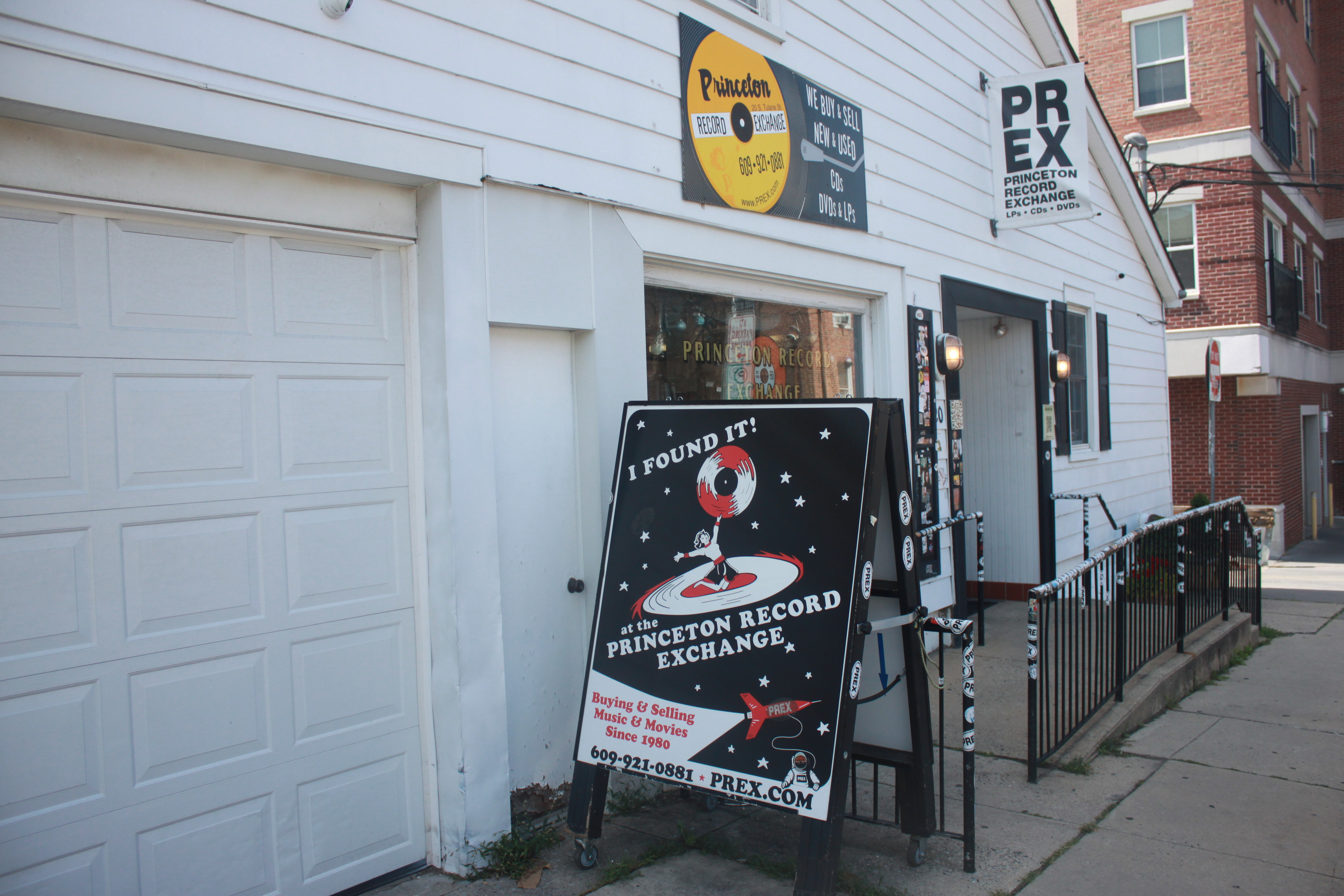
Always on the road, Weisfield laid his heart on Princeton’s streets and couldn’t leave it behind. In 1980, he parked his roots for good, opening the Princeton Record Exchange Store (PREX) on South Tulane Street, a charming cobblestone path off Nassau Street.
Princeton’s location—neatly between New York and Philadelphia—played a role in his decision, offering prime potential for customers. But it was Weisfield’s devotion to customer service that made PREX stand out. He believed the staff should cater to the community, rather than the other way around.
Unlike big-box retailers, PREX emphasizes connection. Staff aren’t just told to sell records—they’re there to make everyone feel welcome, whether first-timers or long-time collectors. Questions are met with enthusiasm, record requests are taken seriously, and the space is decorated for comfort rather than flash.
When Jon Lambert took over in 2015, after years as general manager and close friend to Weisfield, he kept that ethos while adding his own touches. Inside, handwritten canary-yellow tags label the genres, and DIY record dividers keep the vibe simple and accessible.
Overlapping LCD record covers, Vanity Fair spreads of Randy Newman, Ozzy Osbourne concert posters, and artful band collages give the convenience-store–styled building a lived-in charm.
Lambert’s goal is clear: make people want to stay. And they do.
“You know, if you have a business, they [Google] tell you the average length of stay, for people in that organization, and we’re about an hour,” Lambert says with reserved pride. “I think that really speaks to how much people enjoy being there as an event.”
His attention doesn’t stop at décor or inventory—it extends to his hiring.
“I’m pretty picky about picking,” Lambert jokes. He’s less concerned with stacked resumes in the arts and more focused on personality, lived experiences, and values that align with PREX’s mission: to be courteous, kind, and obliging.
He asks potential hires questions like: “What does integrity mean to you?” “How do you live your life?” and “Is it an internal code of ethics or external?”
Lambert sees his staff as an extension of PREX’s promise to Princeton’s community, even when he’s not there. “Those are the things I care about,” he concludes.
Just around the corner, another independent business echoes that sentiment. Labyrinth Books, co-founded by Virginia Harabin, Pete and Cliff Simms, and the late Dorothea von Moltke, serves as a haven for Princeton’s book lovers.
“It’s a place for travelers, it’s a place for locals,” Harabin says.
Labyrinth intentionally sought a large footprint to serve as both a bookstore and a gathering place—though Harabin admits that decision “might have cost [them] a little something in terms of warmth.” Still, thoughtful touches—a cluster of chairs here, a soft rug there, fairy lights strung from the basement ceiling—create cozy pockets for connection.
“I hope that before too long we’ll be able to do something like put a carpet on this floor,” Harabin reflects. “Maybe a different kind of seating area with some softer chairs. I’m emphasizing change and development.”
Warmth at Labyrinth doesn’t just come from décor, but also from decorum. Like at PREX, the staff help create a hub where curiosity meets enthusiasm. Customers openly approach staff, make requests, and linger for informal conversation.
“Somebody comes in and says, ‘Do you have this?’ I look it up; I don’t have it. But I want to have it. I should have it,” Harabin says. “I’m gonna get one for you, but I’m gonna get one for the store too.”
While one caters to sound and the other to story, Princeton Record Exchange and Labyrinth Books share a philosophy: go beyond inventory and revenue. They resist the transactional coldness of big-box commerce, instead valuing personality, conversation, and time spent.
In a town shaped by prestige and tourism, these independent businesses are grounded in cobblestone charm and built on meaningful exchanges. They are more than local commerce—they are the essence of local care, beating steadily under every path.

 The Princeton Summer Journal