

Category Archives: News

Facts of Gaza conflict elude many in New York

A demonstrator displays a flag at a gathering for Universal Peace Day, which commemorates the bombing of Hiroshima and Nagasaki, on Aug. 5.

A demonstrator displays a flag at a gathering for Universal Peace Day, which commemorates the bombing of Hiroshima and Nagasaki, on Aug. 5.

By Angela Kim, Amna Nawaz, Nicholas Santiago and Hasani Valdez
with the staff of the Princeton Summer Journal
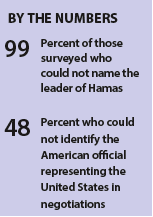
ByTheNumbersNew Yorkers are known for their global-mindedness, diversity and strong opinions. But in a survey conducted by the Princeton Summer Journalism Program last week in New York, a majority of respondents did not know some of the basic facts of the Israeli-Palestinian conflict in Gaza.

A large majority of 410 people interviewed around Union Square on Aug. 5 did not know the name of the leader of Hamas, the political faction which governs Gaza and is regarded as a terrorist group by the United States. Although 58-year-old Khaled Meshaal has run Hamas for the past ten years, 99 percent of those surveyed could not name him. Just three percent of those interviewed were aware that the Hamas leader resides in exile in Qatar.

Of those interviewed, just under 25 percent correctly identified the approximate number of Israeli casualties, which numbered 67 as of Aug. 6, according to BBC world news. (Responses within the range of 47-87 were considered correct answers.) Similarly, just under 25 percent of those polled correctly identified the number of Palestinian casualties within a range of 1300-2300. The number was 1,888 on Aug. 4, according to the Palestinian Center for Human Rights. Continue reading

Proposed pipeline through Princeton draws scrutiny

By Rashid Binnur, Catherina Gioino and Nelly Mendoza

In recent years, awareness of the environmental hazards posed by pipeline projects has grown, driven in part by the possible construction of the controversial Keystone XL pipeline, which would run from Canada to the Gulf of Mexico.

Now there is debate over a proposed pipeline that would pass through Princeton — a 1.3-mile stretch of the partly constructed 10,200-mile Transco pipeline, which would carry natural gas from Texas to New York.

New Jersey Senators Cory Booker and Robert Menendez, along with U.S. Representatives Rush Holt and Frank Pallone, called for an extensive review of the project’s environmental impact last month. A week earlier, Princeton’s town council had passed a resolution asking the federal government to reject the current pipeline plan. Between concerns over environmental damage and human safety, the project has some residents wondering: Is this pipeline a good deal for Princeton? Continue reading

Debenedetti finds work-life balance in accomplished University career

By Vanessa Zamora
Vista, Calif.

Pablo Debenedetti is a man of many accomplishments: Chemical and biological engineer. Dean at Princeton University. Recipient of countless awards. But what does he think is his greatest contribution? “To the world? My two children.”

While Debenedetti is well known for his contributions to the scientific world, he makes it clear that his family is his first priority. In 2012, Anne-Marie Slaughter, also a professor at Princeton, wrote an article entitled “Why Women Still Can’t Have It All,” which focused on the difficulty of balancing a job and a family. Debenedetti, however, shows that men deal with this problem as well. Continue reading

Princeton public schools to offer healthy lunch options

By Asia Matthews
Queens, N.Y.

Black bean cookies, squash fries, and maybe even coconut-raisin rice are all menu options landing in Princeton public school cafeterias in the upcoming academic year. These new healthy-sounding treats, provided by the Nutri-Serve Food Management Inc., are meant to put a new twist on old school lunch favorites.

These changes are being implemented by Stephen Cochrane, 53, who took over as superintendent of the Princeton school district in January 2014. Less than a year into his tenure, Cochrane is already taking big steps to help kids internalize healthy habits. When the district’s last food service contract expired, he seized the opportunity to promote more positive nutritional habits. Continue reading

New Plan B rules cause confusion for NYC pharmacists

By Erick Arzate, Shemaiah Clarke, Miguel Diaz and Hunter Richards
with the staff of The Princeton Summer Journal

Confusion On The Morning AfterThis June, in response to a federal judge’s ruling, the Obama administration made the emergency contraceptive pill Plan B One-Step available over the counter to people of all ages and genders.

But an investigation by The Princeton Summer Journal revealed that the vast majority of pharmacists interviewed in New York City did not know about this recent change regarding the rules for access to Plan B One-Step, the most common “morning-after” pill.

Of 49 pharmacists interviewed Wednesday in Manhattan, Brooklyn, Queens and the Bronx, only 16 were even aware that Plan B One-Step was now available to everyone without age or point-of-sale restrictions.

And of those 16 pharmacists, only 11 were actually selling Plan B One-Step without any restrictions. Several of the pharmacists interviewed said they were still enforcing the now-defunct age restrictions and cited lack of guidance from the Food and Drug Administration (FDA) and the pill’s manufacturer, Teva Pharmaceuticals, as a cause of confusion. Continue reading

Unpaid journalism internships may serve as barrier to profession for low-income students

By Ashley Jones-Quaidoo, Lesley Le Platte, Jeanne Li and Ellen Pham
with the staff of The Princeton Summer Journal

Like many aspiring journalists, Harvard University student Michelle Hu went hunting for media internships this summer. But as a student on financial aid, Hu had to consider money when making her decision. Hu simply couldn’t afford to take an unpaid internship.

In the end, she got an internship with Al Jazeera in Washington, and was able to pull together money to cover basic expenses—a $1,000 stipend from Al Jazeera and a $1,000 scholarship from the Asian American Journalism Association. Even with this funding, however, budgeting for the summer still wasn’t easy.

“I had to find a place with cheap rent,” Hu said. “Every time I bought food it was a conscious decision.”

At least Hu was able to find funding. With the economy sluggish and the news industry struggling, unpaid journalism internships seem more common than ever. And that means students from low-income backgrounds are facing a major barrier to entry in the industry. Continue reading

Princeton students start nonprofit based on Montessori school system

By Navil Perez
Thornton, Colo.

Several Princeton students and alumni are looking to follow in the footsteps of Teach for America founder Wendy Kopp ’89 by tackling the challenge of education in America.

Christian Smutherman ’14, Greg Groves ’13, Jason Warrington ’13 and Amina Yamusah ’13 are establishing a nonprofit called the Freestye Montessori Urban Academy (FMUA). Continue reading

Student entrepreneurs to launch schools in urban areas

By Jasmine White
Birmingham, Ala.

While studying abroad in South Africa during their junior year, Princeton students Jason Warrington ’13 and Greg Groves ’13 found themselves engaged in deep discussions about what they were seeing—for instance, a homeless man sitting outside a BMW dealership. Looking back, Warrington described the poverty as completely “in your face.”

These discussions made Groves and Warrington resolve to do something about poverty here in their own country. And so, this summer, having graduated from college, the pair, along with Christian Smutherman ’14 and Amina Yamusah ’13, is working to start Freestyle Montessori, a not-for-profit organization that aims to provide educational opportunities in urban areas. Continue reading

Start-up schools to address poverty

By Odett Salcedo
New York, N.Y.

Studying abroad in Cape Town, South Africa, last year, Jason Warrington ’13 and Greg Groves ’13 could not help but notice the poverty that surrounded them. The two Princeton students were especially struck by the homelessness and poor standards of education. While the situation moved them, they realized that very similar problems were affecting Americans back home.

Along with Christian Smutherman ’14 and Amina Yamusah ’13, they wanted to find a way to approach the problem. Continue reading