Category Archives: Uncategorized

Stop Web Filtering in Schools

By Aryam Haile
Stone Mountain, Ga.

Grown-ups, envision this: You’re in high school. It’s 2020 and your school has gone virtual. You’re in a Zoom call for U.S. History, and your teacher assigns you to watch a short video on the Great Depression. They send the link in the chat. As soon as you press the link, a red message appears on your screen saying: “Web-site blocked.” In the digital age, many schools have given their students laptops and tablets for online school work. To keep their students safe from mature content, many schools have also implemented website filters on these devices. While shielding students from pornography is important, schools need more precise filters.

Many students have voiced their frustrations on the extensive web-blocking that has prevented them from accessing the information they need to complete as-signments. What good is providing these devices to students if they can’t use them to their full extent?

A vast number of schools use web blocking software that can’t differentiate be-tween inappropriate web-sites and normal content that has no business being blocked. Web filter software uses keywords to determine whether a website is inappropriate, and the simplistic overuse of key-words is doing more damage than good. Schools should lower the number of keywords they consider to be inappropriate. This will allow students to access important, non-harmful websites.

Some may argue that the blockage and filtering of websites are to keep students safe. While websites con-taining pornography should be blocked, schools need to be more careful in how they assess what content is considered mature for students. Giving students access to technology was supposed to increase learn-ing access; extensive web-filtering only acts as another barrier to students and their online education. 

Keep HBCUs Black

By Marshalee Mclean
Bronx, N.Y.

“This place is sacred … and if white people just start coming in here, I feel disrespected, completely,” said a Black Morehouse student in Vice’s video “Being White at a Historically Black College.” The context of the video is an age-old question that only resurfaces in the mainstream occasionally, but sparks heat-ed debate: Should white people attend HBCUs? 

The answer is simple: No, they shouldn’t. 

Historically Black colleges and universities are described as institutions “established to serve the educational needs of Black Americans” by the U.S. Department of Education. Before the inception of HBCUs, Black students were notoriously denied admission to post-secondary institutions. Schools like Fisk, Hampton, Howard, Spelman, and Morehouse were among the first Black private institutions to educate in a racially segregated society. Through time, these institutions evolved into more than sites of learning; they became safe spaces for Black people to be their complete, authentic selves. But now, like almost everything Black owned or populated, they are under attack.

Bluefield, Lincoln, Gadsden, and St. Philips are just a few examples of HBCUs that have majority white populations. Spaces made by Black people, for Black people, full of Black history, culture and pride now have less than half Black student populations. 

This invasion of Black spaces is all too familiar. From houses in Black neighborhoods, to Black-owned mom and pop shops, to clothes and music, society will stop at nothing to gentrify and oppress Black America.

Non-Black people believe that by attending HB-CUs they are furthering an ethos of anti-racism, but the opposite is the case. Coming into Black spaces doesn’t dismantle racism, it perpetuates it by conceiving of it as an individual, rather than a systemic, problem. The myth of racism being solely individual continues to halt true progress toward the destruction of  institutions that profit off oppression. 

Your white liberalism will not save us. 

Attending an HBCU as a white individual, learning about Black history, trying to radicalize yourself, doesn’t compare to the realities of being Black. Try to “understand” us all you want, you will never be us, your privilege still stands. Part of being an ally comes with acknowledgement of privilege. Don’t use said privilege to invade what was, and still is, meant for us. 

These sacred Black spaces aren’t for you.

Pandemic Boosts Pet Adoptions

By Alyana Santillana
Brentwood, Calif.

Jake, a Jindo-terrier adopted by Laura Wager during the COVID-19 pandemic. | Credit: Laura Wagner

The COVID-19 pandemic hit fast and hard. In a matter of days, the entire world left their ordinary routines for a mandated stay-at-home order. Months of confinement inevitably took their toll on the masses. As a result, people found emotional support and companionship in man’s best friends: pets.

Laura Wagner, of Prospect Lefferts Gardens in Brooklyn, was fortunate enough to adopt a Jindo-terrier mix named Jake at the start of the pandemic. “It took until May until we actually got our dog. It was five weeks of applying for a dog and not getting one, and getting our hopes up,” Wagner said.

While the process of adopting her furry friend was long, the wait was well worth it. “Spending a lot of time with Jake probably helped us bond,” she said. “It provided a real structure for my physical life and that has really helped my mental health, as well as a structure  of things to do, because he’s so cute and so fun to be around, so that was nice as well.”

As life slowly begins its return to normalcy, Wagner and her family are in the process of helping Jake adjust to a post-pandemic routine. One of the steps is getting Jake used to be-ing alone in her apartment. “We’re working with a trainer on this thing called guaranteed departures, where you leave for like 10 minutes and come back, in-creasing the amount of time each day so that the dog gets used to knowing that when you leave, you’ll be back,” she said.

While Jake has become a valued member of Wagner’s family, the same cannot be said for many pets who were returned to stores or shelters as people began returning to their normal lives. “We saw a big spike in animal sales, but not any of the animal products. … Animals were being surrendered because people just didn’t know how to care for them any-more. A lot of the animals were being abused,” said Cynthia Salazar, a guest experience specialist at a PetCo location in Texas. “When everything opened up, we started seeing a lot of surrenders as a lot of people were coming back to their jobs,” she added.

While the lockdown undeniably changed the course of our lives and habits, the same goes for the ones we turned to for support.

Simmons Runs For Stamford Mayor

By: Baby Cornish & Selena Moore

Frederick, Md. and Detroit, Mich.

Caroline Simmons

At the forefront of Caroline Simmons’s bid to become mayor of Stamford, Connecticut, is a topic that has dominated the nation-al conversation in recent months: public health.  

“This is everything from mothers facing mental health issues and stressors that relate to environmental injustice, and also the adverse health effects we see from air pollution,” Simmons said in a July press conference with The Princeton Summer Journal. As a mother herself, Simmons said, she particularly cares about combating environmental injustices that contribute to adverse pregnancy outcomes, such as preterm birth.

According to Simmons, a Democrat, infrastructure is crucial to her agenda of achieving environmental and economic justice, and as mayor, she would have “shovel-ready projects” lined up. She said she plans to work with Connecticut’s Department of Energy and Environmental Protection to secure state and federal funding. “I would have a Stamford plan to combat climate change and re-build our infrastructure in a more sustainable way,” Simmons said.

Elected as a state law-maker in 2014, Simmons challenged incumbent Mayor David Martin for the Democratic nomination, resulting in her endorsement by Stamford’s Democratic City Committee by two votes, 21-19. Despite Martin’s loss, he can force a primary by gathering 5 percent of the city’s registered Democrats’ signatures. No Republican has announced a campaign for mayor, the Stamford Advocate reported, though former New York Mets manager Bobby Valentine is running as an unaffiliated candidate. 

As the threat of the COVID-19 pandemic recedes, Simmons said she hopes to grow Stamford’s population. Prior to the pandemic, she said, the city was losing residents to New York and Boston, but as the country shifted to remote work, Stamford began to see an influx of young people from those very cities.  

However, this disproportionately white demo-graphic of remote workers could harm Stamford’s diversity. The city is roughly half-white, a quarter Latino, 14 percent Black, and 9 percent Asian. “Another one of my priorities,” Sim-mons said, “is to continue to support that vibrancy and diversity that we have in Stamford and making  sure that we’re a welcoming city.”

Amid nationwide protests demanding an end to police brutality, Simmons called for strengthening police-community relations. “It means recruiting police officers from the neighborhoods that they’re serving,” she said. She also emphasized the need for officers to forge trust with communities of color who’ve “been targeted and unfairly burdened with police hostility for years.” 

Will these ideas prove enough for Simmons to become Stamford’s first female mayor? That question is one voters will likely have to answer on November 2.

For College Athletes, Payment for Name and Likeness Long Overdue

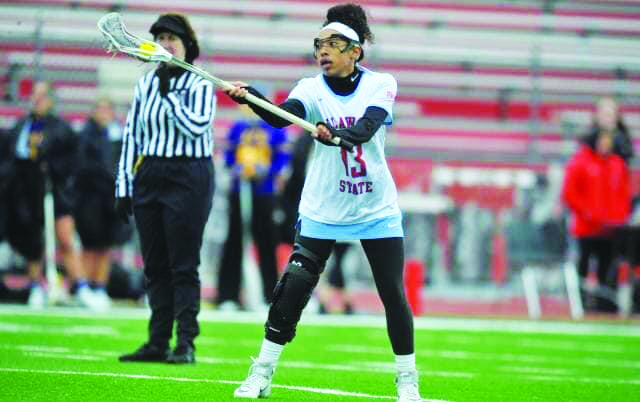
Imani Hill, playing Lacrosse for Delaware State University | Credit: Imani Hill

By Yasmin Mustefa

Federal Way, Wash.

Imani Hill never thought that she would play lacrosse. But her freshman year of high school, Hill’s basketball coach told her that she needed to participate in a spring sport to stay in shape for next season. An hour later, she pulled her out of class to speak with the lacrosse coach. 

“I’m just like, ‘I have no idea what lacrosse is,’” Hill said. But the coach con-vinced Hill to try. “I went out, and it was so interesting to me because of how unfamiliar it was. It was a really challenging task.”

By her junior year, several colleges were observing Hill. She decided to join Delaware State University’s Division I program in the fall of 2015, which she said was the only historically Black college or university (HBCU) at the time with a women’s lacrosse team. In 2019, while attending grad school at Auburn University in Alabama, where she is a current PhD candidate, she switched from player to head coach. 

Although she is no longer a coach for collegiate lacrosse, that breadth of ex-perience gave Hill a distinct perspective on the name, image, and likeness (NIL) laws that multiple states recently passed. The new laws allow college  athletes to use their name, image, or likeness for compensa-tion and prevents colleges and universities from pro-hibiting athletes to do so. 

While Hill acknowledged the “cool opportunities” the NCAA gives athletes, she’s glad players now have money-making opportunities she didn’t. “I think that it’s something that’s necessary  and something that really should have happened a long time ago,” she said.

“As a whole, sometimes we forget that the NCAA is a governing body, and ultimately they are a business. I think that some-times we kind of get that confused with an organization that supports athletes or wants what’s best for athletes.”

As a player, Hill practiced up to 20 hours a week, with additional hours of physical therapy, conditioning, and traveling. Players were given about a $500 stipend every season, she said, but that wasn’t enough to cover off-campus expenses.

Hill’s family lived close to Delaware State, and she remembers them filling up her dorm room with snacks and going home on weekends. “There are a lot of athletes who don’t have those luxuries. So literally their entire dependability is, like, on the university and what the university gives them,” she said. By contrast, the new laws could allow student-athletes to save money, help their families, or buy food, clothes, or school supplies.

At the same time, Hill also believes that the laws will continue to blur the line between college and professional athletes. She’s not sure how she feels about that. “How do we define those lines that let the world know that this person is still a college student before anything else?”

Infographics: Do they have Info?

By: Ebony Riley and Skye-Ali Johnson

Voorhees, NJ and Washington, D.C.

Picture this: It’s a mid-summer day and you unlock your phone to open up Instagram because you’re wondering what’s going on. You come across a post with brightly colored, eye-catch-ing fonts that describe the most current tragic event. This, you realize, is the new trend. 

With the rise of info-graphics, students are left questioning how effective they are in making a  difference. In a recent interview with students from the Princeton Summer Journalism Program (PSJP), students vocalized their opinions on infographics and online activism. 

“You want to follow that up with an action,” says Emi Glass, a 17-year-old high school student from Day-ton, Ohio. Glass believes that, in some cases, online activism can be beneficial and inclusive. But there are steps beyond reposting information on your story that are required to effectu-ate meaningful change.

“OK, I posted this, but what does this actually do for this situation?” asks Huda Tombul, a 16-year-old high school student from New York. She adds that many people post infographics for the sake of posting them, and do not actually care about the information they spread. “Is this actually accurate information? Or did someone simply just write this and everyone went along with it?” Tombul asks. 

“I mean, who isn’t on their phone?” 21-year-old college student Abby Dot-terer admits. Social media is an undeniable facet of daily life. The more people use it to express their concerns or thoughts, the more they begin to question whether or not it is a reliable place to source information.

When asked whether or not we should trust Insta-gram infographics, many interviewees advised caution—there should be individual research done before sharing  information. 

“You need to fact-check them. I don’t think you should trust some random person who posted it,” Glass says. 

“Everyone has their voice. And anyone could say any-thing that could influence other people,” 17-year-old Nhi (Nikki) Huynh from Western Massachusetts says. 

It is evident that social media platforms have be-come a popular place for young individuals to speak their truths, and a place  to spread awareness about topics that interest them on the internet. Sometimes, though, the messages be-hind online activism be-come lost in translation. “Social media activism is al-most like talking to a brick wall,” Dotterer says. 

Do infographics really lack information? “I have seen some that I think are more focused on the visual aesthetic than the quality of the information,” Glass says.

Online activism has taken a turn, and it’s hard to tell whether it is for the better or worse. Are we stuck? Or are we progressing?

No matter how hard we try, it is hard to predict the direction of infograph-ics and digital activism. As Dotterer puts it, “two steps forward, one step backward.” 

Will we overcome this online activism standstill?

By Amber Clay

College Park, Ga.

For years, college ath-letes devoted themselves to their sport—sometimes making millions for their school— with no pay. That is, until the NCAA changed the rules allowing athletes to profit from their name, image, and likeness. 

The NCAA is a billion-dollar business with 460,000 athletes. According to the National Col-lege Players Association, 86 percent of scholarship athletes live below the federal poverty line. That means most athletes don’t have the privilege to only devote time to their sports. These athletes are students, older siblings, mothers, fathers, and providers for their family. 

A former lacrosse player at Delaware State Universi-ty, Imani Hill believes that she and teammates should have been paid because of the amount of time they devoted to their sport. Hill spent 20 hours a week practicing, and when she was not practicing, she was conditioning, or in manda-tory study hall or physical therapy. Hill compared her college sport to a full-time job with no pay. 

While Hill is no longer in college and can’t benefit from the rule change, she said she fears that male athletes will gain more profit from their name, image, and likeness than female athletes. College sports have a history of catering to men’s sports programs not only when it comes to fa-voring them on live television, but also advertising them more heavily. In turn, men’s sports programs bring in more money than women’s sports. This could cause women’s players to lose out on endorsements.

Samari McKinney is a senior at Douglas County High School in Doug-lasville, Georgia. She plays flag football, basketball, and track. She believes that the change of rules will only benefit male athletes. “Honestly, in order to be a female athlete with endorsements you have to look fine,” McKinney said. “I hate that it’s like that, but it’s the truth. At the end of the day, male foot-ball and basketball players are going to benefit, while nothing changes for me.” 

McKinney does, however, think the rule change will help with better representation for underrepresented communities. “I am a member of the LGBTQ community, but many athletes never spoke up for my community,” she said. “I hope with the ability to have endorsements, young athletes will have the opportunity to see themselves represented in sports.”

The NCAA rules have not only affected current collegiate athletes, but youth ath-letes as well. More middle and high school students will be able to have the opportunity to play the sport they love and make an earning from it. While straight male athletes will benefit more, we hope to see a change in the future.

‘Tomorrow War’ is Decent War

By: Eunice Chae

Victorville, Calif.

The Tomorrow War an Amazon Original released in July, enjoyed mixed reviews from both audiences and critics alike. The film boasts Chris Pratt in its starring role as Dan Forester, a former U.S. Army soldier who now works as a high school biology teacher. After fail-ing to get a prestigious job at a science facility, Forester has a semi-midlife crisis and waxes poetic about his life aspirations to his nine-year-old daughter.

During the World Cup, a giant wormhole opens up above the soccer field. A group of soldiers comes through, announcing that they’re from the future. They explain that by the year 2051, aliens have attacked the planet and the human race is virtually extinct. The government sends soldiers into the future to fight, and Dan is drafted.

In the future, the aliens — dubbed the Whitespikes thanks to their sharp teeth, claws and spikes — have overrun the city. Meanwhile, the humans have regular guns and regular bullets which barely do anything to the aliens. You would think that if future engineers had the technology to build a time-traveling device from “chewing gum and chicken wire,” they could have created weapons that were a teensy bit more effective.

When Dan tries to rescue a fallen team-mate, the group is trapped and everyone is killed except for Dan, Charlie (Sam Richardson), and a man named Dorian (Edwin Hodge). Later, Dan meets an older version of his daughter, Muri (Yvonne Strahovski), who develops a toxin for the Whitespikes. Just as the toxin is perfected, the aliens attack the military base. 

Muri is injured, and even though the fate of the world depends on getting the toxin to safety, Dan refuses to leave her. When Muri falls toward a frenzy of Whitespikes, Dan again makes a selfish decision and leaps after her. However, he’s transported into the present in the nick of time.

The movie takes a slightly bizarre turn when Dan, Charlie, Dorian, and Dan’s estranged father, James (J.K. Simmons), find a crashed spaceship. Instead of alerting others at once when they find it, the group traipses in alone. To be clear, humanity depends on killing these aliens, and only they know their location. If they die in the spaceship, the knowledge to save the world dies too.

Whitespikes on board eventually attack, and Dorian sacrifices himself, blowing up the ship while Dan, Charlie, James, and a female Whitespike escape. There’s a pleas-antly subversive scene near the end, when James attempts a self-sacrifice. In a small twist, Dan rescues him before he actually can, and kills the last Whitespike himself.

All in all, if you’re looking for a decently fun action flick with above-average performances of a remarkably selfish protagonist and unfortunately two-dimensional characters, The Tomorrow War fits the bill. Just don’t start squinting too hard at the plot, though, because that’s when it starts to crack under the pressure.

‘Luca’ is Accidental Hit for Disney

By: Mariah Colon

Buffalo, NY

Disney’s Pixar is a controversial topic among film critics due to what many describe as the studio’s fall from grace.  Since the end of the company’s golden g age in 2010, its films have gotten less  traction and for good reason. Recently  the studio has been producing average  children’s films, not the masterpieces  they came to be known for. “Luca,”  their most recent project, is yet another example of this mediocrity. 

“Luca” undoubtedly has made an  impression, but it’s not due to the film being good. Many viewers got at- tached to the relationship between protagonist Luca and his newfound best friend Alberto and the subtle im- plications that the feelings between the two boys were more than platonic. 

Had fans of the film not jumped and made their own narratives about  Luca and Alberto, though, it’s incred- ibly likely that the movie would have  been thrown in the pile of modern,  mediocre Pixar films. The characters are forgettable and hardly fleshed out.  

Luca doesn’t have enough traits to be  considered three-dimensional. He’s a sea  monster in a world of humans—an outcast. We’ve seen this trope countless times, and the film does nothing special with it. Alberto has the basis for an interesting character, but there isn’t enough time given to properly flesh out what makes  him compelling. He’s a young sea creature who was abandoned by his father. The movie seemingly attempts to do the found family trope with him, but it’s so glossed over that it can hardly be considered an important part of the story. Then there’s Giulia, the third protagonist in the film who befriends Luca and Alberto. To be honest, before starting this article, I had to look up her name: that’s how forgettable she is. She’s really only used to develop Luca’s character and fuel some conflict.

Characters aside, the plot itself is boring and rushed. How it manages to be both is beyond me.

So how did “Luca” become so popular? Well, simply put, it was by accident. The idea of Luca and Alberto being outsiders while also being extremely close to each other touched the hearts of many LGBTQ+ viewers. Feeling out of place is common for queer youth, and that’s exactly how the boys felt in human society. On top of that, the way Alberto and Luca interact comes off as more than just a platonic relationship. For example, at one part of the film, Alberto gets so upset with Luca for spending time with Guilia that they get in a fight and Alberto ends up outing himself as a sea monster. Tell me that’s not dripping with metaphor and implications!

When asked about “Luca” possibly being a queer story, though, director Enrico Casarosa said, “I was really keen to talk about a friendship before girlfriends and boyfriends come in to complicate things.”

Essentially, “Luca” wasn’t intended to be an LGBTQ+ film, yet the movie’s queer subtext is the reason it got so popular, despite the movie itself being mediocre.

‘Quiet Place’ Surpassed Expectations

By: Jennifer Alvarado

Phoenix, Ariz.

A movie with nearly no dialogue. You’d be surprised at how your blood runs cold at the sight of it. With a well-known career as an actor, but not as a director, it was easy to be skeptical about John Krasinki’s abilities behind the camera. Nevertheless, he surpassed everyone’s expectations with the horror/thriller movie “A Quiet Place,”  and did it once again with the sequel. 

 In a film bound by the limitations  that come with not being able to make  a sound, it can become easy to rely 

 too heavily on other elements of film- making, but Krasinski uses the perfect  balance of sound, mise-en-scène and  narrative. This, of course, is supplemented by the incredible acting of Emily Blunt, Krasinski, Cillian Murphy,  Noah Jupe and Millicent Simmonds.

The movie, which takes place in a small town, starts with Krasinksi’s character, Lee Abbott, and his deaf  daughter, Regan (Simmonds), walking  to their truck after seeing an unknown  object making its way to Earth. Only  moments after that, we catch our first  glimpse of the terrors in this movie. 

 After some action-packed sequences  featuring the Abbott family struggling  to escape creatures with significantly enhanced hearing abilities and a great number of sharp teeth, we move for-ward in time to day 474, after the tragic events of the first movie transpired. 

Evelyn Abbott (Blunt), along with her three children, Regan, Marcus, and baby Abbott, were forced to continue moving in search of asylum somewhere safe, all while mourning the loss of Lee, who sacri-ficed himself at the end of the first movie.

With the knowledge that Regan’s cochlear implant could produce high-frequency audio that temporarily incapacitates the creatures, the family walks a path surrounded by greenery in every direction. Slow, steady camera movements add to the tension and the constant thought that any sudden noise could alert the creatures to their presence. 

Finally, Regan and a family friend arrive at an island safe from the creatures. Mean-while, Evelyn, Marcus and baby Abbott are at an abandoned steel mAill, trying to fend off the creatures that have made their way into their temporary hiding spot. 

With scenes that display the parallels in the situations the children are in, we see that this entire time, Krasinski was setting the film up to make the kids the heroes, the ones that ultimately use their courage and creative thinking to aid the adults in finding a haven. Whereas in the first movie Krasinski primarily directed his focus to the concept of parents risking and sacrificing everything for their children, he flipped that around and allowed for Simmonds and Jupe to be given the spotlight.