In “Bad Shabbos,” Daniel Robbins Paints Gritty Family without the Tropes

By Ashanty R.

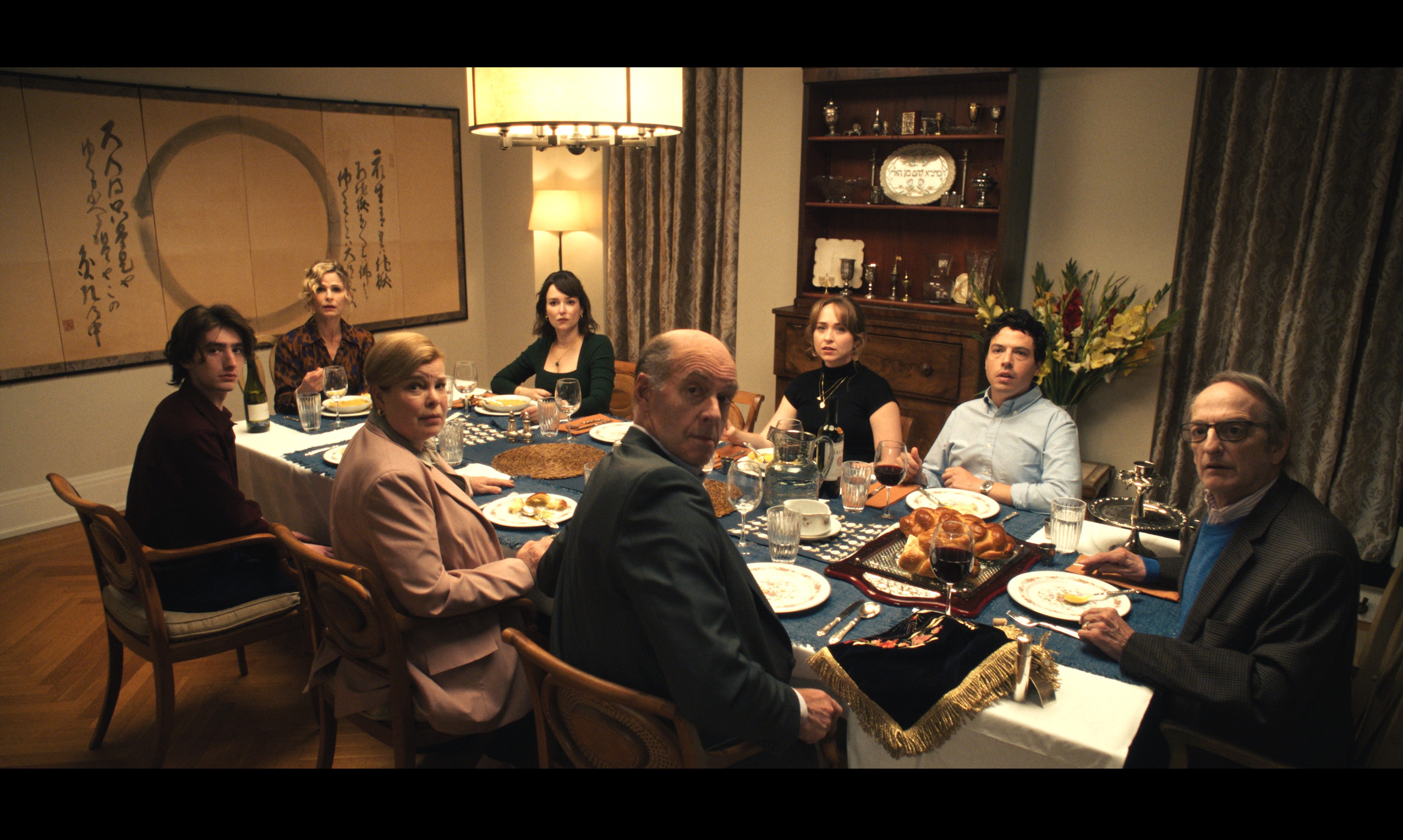
In apartment 10B on the Upper West Side, wingback chairs and towering bookshelves decorate the living room. Untouched plates set the stage for an orderly Friday Sabbath banquet. The audience is immediately pulled into the world of an upper-middle-class family putting on their brightest smiles.

Caught up by the highbrow decorum, it wouldn’t cross a viewer’s mind to check the bathroom for a body. 

Director Daniel Robbins delivers a dark comedy that upends the “dysfunctional family” trope by leaning all the way in. Bad Shabbos follows an interfaith couple, Meg and David, attending a Shabbat dinner with David’s family; hyper-observant matriarch Ellen; mild-mannered patriarch Richard; wisecracking sister Abby, her philandering boyfriend, Benjamin, who has unfortunate digestive problems; and Adam, the socially awkward younger brother known for impulsive pranks. 

Then Adam kills Benjamin.

To be fair, it was an accident. A subtle wrist flicking crushed laxative pills into a cocktail sends Benjamin rushing down the hall with a gurgling gut. Futile attempts to pull down his pants cause him to crack his head on the bathroom sink, and from there, he’s a goner.

While there was some finger-pointing in the beginning – because who wouldn’t blame a murderer for murder? –  they make a choice: protect their own.

Was it morally wrong? Absolutely. 

But Bad Shabbos couldn’t care less about moralizing, and they never said they did. It’s alluring because of the messy, contradicting truths about family that lie under each dynamic, each decision, and each quip.

The biggest one?

They fight like feral dogs, nipping at each other’s wounds and beaming when the other bites back. But they would pull their teeth before turning one of their own in. 

“We’re not good people,” Abby mutters as she begrudgingly drags Benjamin’s body toward the fire escape, “but we’re our people.”

Robbins refreshingly rejects the posterboard Hollywood route to family. Trading in the estrangements and disownments, he brings a murkier take to the table. These characters do more than skip hand-in-hand into the horizon. They snap, snark, and plot just like we do – but when a crisis hits, they become one..

It’s especially clear in a scene when Adam, once the black sheep of the family, is herded by his siblings through the decently-competent clean up posed by their lobbyist, Jordan, who his siblings managed to pull into the coverup. Adam’s parents are fully complicit, too. Ellen’s well-timed “kitchen mishap” delays all talks of dinner and deflects suspicion from the incriminating hallway, while Richard hosts “Shabbat hymns” at the table with closed eyes – buying David enough time to turn his bloody cuff inside-out.

Admittedly, Bad Shabbos plays some scenes for laughs. But emotional residue sticks to the audience even as they leave the screening. 

The film holds up a mirror, calling to mind every subtle elbowing and quick-whipped insult that burns tongues at home. But it also brings to mind also every caring hand wiping away tears and every smothering bear hug. It’s every eye roll and painstakingly grunted, “I love you,” followed-up with a quick jab — because we can never get too comfortable with family, right?

While your misfit family may not lug around a body, scrub bathroom tiles, or trash damning lobby footage, Bad Shabbos makes it clear that even a disjointed herd still moves as one.

Rickea Jackson Devastates New York City

By Dominic T.

The July sun wasn’t the only thing heating up in Brooklyn on Saturday night. As Kelsey Plum of the Los Angeles Sparks stood looking frustrated at center court, the Liberty’s Natasha Cloud couldn’t do anything but grin while the crowd roared.

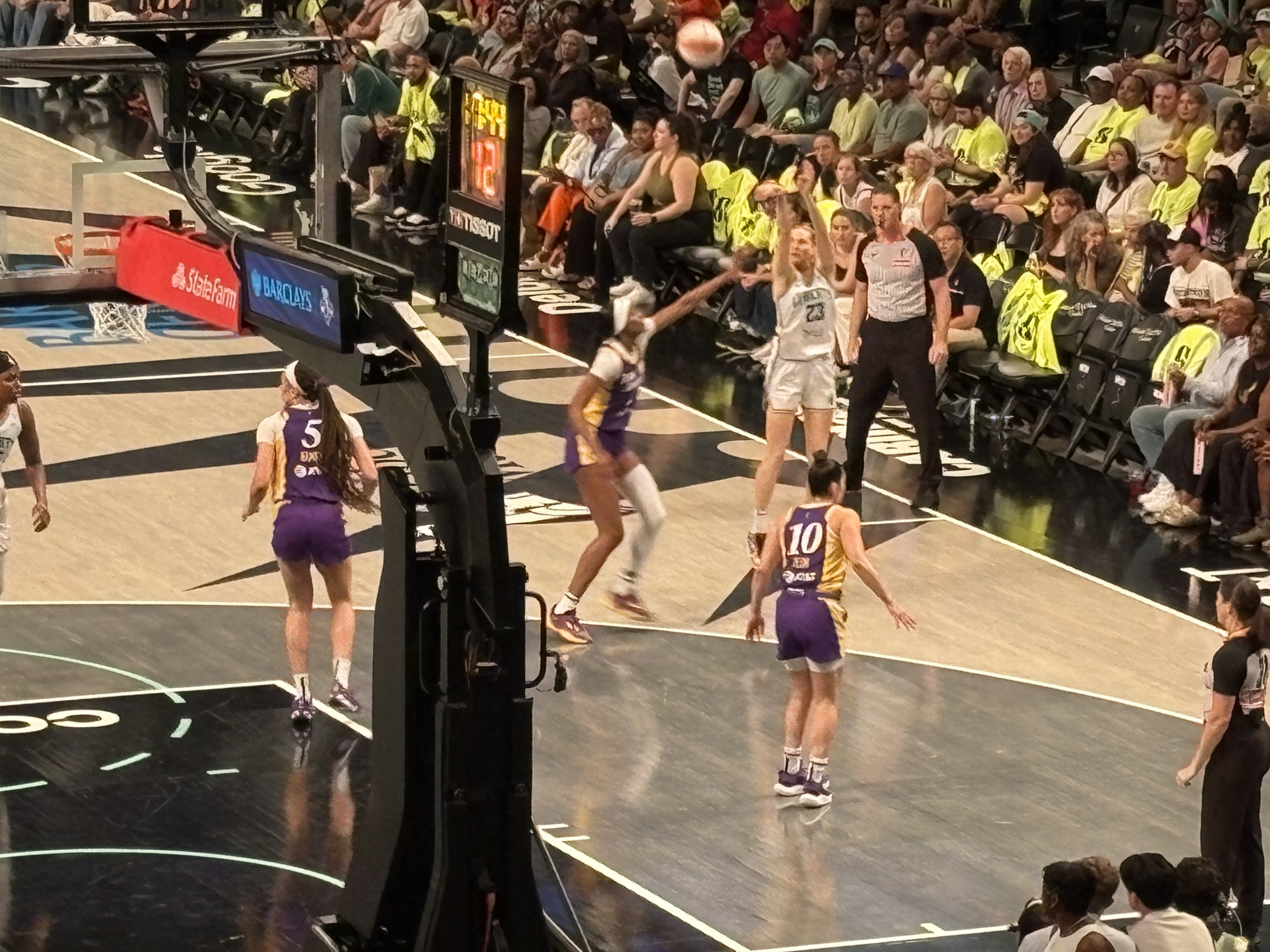
Fittingly, a hyper-intense contest ended in a frantic layup by Sparks forward Rickea Jackson to beat the buzzer and put an end to New York’s 15-point comeback with a 101-99 victory. Silence fell over the arena so quickly you’d think someone had died on the court, while Los Angeles celebrated over the gravestone. Jackson finished the game with 24 points on 9-15 shooting, 4-6 from three. 

The recent explosion in popularity of the WNBA directly contributed to the passion both on the court and in the stands that night. When players faced off emotionally and physically, the crowd erupted. When the players are invested, the fans are invested at the games, on TV and online. In turn, the league can invest more into its players. The 2025 season has been defined by its fierceness, and it’s projected to earn $1 billion in revenue. 

Performances like that of the Liberty’s Sabrina Ionescu get even more attention as a result of the growing audience size. In her 16th career 30-point game, setting a franchise record, the 5’11” guard contributed eight rebounds, six assists, and four steals. Her final basket came with 23 seconds on the clock, tying the game 99-99 and sending the crowd into a frenzy. 

Perhaps the only person with more hustle than Cloud, meanwhile, was the man mopping the court in between offensive sets. The guard’s 22-point, nine-assist outing was sprinkled with multiple enthusiastic confrontations with Plum. Her death stare into the stands lit a fire in the crowd after a quick-step and-1 in the fourth quarter.

Despite Cloud’s hustle, Plum managed to orchestrate the Sparks offense, scoring 20 points and dishing out eight assists. The Liberty simply didn’t have an answer in the paint after Breanna Stewart went down with a hamstring injury three minutes into the game. 

With the loss just past the halfway point in the season, the Liberty ended their home stand 6-2, clinging to the first seed in the east. The Sparks expanded their red-hot win streak to five in an attempt to save their season. No matter who comes out on top this season, every team in the WNBA has won the hearts of basketball fans across the country.

The Debate of Meritocracy

By Ipichiesimhe I. and Michelle F.

In America, does success derive from hard work, or merely connections and loyalty? Are leadership positions handed out like Costco freebies to the elites or can years of education and passion earn you prestigious responsibility? 

Citizens on the streets of Princeton, New Jersey were asked their views regarding the debate over whether the United States is a meritocracy.

It is clear that the public’s view is divided; some think that the country does a good job awarding people the outcomes they deserve, while others believe it is unfair how hard work is rewarded.

“If I’m honest, maybe I’m a little cynical,” says New Jerseyan Vanyah Harrigan when asked how she feels about the way merit is valued in leadership roles of the U.S. 

“I immediately think of the president’s office, right?” Harrigan says, noting what candidates should be expected to do to succeed but aren’t doing now. “You have to go to really difficult places to earn it. If you want to run for the highest office, that should be an expectation.”

Samuel Makino, a former Marine, shared his views on the changes he observed since he left the military. “For me, having guys who I served with that had the qualification to save lives, and for the leadership position [we relied on] the people in government—now, it’s a complete joke,” Makino says. “You need to have competent people in leadership, which unfortunately right now, we don’t have.”

But another man, who chose to be referred to as Mero, disagreed, saying he believes meritocracy does exist in politics. “There were elections and apparently merit is coming back,” he said.

Mandy Duffy, a tourist from the United Kingdom visiting Princeton with her children, said that the U.S. is not truly where it wants to be. “My understanding is that the U.S. is already a meritocracy society, well, at least in theory. In practice, it could be something different.

Princeton Mayor Addresses Affordable Housing

By Emmy M.

On July 30, Mayor Mark Freda addressed progress on affordable housing in Princeton, New Jersey, in a press conference with the Princeton Summer Journal.

“So what are we becoming? We’re becoming a town that has million-dollar-plus properties and… a pretty robust affordable housing program,” said Freda, emphasizing the importance of accessible housing for all income levels.

Building affordable housing in New Jersey has historically been difficult due to zoning regulations, but zoning in Princeton has changed significantly. Freda said that the town has put in place affordable housing overlay zones, a type of re-zoning that allows for more high-density housing. 

The municipality adopted its Fourth Round Housing Plan Element and Fair Share Plan in June. According to Freda, Princeton built around 750 affordable units in Round Three. Round Four proposes 276 units to be built in the next ten years. These units will be spread over 13 locations, including three 100 percent affordable sites.

“I think the main issues are what are we doing to help people, whether it’s the immigrant community or people that are just not as well off as others,” said Freda.

The way most of the sites are built is through developers who promise a certain number of affordable units if they’re allowed to build market-rate ones as well. The market-rate apartments offset the lack of profit on the affordable units, Freda said.

While he said the system isn’t ideal for the upkeep of resources like sewage, land capacity, and infrastructure, he did place an emphasis on creating incentives for developers to construct affordable housing. Recent federal budget cuts haven’t stopped the proposals, either. 

Freda explained that the town doesn’t rely on federal funding for affordable housing projects, since it mostly works with private developers or provides the funds itself.

Still, Freda emphasized that the process of building affordable housing in Princeton is far from over. “The average price of a residential home in Princeton last year was $1.4 million,” he said. “Unbelievable.” 

The WNBA Has New Players. We Call Them Officials

By Selah D.

When fans criticize WNBA officiating, it’s rarely about one bad call — rather, it’s the inconsistency that sparks anger. One night, physicality is ignored; the next, the same play draws a foul. This makes it extremely difficult for players to gauge how far they can push the boundaries. 

As a result of the lack of consistency, every foul can sway the game one way or another. Players, coaches, and fans are increasingly upset that officials are changing the outcome of games instead of the players. 

This season, several conflicts between teams have broken out mid-game due to inactive officiating. Take the Indiana Fever-Connecticut Sun game just before the All-Star break, in which a highly anticipated matchup was derailed by constant physical altercations. Instead of just playing basketball, multiple players were fined or ejected for what was fundamentally a lack of consistent, effective calls made by the officials.

In the press conference following the game, Fever head coach Stephanie White commented on the officiating: “When the officials don’t get control of the ballgame, when they allow that stuff to happen — and it’s been happening all season long — this is what happens. You’ve got competitive women who are the best in the world at what they do and when you allow them to play physical, they’re gonna compete. [The officials have] gotta get control of it, they gotta be better.” 

Not only do the officiating problems create opportunities for conflicts during games, but also may be one cause of injuries that have plagued the WNBA this season. Dangerous plays have become increasingly common. Excessive fouls and over-the-top physicality lead to situations where players are highly subject to injury. This year, Caitlin Clark, Kayla Thornton, Breanna Stewart, and many other prominent players have all missed time while hurt. With concerns related to the health of star players, officials may finally be held accountable. 

Whether it’s Paige Bueckers asking the refs if they need her glasses, Diana Taurasi saying she’ll see them in the lobby, or Sabrina Ionescu daring them to tech her, players are fed up with how the refs are impacting the game. Inconsistent officiating has been a league-wide problem for far too long, and now. With viewership at an all-time high, the issue needs to be addressed now more than ever. Fixing WNBA refereeing will create a better game experience not only for those playing and coaching, but for the fans watching too.

Buzzer Beater Downs NY Liberty 

By Arianna S.

Stepping into the Barclay’s Center 90 minutes before a game feels ritualistic. The lines are short, the corridors are all but empty, and the promise of what’s to come hums in the air as the first few fans prepare for tipoff.

Slowly, the seafoam green tide rises, flooding every level. New York Liberty jerseys, signs, face paint — suddenly, Barclays is alive. Chants begin in pockets, swelling into unified roars. When player introductions roll across the Jumbotron, each name — Jones, Ionescu, Cloud, Stewart, Fiebich — is met with uproar. The crowd isn’t just watching; it’s performing.

Then the game begins.

When the New York Liberty took on the L.A. Sparks at home on July 26, they came in on a five-game win streak, ready to take on a team they had defeated a few weeks earlier.

Jonquel Jones got the first points on the board for the Liberty early, making the New York faithful believe it’d be a game of triumphant moments. Instead, it was the beginning of a rather dull first quarter, involving bad passes, missed shots, and aggravating calls. The energy on the court was not matching the energy in the stands, especially after Breanna Stewart left the game with a leg injury three minutes before the end of the period.

Even as the Liberty pulled closer in the second half, it felt as though the tone on the court had been set against them, and it never quite lifted. In the end, a last-second desperation shot gave the Sparks the 101-99 victory, and a five-game win streak. 

Though New York came in with momentum, superior talent, and home-court advantage, none of it seemed to matter once the clock started. The chemistry that usually characterizes the reigning champions felt off, and while individual moments sparked the momentum fans expected, the Liberty never fully connected. That one slow quarter turned into a game in which a top-tier never seemed to be able to keep up their typical pace.

Thankfully for the Liberty, the Brooklyn crowd kept it hyped throughout, cheering as if they’d never see these players again. Sometimes, it’s the fans who make nights like these unforgettable.

Mayor Mark Freda Provides Updates on Recent ICE Raids

By Gabrielle B.

In a press conference with student journalists, Princeton Mayor Mark Freda provided updates regarding a United States Immigration and Customs Enforcement (ICE) raid that sparked fear in the community. Freda discussed the continued impact of the raid on the town and its immigrant communities.

Early morning July 24, 15 people were detained while heading to work. According to Freda, ICE was only looking for one person, but when the person entered the van, agents detained the others.

“We are very sure, like 90-some-percent sure, that at least one of those people had working papers and is here legally, and there was no reason for that person to be taken,” Freda said. “I mean, these are all people who are going to their jobs. They’re going to work. None of them are criminals.”

“Princeton has always been a very welcoming place,” he said, noting that his Italian family immigrated to Princeton in the 1900s. But now, the town’s immigrant community is questioning its safety. 

After the raid, Freda called the regional ICE director, demanding further information. He said he was “surprised” by the raid because ICE had not visited Princeton since last summer, marking the first raid since the Trump administration took office. 

While Freda is working to resolve the issue, the town is considering its stance on the New Jersey Immigration Trust Act, which protects immigrants by limiting cooperation between federal and local authorities. 

During a recent town council meeting, Freda said, officials faced a significant backlash when 70 people came to advocate for a resolution supporting the act, but the debate turned unproductive.

Many of those supporting the act were not from Princeton. However, Freda explained, “other people in our immigrant community here in town have suggested to us that passing such a resolution would be counterproductive,” because it could possibly make Princeton more of a target for ICE raids.

He believes that the legislation is a state rather than a local matter. “We cannot protect people from ICE. We just can’t. It doesn’t matter what resolution we pass,” he said.

Freda said his administration does offer support through the town’s Human Services Department that provides an emergency expense fund and connects immigrants with legal services, but there is only so much assistance the town can provide.

“It doesn’t matter. We can’t until the federal things change at the federal level. All we can do is offer help,” Freda said.

In Princeton, Soaring Prices Push Residents Out

By Claire B.

One million dollars, $3.4 million, $5.75 million. When turning onto streets in Princeton’s neighborhoods, admiring the houses and the cozy community, it’s hard to imagine that this is what it can cost to live there. According to United States Census data, 53.7 percent of houses in Princeton cost over $1 million.

“The average price of a residential home in Princeton last year was $1.4 million, unbelievable,” Princeton Mayor Mark Freda said in a press conference with the Princeton Summer Journal.  

The median household income in Princeton is $184,113, nearly double the median household income of New Jersey. But 6.8 percent of Princeton’s population lives in poverty, making the need for affordable housing a priority for Freda.

“The list of people for affordable housing units is thousands and thousands of people,” he said.

Once they’ve entered an affordable housing unit, residents continue to work in the hopes that they can save enough money to afford the next level of housing, like renting an apartment or a small townhouse. 

“But that level of housing is almost gone from Princeton, so if people have no place to go, they’re trapped in the affordable housing unit that they’re in,” Freda said. 

People looking to move out of affordable housing tend to move out of Princeton. The historically Black Witherspoon-Jackson neighborhood has lost a significant portion of its community as people leave in search of more affordable housing and a lower cost of living. 

Not only is Princeton struggling to provide more affordable housing, but it’s starting to lose its socioeconomic diversity as the lower middle class moves out of town. 

“We are trying to find a way to address that, but it’s really hard,” said Freda of the challenge of funding affordable housing. “The market works against us, there’s definitely no federal money, not for a few years at least, and there’s not a lot of state money right now either,” Freda said.

It’s not only people below the poverty line who can’t afford houses in Princeton. Even the town’s mayor would have trouble finding a house.

“If I were to buy a house here now, I couldn’t afford to buy a house,” Freda said. “So I’m the mayor, … [and] if I were to buy a house today, I’m guess[ing] I have to rent a place or go somewhere else.”

Heightened Security Doesn’t Increase Students’ Feelings of Safety, PSJ Survey Finds

Sandy Hook. Marjory Stoneman Douglas. Umpqua. Marysville. Red Lake. Northern Illinois. Oikos. Santa Monica. Santa Fe. West Nickel. Columbine. Over the past two decades, school shootings have become an all-too-common tragedy. In 2022, such shootings have happened at a rate of nearly one per week, leaving 83 people killed or
wounded as a result. In May, a mass shooting at Robb Elementary in Uvalde, Texas raised questions yet again about what school districts and lawmakers
should do in response.

This summer, the Princeton Summer Journal sent detailed questions to thirty-two school districts seeking to understand what changes these districts have in place to prevent school shootings and protect students’ physical and mental well-being. The survey used by PSJ also asked district administrators to share what new procedures or policies they were considering, specifically in the aftermath of the Uvalde shooting that left 19 fourth graders and two teachers dead.

PSJ reporters surveyed the principals of individual schools, school-security directors, and superintendents of entire school districts. These institutions spanned the country, from major cities including Philadelphia, Chicago, and New York, to rural Oregon, the central valley of California, and across the Southwest and South regions. Officials from 17 schools or districts responded to some or all of PSJ’s questions. Nearly every institution contacted by PSJ mentioned using enhanced security measures, including hiring more security officers, using metal detectors and cameras, and more training for students and teachers to identify potential shooters or respond to active threats. Only
a handful of institutions mentioned mental-health programs to respond to the school shooting crisis.

PSJ also surveyed twenty-eight students about their views on school safety and violence prevention. Most of the students said they felt safe in their schools. More than half of them voiced that their school and district had not clearly explained what to do in case of an active shooter on school grounds. Mostly, though, the students interviewed by PSJ said they recognized the larger issue of school shootings and lived with a fear that their school could be the site of a tragedy, the next Uvalde, Sandy Hook, or Marjory Stoneman Douglas.

“At some point in my life, I used to consider school my safe space that protects me from all the dangers in the world,” said Maria Cuevas, 18, a high school student in New York City. “However, due to recent events in the world, as much as I would love to say that I do feel safe at school, I would be lying to myself.” If there was an overarching theme in the responses from school leaders and administrators about steps taken to prevent
future shootings, it was an emphasis on security measures such as security cameras, metal detectors, staffed entry and exit locations, and heightened screening of visitors. In most districts, these measures included hiring school-security officers; in a few cases, school officials said they had partnerships with local law enforcement agencies.

Dr. Randy Shearouse, superintendent of the Limestone County School District in Athens, Alabama, said his district “partners” with the county sheriff’s department to “provide resource officers at each of our schools.” Dr. Tyrone Weeks, superintendent of
Dearborn Heights Public Schools in southeast Michigan, said his district “has a contractual partnership with the Dearborn Heights Police Department in which a police liaison officer is assigned to support the district’s six schools, Board of Education Office, and support staff buildings.” Peter Varela, principal of South Brunswick High School in central New Jersey, said his school has “security and police present at SBHS every day” who are “retired law enforcement officers.”

Bernard Watson, director of community relations for the school system in Gwinnett County, a suburb of Atlanta, said the county’s schools have their own police force, employing ninety-eight officers with plans to hire more. “Our officers’ mission isn’t just
to protect students and staff,” Watson said. “They are dedicated to developing real relationships with students, creating an environment of mutual trust which helps prevent problems before they happen.” School officials and administrators also said they had sought out local and national law enforcement agencies as they updated their safety policies.

Most institutions surveyed by PSJ declined to share their active-shooter protocols for security reasons. When asked how often they reviewed and updated their school-safety policies, many respondents said they did so every year, as required by law in certain states. Scott Walsh, principal of Multicultural High School in Philadelphia, said Pennsylvania law requires school systems to submit new safety plans to the state every year by July 1. PSJ specifically asked school leaders and administrators to explain what changes they were considering or had already made since the Uvalde mass shooting in late May. According to law enforcement, the alleged shooter in Uvalde gained access to Robb Elementary through several faulty or insecure doors at the school. Not surprisingly, several institutions said their newest safety policies focused on securing the entrances and exits at their schools. Scott Walsh, the Philadelphia principal, said his high school had “replaced all classroom doors this summer and ensured that every door can lock from the inside.” He added that each room in the school had the room number posted inside and outside if a staff member needed to call 911 and alert emergency responders to their exact location.


Just four of the institutions that completed PSJ’s survey listed mental-health support services or interventions as part of their school safety plans. Weeks, head of Dearborn Heights Public Schools, said his district has partnerships with a nearby hospital system to “provide additional mental health professionals to our schools to serve as yet another layer of prevention.” Weeks added that Dearborn was developing a new “threat assessment protocol” to train school employees “to identify potential behaviors of concern to ensure that potential concerning behaviors are addressed and curtailed before they can be actualized on school grounds.”

The students interviewed by PSJ expressed a diverse set of views about the efficacy of their school’s safety policies, how safe they feel in school, and what it feels like to be a student in a time when shootings on school campuses occur with such frequency. Most students said they were familiar with their school’s active-shooter protocol and had gone through rapid-response drills on school grounds. Multiple students pointed to increased security measures as a reason they felt safer in their school. “I guess [I feel safe at school] because of the metal detectors, but if we didn’t have them, the adults in our school would not do well protecting us,” said Samarah, 16, a student in New York City.

A small percentage of students who answered the survey expressed concerns about their own safety and their school’s apparent lack of planning for a possible shooting. Olivia, a 17-year-old student in Brooklyn, said she felt her school made it too easy for strangers to enter the building and that the school’s active-shooter protocol was woefully insufficient. “My school’s soft and hard lockdown protocol is based on hiding and hoping that we won’t be found,” she said. “I believe that we need to change these protocols for present-day situations.”
Even if they didn’t feel unsafe in their own schools, many students said they supported new laws or restrictions on gun ownership to prevent future shootings. Several students, for instance, called for raising
the legal age to buy a rifle from 18 to 21 in all states, or restricting the number of weapons an individual can purchase in a specific period of time.


Yet no matter how many metal detectors or security officers their school had, no matter how many active-shooter drills they had experienced, some students said they could not escape the sense that their school could still be targeted and that going to school each day came with a degree of risk. “I don’t think I’ll feel safe,” said Bang, 17, a student in Pennsauken, New Jersey, “no matter how much protocol the school has prepared, when I’m aware of the lack of gun control and the many past shootings that have happened.

Survey Finds Few Schools Adapt To BLM

This story was reported by the staff of The Princeton Summer Journal. The project was led by Ryleigh Mae Emmert, Synai Ferrell, Roxana Martínez, Mmachukwu Osisioma, and Lewis Stahl.

Thomas Stone High School is located about twenty-five miles south-east of Washington, D.C., in Charles County, Md. Roughly 1,100 students are enrolled there, most of them African-American. After nationwide Black Lives Matter protests erupted in the spring of 2020, following a spate of high-profile police killings of African-Americans, students and faculty at Thomas Stone wondered how the school would address themes of racial injustice. “I have had three teachers talk about race in my whole experience at Thomas Stone: one world history teacher, one chorus teacher, and one English teacher,” said Tah’Kiyah Coleman, 17, a 12th grader at Thomas Stone, in an interview with the Princeton Summer Journal. “I do think they sugarcoat things to make it seem that they are not as racially unjust as they are,” she added. Coleman was addressing a question countless others would pose around the country: Would schools continue teaching the same curriculums, or make changes inspired by the Black Lives Matter movement?

At Thomas Stone, it turned out, nothing much changed. “We were in the virtual environment and were cautioned about teaching certain things, because students were at home and parent/guardians could hear what was being discussed and could take them out of context,” Niyati Green, an English teacher at Thomas Stone, told the PSJ. “I was not discouraged, but was warned that this virtual platform was not the best time to push the envelope .” Ultimately, Thomas Stone’s principal confirmed, no school-wide curriculum changes were implemented, though an “educational equity” task force was created in October 2020 to provide students with “essential academic, social, emotional and economic resources.” 

This summer, the PSJ sent survey questions to 42 high schools or school districts across the country to form a picture of how American schools are addressing race in history, literature, and other subjects. The institutions surveyed ranged from a large public school in Brooklyn, N.Y. to a charter school in Houston, Texas, to a small high school in rural western Tennessee. Representatives from 17 schools or districts replied. The schools that refused to answer may have done so out of caution, as race in the classroom has recently become a third-rail in American politics. In response to the uprisings of 2020, countless schools around the country began to assign recent texts about the history and legacy of American racism, such as The New York Times’s “1619 Project,” and Ibram X. Kendi’s “How to Be an Anti-Racist.” In response, according to the education site Chalk-beat, 28 mostly conservative-leaning states have proposed or passed legislation this year seeking to restrict the teaching of Critical Race Theory, a contested school of thought that centers the teaching of structural or systemic racism.

Among the schools surveyed by the PSJ, however, change was the exception: Just four reported that courses had been added or altered to address topics central to the Black Lives Matter movement. In Philadelphia, a charter school added a course called “Intro to Criminal Justice.” In Phoenix, a large school district offered three new courses exploring African-American, Mexican-American, and Native American perspectives. In the northern California city of Brentwood, an African-American history class was added. In a Brownsville, Texas charter school, an eighth grade social studies class was altered to incorporate themes of social justice.

There are varying reasons other schools did not make changes to classroom instruction. Several majority-minority charter schools argued they had been founded on a mission of inclusivity and didn’t require significant changes. Traditional public schools in Massachusetts and Maine had diversified their syllabi in the years running up to 2020. A school in Tennessee, meanwhile, responded that it has been hamstrung from making changes by the recent statewide ban on Critical Race Theory. Respondents from other school districts cited bureaucracy or budgetary limitations.

Nikolai Vitti, Detroit’s public schools superintendent, was one of the respondents who felt his school district was ahead of the curve on race-conscious learning, before the protests of 2020. “Our district has always been very intentional in teaching history from multiple perspectives” and elevating “the voices of those who have been most marginalized and oppressed,” he told the PSJ. Antonio Cano, the principal of La Joya High School, located in south Texas, said there had been no curriculum changes at his school, but added, “I am sure if students were to start a conversation relating to race, protests, or Critical Race Theory, our teachers will make time to acknowledge their questions and have a discussion within the class.” (This summer, Texas passed a bill seeking to ban elements of Critical Race Theory in public schools.)  

At Bioscience High School in Phoenix, Ariz., teachers have recently begun diversifying the curriculum by assigning reading materials such as “Just Mercy,” lawyer Bryan Stevenson’s memoir of fighting wrongful convictions and cruel prison sentences, or Trevor Noah’s “Born a Crime,” about the author’s upbringing in apartheid South Africa. Holly Batsell, the school’s principal, worries that Arizona’s own recent bill restricting certain teachings around race—which fines school districts $5,000 per violation—will impede their efforts. But it is unclear if such books would run afoul of the state’s new laws, which do not address which reading materials may be assigned. More narrowly, the bill attempts to ban the teaching that any one person, by virtue of their race, ethnicity, or sex, is “inherently superior” or “inherently racist, sexist, or oppressive,” among other provisions. (So-called anti-CRT laws are likely to face legal challenges.) 

Teachers or administrators at the vast majority of the schools surveyed seemed comfortable with race-conscious pedagogy. But it was generally individual teachers, rather than districts, who had the flexibility to introduce new reading materials in the classroom. “As we returned to school after the summer of 2020, at least in my high school, to my dismay, there was little mention of race whatsoever,” said Dave Brooks, an AP Language and Composition teacher at Lewiston High School in Maine, where the majority of students are caucuasian.

Still, Brooks didn’t shy away from assigning texts about the uglier facets of U.S. his-tory, something he said students responded well to. “The idea that white students are so fragile that they can’t bear the uncomfortable feelings that surface when they find out the truth about redlining, mass incarceration, Christopher Columbus, or anti-Black stereotypes in the media is not only ridiculous, but dangerous,” he said. “Instead, they often express gratitude for discussing things honestly and openly.” 

The PSJ’s questions about Critical Race Theory generated mixed responses. Perhaps because there is disagreement about what the once-obscure academic term means, even some progressive educators seemed hesitant to be associated with it. Joseph Peters, who teaches AP History at Midwood High School in New York City, seemed to regard the term as an epithet more than anything else. “Critical Race Theory is a label that people are using in bad faith to try and push a sanitized view of American history,” he told the PSJ. “But American history is messy. It hasn’t been one long march towards progress and prosperity for all Americans.” However schools wind up addressing race in America, it is hard to argue that even the most well-intentioned schools won’t continue to reflect—even symbolically — the country’s complex legacies of injustice.

Thomas Stone, the namesake of the high school in Maryland, is best known as a signer of the Declaration of Independence , and a member of Mary-land’s Senate. He also presided over a plantation, on which he kept roughly 25 enslaved people in servitude. “In my high school career, most of what I read was from the European male view, and I saw how they viewed their place and existence in the world,” said Green, the English Teacher at Thomas Stone. “That was the only perspective I got. It is important to teach various perspectives with Eurocentric views, but also marginalized views.”