Tag Archives: Immigration

“We Cannot Protect People From It,” Says Mayor Freda on ICE 

By Grace S.

On June 30, Princeton Mayor Mark Freda attended a press conference with the Princeton Summer Journal, where he discussed recent United States Immigration and Customs Enforcement (ICE) activity in the small New Jersey town. 

“Our police do not work with ICE. We do not support ICE in immigration matters in any way, shape, or form,” he said, expressing his dislike for the federal organization.

“It seems to me that ICE is concentrating on anybody that appears to be Latino. That is their A-number-one target, and so that’s problematic,” Freda said. Of the 15 people taken, he said he was “90-some-percent” sure that at least one had work authorization. “They’re going to work,” he said. “None of them are criminals.” 

Freda went on to discuss what his administration is doing to aid the detainees. One option is for the town to support the proposed New Jersey Immigrant Trust Act, which would protect immigrants and their personal information. The act has faced both pushback and support. 

“The Immigration Trust Act is something the state legislature will hopefully act on at some point,” Freda said. “People are concerned that if we pass the resolution in support of the act, that somehow, ICE and others will pay more attention to Princeton.” 

Freda faced pressure surrounding the legislation at a recent town council meeting. “We had probably about 60 or 70 people show up and were giving us a really hard time,” he said. Freda maintained that the act is a state matter and he is still undecided if he will support it. 

Despite immigration issues being out of his hands on a federal level, Freda still wants to support his constituents, as hard as that may be. 

“Why are we bothering these people? We cannot protect people from it. We just can’t,” he said. “It doesn’t matter. What resolution we pass doesn’t matter. We can’t. Until [things change] at the federal level, all we can do is offer help.”

Princeton Mayor Mark Freda Addresses ICE Raids, Public Discord, and the Fight for Trust

By Jayden W.

Princeton Mayor Mark Freda has officiated weddings, shaken hands at hundreds of community events, and spent decades fighting fires for his hometown, but these past few months have proven some of the most difficult of his career. Not a blaze in a building, but a firestorm of public outcry.

The mayor, who joined Princeton’s volunteer fire department at just 15 years old, grew up in a Catholic household rooted in community service. That foundation shaped him into a leader who takes pride in public service, but the present political climate has tested even his strongest foundational principles.

At last week’s town council meeting, nearly 70 attendees packed the room, demanding answers after a disturbing encounter between community members and the United States Immigration and Customs Enforcement (ICE).

According to Freda, ICE agents stopped a van carrying 15 people to work. The organization was reportedly looking for one individual, but detained everyone onboard, regardless of legal status or criminal history.

“It seems to me that ICE is concentrating on anybody that appears to be Latino,” Freda told the Princeton Summer Journal. He said he was “90-some-percent” sure that at least one person arrested had work authorization. “None of them are criminals,” he said. 

Freda noted that many who attended the council meeting were not Princetonians, but outsiders who were not focused on useful outcomes. “They were more concerned with how they were going to look on those film clips,” Freda said.

At the heart of the debate is the New Jersey Immigrant Trust Act, a proposed law to protect undocumented residents from deportation by restricting cooperation between local law enforcement and ICE. The Princeton town council is considering a resolution to support the act.

“People are concerned that if we pass the resolution, ICE and others will pay more attention to Princeton,” Freda said. “I don’t know if that’s actually true.”

The New Jersey State Legislature has the final call. Despite this tension, Freda remains steadfast in his love for the community that raised him.

“I’ve been here forever,” Freda said. He went on to share that what he wants is for his critics to say: “That guy was okay. I didn’t agree with him all the time, but you know what? He was okay.”

For Freda, the goal isn’t perfection, it’s presence. In a town that often demands both, “okay” might just be the most human standard of all.

How Undocumented Students Experience College

By Tahia F.

The Trump administration’s crackdown on illegal immigration affects millions of immigrants, including the 408,000 undocumented students at American colleges and universities. A.H., who requested to be anonymous, is a student at City University of New York, and Gabriela, who attends a university in Oregon, are just two of the many undocumented students who share this struggle. Their experiences paint a bigger picture about the association between immigration status and education in the United States.

Gabriela’s family uprooted themselves from Guatemala and moved to a majority-Hispanic neighborhood in Maryland when she was 13. She missed the leisure of playing soccer outside without fear of deportation. “I loved going next door and sitting there for hours until my mom picked me up, or playing with the kids in the neighborhood,” Gabriela says of her hometown in Guatemala. “I used to play on the dirt without shoes on. The football balls were made out of plastic, just plastic with air.” 

In Maryland, she was surrounded by Spanish speakers, but having no prior English education, she was placed in specialized classes for English language learners.

The language barrier was just one of many obstacles in her path. But with the odds against her, Gabriela knew her dream was to help people in any way possible. This dream led her to take an interest in becoming a surgeon, however she ultimately decided against it. “You cannot ask for loans, you cannot ask for aid,” Gabriela said. “Most of the scholarships require status.” Ultimately, she was forced to reshape her dream, which led to her newfound interest in social work. 

On the other side of the country resides A.H, a biochemistry major from Bangladesh. A.H. came to the U.S. unexpectedly five years ago with her two older siblings, leaving their parents behind. She planned to apply for asylum but that turned out not to be possible. “I was told I would be documented,” she says, “but that wasn’t the case.” 

Similar to Gabriela, A.H. didn’t experience much cultural shock after moving to the U.S. The bustling city of New York reminded her a lot of her home in Dhaka. Her fluency in English and the rigorous education she received in Bangladesh’s school system helped her thrive in U.S. schools.

While both A.H. and Gabriela are striving to achieve their goals, they remain uncertain about their futures. Things for each of these students — financial stability, physical safety, job security — can change in an instant.

“Every year when I have to do the FAFSA it is scary,” Gabriela says, referring to the inconsistency of financial aid. “Okay, if this is the amount I have to pay then I am not continuing my education.”

A.H. agreed. “It’s kind of hard for me to envision a job job because I’m undocumented,” she says.

A.H., who is able to attend college with the support of a generous scholarship, hasn’t been deterred from pursuing her initial career choice: becoming a professor. It is more than just a personal goal. “The reason that we don’t feel seen is the reason that we try,” she says. “Where is a Bengali career woman? I think a lack of representation is a motivator for me.”

A.H. shows this dedication by volunteering with various political movements, including Desis Rising Up and Moving, one of the first groups to support New York City Democratic mayoral nominee Zohran Mamdani. 

Gabriela, too, expressed a desire to help others. “I know that I have the potential to help people, I have always helped people and I want to work with them. I know that I could be an inspiration to the students,” she says. “I have that mentality that other people are looking up to me.”

Both students dedicate their time to support others in spite of the lack of support they receive themselves.  “There’s no guarantee,” A.H. says. “If ICE shows up on campus, there could be a collateral arrest.”

The constant threat of deportation and loss of financial resources has taken a toll on both Gabriela’s and A.H.’s mental health.

“I don’t get any mental health resources or [support from my class],” Gabriela says. “When the presidential election was going on, it was a time when I really needed support. There were no ways for me to stay on campus.”

A.H. expressed similar concerns. “There is a lack of understanding on how faculty can support students. I’m tired of therapy circles, I need actual organizing efforts,” she says.

Despite the hurdles, Gabriela and A.H exemplify the courage, perseverance, and resilience it takes for undocumented students to succeed. Undocumented people are more than just statistics. By continuing to pursue their dreams in a system that works against them, they challenge narratives that reduce them to numbers.

Gabriela and A.H. are just one part of a larger story, as undocumented students continue to rise above intolerant policies to keep learning and accomplishing their dreams.

Mayor Mark Freda Provides Updates on Recent ICE Raids

By Gabrielle B.

In a press conference with student journalists, Princeton Mayor Mark Freda provided updates regarding a United States Immigration and Customs Enforcement (ICE) raid that sparked fear in the community. Freda discussed the continued impact of the raid on the town and its immigrant communities.

Early morning July 24, 15 people were detained while heading to work. According to Freda, ICE was only looking for one person, but when the person entered the van, agents detained the others.

“We are very sure, like 90-some-percent sure, that at least one of those people had working papers and is here legally, and there was no reason for that person to be taken,” Freda said. “I mean, these are all people who are going to their jobs. They’re going to work. None of them are criminals.”

“Princeton has always been a very welcoming place,” he said, noting that his Italian family immigrated to Princeton in the 1900s. But now, the town’s immigrant community is questioning its safety. 

After the raid, Freda called the regional ICE director, demanding further information. He said he was “surprised” by the raid because ICE had not visited Princeton since last summer, marking the first raid since the Trump administration took office. 

While Freda is working to resolve the issue, the town is considering its stance on the New Jersey Immigration Trust Act, which protects immigrants by limiting cooperation between federal and local authorities. 

During a recent town council meeting, Freda said, officials faced a significant backlash when 70 people came to advocate for a resolution supporting the act, but the debate turned unproductive.

Many of those supporting the act were not from Princeton. However, Freda explained, “other people in our immigrant community here in town have suggested to us that passing such a resolution would be counterproductive,” because it could possibly make Princeton more of a target for ICE raids.

He believes that the legislation is a state rather than a local matter. “We cannot protect people from ICE. We just can’t. It doesn’t matter what resolution we pass,” he said.

Freda said his administration does offer support through the town’s Human Services Department that provides an emergency expense fund and connects immigrants with legal services, but there is only so much assistance the town can provide.

“It doesn’t matter. We can’t until the federal things change at the federal level. All we can do is offer help,” Freda said.

An immigrant’s story

Credit Maggie SalinasMaggie Salinas

By Maggie Salinas

Sunland Park, N.M.

My father, Carmelo Salinas, immigrated to the U.S. in the 1970s after he couldn’t find work in Mexico. He was only 17, and he supported himself by picking pears in Southern California. We recently discussed how hard those early years in America were after he kept his experiences silent from everyone for years. Why did you find it necessary to immigrate for work?

“Mexico was corrupt and they didn’t want gente like me working. Everyone needed the money and was out to get you en Mexico. My dad used to be a bracero when he was young too, and he introduced my mom to American money.” What exactly did you work as?

“A lot of us usually worked in barracas de comunidad, and we would go up the mountains en Tehachapi [a city in California] to trim pear trees. Las barracas looked like prison cells. There [was] a two-in-one small bed, and we shared one toilet and a kitchen. Looking back, it was dangerous, but back then it was better than nothing.” Do you remember how much you earned?

“The owner would visit every quincena to pay us, 15 days. He would come up to you and go:

¿Cuantos arboles podaste, Carmelo?’

No pos’ que cien’

‘Bueno, son $150 por cien arboles’

He gave us about $150 per 100 trimmed trees every 15 days or a month algo así.” Did you face conflict with other workers?

“Sí, there were some old folk with us who didn’t want to go out and work with us because they had reumas, like arthritis, and they didn’t want to go out in the cold. Pero there were others who were just lazy. And they wanted us to split our earnings with them, or they would threaten to beat us. Some of us got into a fight with some of them. We didn’t want to pay them, and they tried stabbing me. I was able to take the knife away from him but your tío started punching him out of anger for threatening me. I remember telling him to stop so we wouldn’t get in trouble.” Was trimming pear trees the only way you earned money?

“No, after la temporada de piscar [harvesting] we would go to Bakersfield and lay down an irrigation system. We had to move pipes, and I remember when I had to supervise them at night, I would sleep under the water when they broke because the water was warmer. We needed to rent a place down in Bakersfield, and they paid me $3.25 per night. It was good money. We rented this house, and we had six Mexican guys, including your tío and me, and four girls. Some were American, and others were pochas, Mexican-American.” Did you have any encounters with deportation?

“Oh yeah. I used to have a girlfriend, her name was Suzy, but she was part of the pandillas, like gangs, in East LA, and I was really scared of the cholos. Fights would break down often when we went out to eat in her area, and I tried to get away, but one time la migra, immigration, came down and got us. They took us down to Tijuana. Sometimes they took [us] down to Calexico, Chula Vista, and Downtown LA for detainment. They would deport [us] in about 48 hours.” What did you do when you were deported?

Credit Maggie Salinas 1

Maggie Salinas


“I came back, por la familia.” Did you meet any interesting people?

“Cesar Chavez. I met him when he began his protests in Bakersfield, around 1973. Maybe it was just me, but I didn’t participate. To me, I felt there was no real gain in protesting other than attention, but I had more to lose. If I were older and had been educated past age 12, maybe I would have spoken to him more. A lot of us stayed away from the huelgas. We needed the money, our parents needed the money, and it was better than unemployment in Mexico. Uno tenia miedo de perderlo todo.”

“I was young, I only knew to survive. If I were educated, I think I would have appreciated the movement more. But I didn’t want to lose my progress in life. And he was famous, but I didn’t care to pay attention, but that was just me.” Today, Carmelo Salinas is a father of five children, all first-generation American citizens. He worked his way from being an immigrant in California to residing in Sunland Park, New Mexico. Born in 1955, he immigrated to California in the ’70s and learned English through pop culture. Though he didn’t receive his GED until 2014, along with his wife who was also an immigrant, he earned certification as a machinist and welder. He earned his American citizenship in the ’90s and helped his wife gain residency in 2007. To this day, he works endlessly to support his family, and contrary to harsh claims that date back to the ’70s, he never took advantage of welfare or the government’s re- sources without working. Although monetary wealth is not present in the family, love and moral values always are.

My mother’s escape from civil war

By Saw Kay 

San Diego, Calif.

The Karen Conflict started in 1949 in Burma (Myanmar), when the Burmese government began ethnic cleansing by killing non-Burmese or expelling them from the country. This continues today, including the religious cleansing of non-Buddhists, and is the longest ongoing civil war in the world.

At least 50,000 people have been killed. Around 93,000 people live in the nine refugee camps along the border between Burma and Thailand. Most of them are of Karen ethnicity. There are at least 1.5 million Karen who left Burma due to this conflict. They now reside in various countries around the world: the United States, Australia, Canada, Korea, India and Sweden.

Among them is my mother. My mother’s name is Ma Aye Myint and she is 60. She had to flee through the jungles in Burma for many years just to settle in Mae La refugee camp, Thailand. She was around 10 years old when she escaped from the Burmese soldiers who attacked her village.

1920px-Flag_of_the_Karen_National_Union.svg

The Karen Flag

The village my mother came from is Chitturae, located in Burma. She lived in the village with her parents and siblings. In my mother’s village, every day was a repeat of working in the field picking plants, selling food to the community, hunting, and holding com- munity events. Everyone in the community viewed one another as family members. They all held a warm and welcoming space. It was a home that could never be replaced, as my mother told me in a recent interview.

The villagers were prepared to face the conflict given the fact that it started a few decades earlier. However, they would not know when they would be the next victims.

The village was attacked around 1970. They were given no mercy and had to quickly flee for survival. What once was a beautiful village was now torn apart due to the destruction of the conflict.

When the Thailand refugee camps opened in October 1979, my people feared entering the camps since they might have been a trap. This influenced my mother’s family and caused them to constantly flee in the jungles between Burma and Thailand. In order to make it out alive, people would have to be mobile and not settle in one spot for too long. She would tell me that she had to flee barefoot because there were no such things as shoes where she came from.

As the years continued, my mother’s parents passed away and there were no safe villages to re- turn to. She could not depend on anyone for help and eventually sought refuge in the Thai camps at her own risk. She was between 20 and 30 years old at the time of arriving at one of the camps.

Life in the camp was very different from the village she came from. It was bordered off and you were prohibited from entering the city. Despite the protection she received, she remembers having to flee again from Burmese soldiers. To make things worse, she was pregnant with my older brother. We were born in the Mae La refugee camp. He was born in 1999 and I was born in 2002.

I am the youngest in my family and I was born with a disorder that influenced my parents to enter the U.S. I had to use a colostomy bag because my digestive system did not function normally. This was a disability I struggled with. The whole camp knew about me and believed that I would not make it. However, this would not stop my mother from reaching out to doctors to help me. Most professional doctors and nurses gave up on giving me treatment and doubted my chance of living. My mother’s love was too strong to give up on me and so she continued. She did not want me to be another child neglected by an undeveloped medical system in a third-world country. Only one doctor said I would make it and gave my mom hope. After a few years, once our papers to enter the United States were approved, we were sent to the Bronx, New York.

Princeton a more inclusive place under Lempert

By Jennifer Garcia

Los Angeles, CA

As a Latina, walking down the street anywhere that isn’t home can be frightening and dissociative, with the feeling of not blending in with those around around me. Today, there’s a special layer of sensitivity among the community, which often clouds our mindset and distorts how we navigate the world. 

In Princeton, the narrow, busy streets are filled with small local shops. The cleanliness of the atmosphere makes clear that its residents have money. The people I see walking down the street are mostly white. A person of color, especially one with brown skin and dark hair like me, does not blend in. But the woman who greets me with a smile at the door makes me feel comfortable. She offers information with empathy in her soft voice, treating everyone as equals in her office. 

The woman is Princeton’s mayor, Liz Lempert. Under her leadership, Princeton does not cooperate with Immigration and Customs Enforcement in immigration cases. Lempert advocates against the detention and deportation of immigrants in Princeton—or anywhere. 

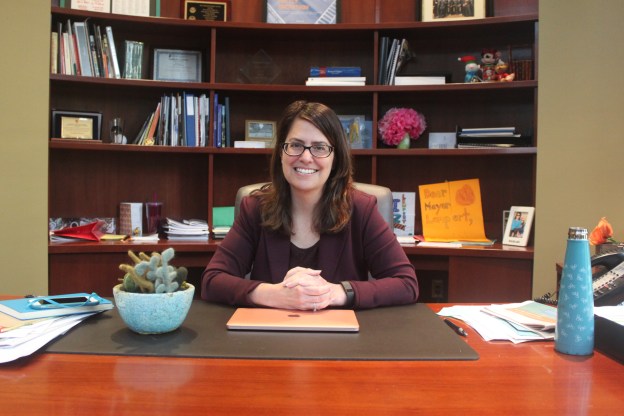
The mayor’s office itself is a representation of her values. Behind Lempert’s desk are compartments decorated with books and family photos. Letters, one of which appeared to be written by a very young child, said “Dear Mayor Lempert” in crayon, with a rainbow and happy face in each corner. 

When discussing the current presidential administration, frustration and disbelief appear on Lempert’s face before she even speaks. When asked about her favorite publications and podcasts, the happiness and lighthearted nature of her persona returns and radiates the room. Lempert’s eyes glimmer as she recalls her childhood in California. Her parents and grandparents were Jewish immigrant, and Lempert still remembers her family’s struggle to assimilate in the United States. Though Lempert is short and slim, she draws attention toward her. Her voice is both quiet and confident, gentle but firm.

Despite the upheaval surrounding immigration across the country, the mayor is proud of her town. She recalls the numerous rallies held in front of the town’s library on June 30, the start of a municipal ID program for immigrants, and ceremonies held for the citizenship for immigrants. While Princeton residents have been supportive, the mayor receives letters filled with hatred sent from elsewhere.

Lempert emphasizes the protection of children and the need to keep immigrants as well as their family and friends informed of their rights and options for protection. “If you’re the victim of a crime,” Lempert explains, “we don’t care what your immigration status is.”

Walking back from her office, I saw the clean streets differently, the white people differently. I didn’t feel so out of place anymore. 

Chief: Police won’t ask about immigration status, unless arresting

By Katheryn Quijada-Polanco

Oakland, CA

The man was unconscious. He’d been beaten and robbed. Nick Sutter, then a young detective in Princeton, feared he’d never catch the person who did it. That wasn’t because the attacker’s identity was unknown — the victim’s family knew exactly who was responsible. But they were undocumented immigrants from Guatemala and terrified that, if they talked to police, they’d be deported.

Sutter is now Princeton’s chief of police. That case, in particular, helped shape how he wants his officers to police immigrant and minority communities: by gaining their trust instead of instilling fear.

In many crimes, Sutter recently told The Princeton Summer Journal, victims are targeted “specifically because of their immigration status and their perceived hesitation to cooperate with law enforcement.” He added, “we’ve been trying to overcome that stigma with our community for a long time.”

Several recent incidents have made Sutter’s job harder. In 2016, Imani Perry, a Princeton African-American studies professor, was pulled over for speeding and then arrested on a warrant for unpaid parking violations. Perry’s account of being searched by a white male officer and handcuffed to a table at the police station made national headlines. Then, earlier this year, amid a national debate over officer-involved shootings, a mentally-troubled veteran named Scott L. Mielentz charged into a Panera Bread near the university with a bb gun. After an hours-long standoff, state troopers fatally shot him. “When a life is taken it’s not something that you get over quickly,” Sutter said.

Sutter lamented the mistrust between some residents and law enforcement—he said he became an officer to protect those who can’t protect themselves and shared several ideas for how to fix this. First, expand the department’s inventory of less-lethal weapons such as bean bags, tasers, batons, and pepper spray to better help officers disarm unstable people.

Sutter also wants his officers to wear body cameras to show the public that they’re trustworthy. He also plans to continue to diversify the department.

After all, he only solved the case of the man beaten into coma because someone from the Guatemalan community convinced the family to talk.

Chief seeks to build bridges

By Jesse Mendoza

South Gate, CA

Princeton Police Chief Nick Sutter understands why immigrant families might be fearful of the police. Sutter, a department veteran of 24 years, has always been aware of the possible disconnect between the police department and immigrant communities.

According to Sutter, immigrants are oftentimes wary of interacting with police because they fear deportation. Yet, Sutter is concerned how misconceptions of law enforcement can discourage and deter immigrants in the community from calling for help when in need.

Sutter recalls a situation in his career when an undocumented, Hispanic man was sent to the hospital after a gruesome beating left him horribly injured to the point of comatose.

Sutter tried to question the victim’s family to find possible leads. He was certain that the family knew who the culprit was, but the undocumented relatives resisted interacting with the police. Because Sutter understood why the family was fearful around investigators, he made the conscious decision to stop approaching the family and find alternative witnesses.

Despite the additional time and energy, Sutter was eventually able to find the culprit.

On a recent afternoon, Sutter walked into a Princeton classroom wearing a light blue suit and a gentle smile. Using a calm yet confident tone, he introduced himself as the Police Chief of Princeton, then sat down, maintaining his dominant stature. “If [an immigrant’s] child is sick,” Sutter said, “We don’t want them not to dial 9-1-1 because they are scared that we’re going to ask about their immigration status.”

Sutter is determined the change the perception that police might ask about immigration status not only for immigrants but for the wider Princeton community. Sutter has implemented procedures that are similar to sanctuary cities with policies that limit cooperation with the federal government in enforcing immigration law.

In Princeton, immigrants won’t be asked their citizenship status unless they’re arrested for a crime such as driving under the influence.

Sutter has also pushed for “community policing events,” where law enforcement can socialize with immigrants. Every squad on the force is required to participate in an event such as a car wash or barbeque to get to know the wider Princeton community.

Misconceptions aren’t only an issue for police officers and immigrants, but also a problem for doctors and politicians and professionals in other fields. Sutter knows that such perceptions are harmful and false and has made it his mission to change them.

Princetonians divided on immigration border crisis

By Paige Pagan
Bronx, N.Y.

Tens of thousands of undocumented, unaccompanied minors from Central America have recently passed over the United States border. Parents from countries including Guatemala and Honduras have been paying smugglers in a desperate attempt to have their children whisked away to the safety of the United States.

This ever-growing problem is focused in Texas. Containment hotels and refugee camps are being filled by the day, and places to send these incoming children are increasingly running out. Now, some view government officials as babysitters to care for these children. Continue reading