Author Archives: princetonsjp

How Racism Leads To Anime’s Stigma

photo-1581833971358-2c8b550f87b3Credit: Tim Mossholder

By Crystyna Barnes

Elm City, N.C.

Have you ever heard of anime?” asked a student at the front of the class. My teacher looked at the kid, confused. “It’s like those weird cartoons from Japan or something,” the student added. “Don’t watch them. They’re really gross and weird.”

The students, and even the teacher himself, laughed. I sat in the back of the class beside my friend, a fellow fan of anime. We slowly turned to look at each other, puzzled. The last anime I’d watched was about a middle school boy rediscovering his love for piano. What’s so gross about that?

Cartoons are a staple of most childhoods. No one bats an eye when asked about their favorite Disney film. Why is it any different when the content originates in a foreign country? The watered-down reasoning is that it’s simply racism. But the bigger culprit is social conditioning that teaches us to think of something outside of the norm as “weird.”

What people don’t know is that they’ve probably already consumed western content inspired by anime. Ever watch “Avatar: The Last Airbender”? “Powerpuff Girls”? “Teen Titans”? All of these childhood favorites took notes from anime: exaggerated facial expressions, big eyes and mouths, and a color- ful palette for character designs. We’ve been enjoying cartoons based on anime all along.

Whenever I’ve asked someone why they don’t like anime, the answer is short: “It’s weird” or “I just don’t get it.” I have even heard people say that anime all seem per- verted. I don’t necessarily believe that the average person who says these things is outright racist, but continued anti-Asian stigma and a lack of edu- cation contribute to this pointless opposition. If all someone hears about anime is that it’s strange and distasteful, a cycle of indoctrination has been created where no one questions or denies this out of fear of being viewed as weird as well.

In the scheme of things, the only noticeable difference between the cartoons we know and love and anime is the place of origin. Anime is not just one genre or one style. Just like cartoons, there is one out there for everyone.

If we want to end the stereotypes around Asian culture, change starts with the individual. Go on Netflix, find an anime with a plot that piques your interest, and start watching it. Suggest it to friends. Normalizing content that is viewed as abnormal will only create more open-minded people and more shows and movies to enjoy.

Asians Face Growing Racism

nicholas wu sjpNicholas Wu (l.), a reporter with USA Today, was accosted while running on the National Mall.

By Stephen Kim

Los Angeles, Calif.

Nicholas Wu was on a morning run on the National Mall when a woman started shouting at him. “Stay away, stay away, stay away,” Wu recalled her yelling. But when a
white person ran by her—much closer than Wu had—she made no similar comments.

These days, Wu said, he gets weird looks and people moving away on the subway. Other Asian Americans have experienced even worse treatment amid the COVID-19 pandemic: physical altercations, racist slurs, and other racially motivated, hateful incidents.

“COVID has acted as an accelerant on existing inequities in American life,” said Wu, a 24-year-old congressional reporter for USA Today. He attributes it to the “forever foreigner” phenomenon: Even if Asian Americans were born in the United States, they will always be considered an “other,” a foreigner, in this country. No matter the hard work they may do, the amazing accomplishments and successes they may achieve, Asians in this country will never be identified as “real Americans.”

Growing up in Grosse Pointe, Michigan, a suburb of Detroit, Wu was one of few Asians in a predominantly white part of town. “Teach us kung fu,” kids would say to him. They chanted “ching chong ching ling” when imitating speaking Mandarin. Wu was even asked if he was adopted because the only other Asian kids his classmates knew were adopted into white families.

Racism against Asians in both explicit and implicit forms has been present in this country ever since the first Chinese immigrants came across the Pacific to build the
railroads.

Mos Neammanee commutes to class at Rutgers by public transportation. But in the wake of COVID-19, he has sensed a difference in the treatment from fellow students. As he entered the bus, and tried to find a seat on his way to class, he overheard a fellow pas-
senger saying, “Why are they letting these people into the country?” People routinely seemed uncomfortable with the presence of Neammanee on public transport, he says.

He chuckled as he recounted these memories in a Zoom call, but he acknowledges that they put great strain on him. Neammanee is an active member of an organization called RAISE that advocates for young Asians who are undocumented and trying to apply for DACA status, and a DACA recipient himself. When he encounters people like the man on the bus on his way to school, it adds additional insecurity and anxiety on top of his undocumented status, which has been the subject of controversy under the Trump administration.

Twenty-three-year-old community organizer Audrey Pan works with Neammanee at RAISE. While Pan said she doesn’t experience explicit racism, she does feel “hyper-visible,” she said. She experiences the “feeling of people watching” when she goes outside. If she wears a face mask, people stare at her. If she doesn’t, the same thing
happens.

Pan agreed that the “accelerant” of COVID-19 has accentuated the feeling of otherness experienced by Asian Americans.

Students Face Abrupt Trips Home After Virus Strikes

By Lia Opperman

Galloway, N.J.

Over the past five months, COVID-19 has disrupted millions of American lives. But college students were hit especially hard: They were forced to rush out of their dorms and adapt to a new, virtual experience. Low-income students, even those at Harvard University, scrambled to find affordable flights, housing, and storage with little notice.

On March 10, Ryan Morillo, a Harvard freshman and Princeton Summer
Journalism Program alum, was about to walk to class when he received the email
that brought his short-lived time on campus to a halt. Harvard was canceling in-
person classes. “Everything was kind of rushed,” he said. “We were kicked out
on a Tuesday, and they said that by Sunday, everybody had to leave.”

Harvard’s spring break was scheduled a week after in-person classes were canceled, so Morillo already had a flight booked home to Miami. He still felt that the university’s last-minute message was irresponsible. “It was very abrupt the way they did it. And it was just kind of scary.”

Daniel Lobo, president of the group First Generation Harvard Alumni, said that the pandemic has put campus inequalities in sharp relief. “This whole experience is just a
reminder that low-income students don’t have as many resources and the form of disposable income to get through this sort of crisis,” he said.

In response to the Harvard campus emptying out, the group launched a relief grant program for low-income, first-generation undergraduates. Lobo realized that many
students didn’t have a safe home to go to and needed alternate accommodations. He also knew that some needed to store their belongings, but couldn’t afford to pay for storage.

“We had alumni volunteering to open up their homes to students to let them stay with them until they could figure out more permanent accommodations,” he said.

Eventually, the university began providing students with storage, boxes, and alternate lodging, arranging for some to remain on campus if they had no other option.

“The school was generous enough to cover the cost of storage,” Morillo said. “They took care of a lot of expenses and then eventually gave the students a partial refund on room and board [and] tuition.”

For the fall, Morillo has decided to accept a $5,000 stipend that Harvard is offering to students who choose not to move back to campus in the fall.

“To me, as a very low-income student, it’s a lot of money,” he said. “It kind of incentivizes me to stay home, even though that’s really damaging to education.”

As Virus Rages, Essential Workers Seek Protection

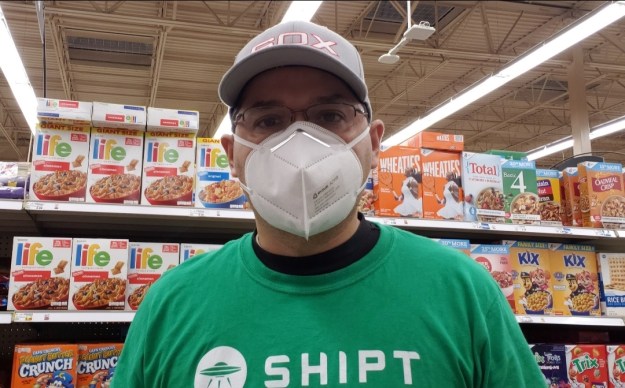
willy solis essential workersWilly Solis has spearheaded the Gig Workers Collective, which seeks to organize Shipt, Instacart, Lyft, and other gig platforms.

By Brianne LaBare

Orlando, Fla.

Every morning, Willy Solis, a worker for Target’s Shipt delivery app, wipes down his dashboard and steering wheel with disinfectant wipes and slips on his gloves and mask, which he bought himself.

Then Solis drives to the grocery store, discards his used gloves in a garbage bag, and heads inside to begin filling orders.

At a time when essential workers are going above and beyond to serve the public, Solis can’t help but think about the hardships working for Shipt has brought upon him. Or the trash bag of used gloves sitting in his backseat.

Because of this, Solis has spearheaded the Gig Workers Collective, which includes workers for Shipt, Instacart, Lyft, and other gig platforms. Their main demand is that corporations provide personal protective equipment, such as masks and gloves, to help keep them safe.

“The major thing that shoppers try to do is make sure that they wear the proper PPE and have it at all times,” Solis said. “We have been providing that for ourselves for the most part during the pandemic, and a large majority of shoppers do express concern about spreading it to customers or to their families. That’s a major concern for us.”

In a statement to The Princeton Summer Journal, a Shipt spokesperson disputed this, saying shoppers can pick up face masks and gloves from their local Target store for free.

Concerns about safety span many essential jobs. Ada Fuentes is a senior membership organizer from Jobs with Justice, a nonprofit that advocates for worker rights. She
said Uber drivers were informed via email that they would get PPE. But many drivers were unable to access the equipment because Uber’s in-person driver help centers were closed due to the pandemic.

Uber said in a statement that drivers could request masks and sanitizer by mail or pick them up at reopened Greenlight Hubs. The company added that it had distributed more than 9 million masks, wipes, and containers of hand sanitizer, and that it had “never run
out of supplies.”

Still, through social media coverage, blog posts, and advocacy efforts, stories about mis-
treated essential workers abound. Solis of the Gig Workers Collective said that, during the pandemic, Shipt even made a temporary pay cut permanent. (The company said that, under its “updated pay model,” shopper base pay in most metro areas has remained the same, or even increased.)

“The CEOs of these companies are definitely not the ones out there doing this job on a daily basis and exposing themselves and their families to this,” Solis said. As for their treatment of the people who are: “to put it bluntly, it’s despicable.”

Gen. Z Gives Biden’s Run Tepid Support

By Angie Cisneros and Daniel Sanchez

Minneapolis, Minn. and Boca Raton, Fla.

Most teenagers may not be eligible to vote, but Generation Z has increasing influence on the policies of both parties, especially those of Democrats. In interviews with four high school students who are part of the Princeton Summer Journalism Program, the clear consensus was that young people are putting their support behind Joe Biden for one major reason: He is not Donald Trump.

Sitting in her home in Boston, 17-year-old Paola Ruiz put it simply: “We have to vote for the lesser of two evils.” Ruiz called Biden “chemotherapy” for the “cancer” caused by the current administration.

Other teenagers had similar views of Biden, both as an individual and as a candidate. Sofia Barnett, a 17-year-old from Frisco, Texas, rattled off what she finds distasteful about Biden, from his 1994 crime bill to the sexual assault allegations made against him. However, when asked who she would vote for, she stood by the Democratic nominee.

Kayla Bey, a 17-year-old from Lilburn, Georgia, said Biden alienated her when he said on a radio program that if you vote for Trump, you “ain’t Black.”

“I just feel like the Black community has gone through so much; I think it was entitled
for him to say that,” Bey said, suggesting such comments may have dampened enthusiasm for Biden.

The teenagers were adamant about their desire to elect more progressive figures. “I was a big Bernie supporter,” said 17-year-old Andrea Plascencia from Flower Mound, Texas—a view echoed by her peers.

Bey mentioned Beto O’Rourke, a Democrat known for supporting the legalization of marijuana and raising the minimum wage.

But after their preferred candidates dropped out of the primary, students have tried to find the same ideals in the presumptive nominee. Bey suggested that Biden would be more palatable if he more strongly advocated for expansion in health care. Ruiz, meanwhile, called on Biden to offer free college for all and debt relief, while Plascencia said she hoped he “can advocate for equality” through policies that benefit people from low-income backgrounds.

All of the students interviewed viewed Biden as an “intermediate” president, one who would work to bring the country back to a normality present before the Trump era.

Jariel Christopher, an 18-year-old from Port Allen, Louisiana, summed it up by saying the strongest argument she saw for Biden is that she foresees more chaos in the country if Trump is reelected.

De Blasio Run Lacks Support in N.Y. Survey

20190801_034949152_iOS

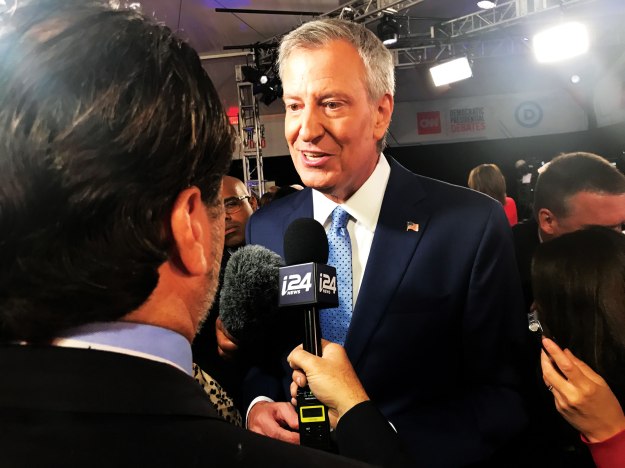
New York Mayor Bill de Blasio takes questions at the second Democratic debate on July 31. Photo Credit: Brian Rokus

By the Staff of the Princeton Summer Journal and written by Jhoana Flores, Jarlem Lopez Morel, and JC Villon. 

New Yorkers don’t want their mayor running for president in 2020. In a survey of 154 New Yorkers, nearly three out of four voters said they are not happy Bill de Blasio is participating in the presidential election.

The survey results contradict de Blasio’s claims that his time running the biggest city in America means he should be elevated to the White House. De Blasio, who announced his campaign in May, is one of two dozen Democrats in the race. He has been polling at one percent or lower nationwide. Many New Yorkers told The Princeton Summer Journal they disapprove of not just his presidential campaign, but also his work as mayor of New York City.

“He isn’t worried about New York because he’s too concerned about his campaign for president,” said Kristie Summers, 20, from the Bronx. “If he can’t be a mayor, how can he be president?” She was one of many New Yorkers who said de Blasio has neglected his mayoral responsibilities to the city and as a result cannot rise to the challenges of the 2020 presidential race.

New Yorkers of both political parties disapprove of de Blasio. When asked if they approve of the job he is doing as mayor, slightly over half of both Democrats and Republicans responded “no,” as did nearly two-thirds of people who identified as a different political party. Three-quarters of both Democrats and Republicans also said they are not happy de Blasio is running for President.

When it came to the prospect of voting for de Blasio for President, New Yorkers were inclined to vote “no.” More than 80 percent of both Democrats and Republicans surveyed said they would not vote for him.

Not all New Yorkers are turning their backs on the mayor, however. “He is do-
ing his job correctly, eliminated crime from the city, got day care and made a
universal pre-K system,” said Steve Pastor, 68, a Queens resident.

Some New Yorkers cited not only de Blasio’s policy achievements, but also the community he is building within New York City. “I feel like he’s making the city better for both genders,” said Sandra Acuna, 30, of Manhattan. However, others have a dark outlook on de Blasio. Jason Woody, 35, from Brooklyn, criticized de Blasio’s pedestrian safety record. “He ran on a platform highlighting Vision Zero, but … I’ve had two friends killed on bikes by drivers, no one has been arrested,” Woody said.

Shawn Haz, a 28-year-old from Brooklyn, said he is frustrated with city zoning issues. “He rezoned everything…I’ve been rezoned, kicked out, and everything,” he said. “Gentrification is messing it all up. It doesn’t really help anything but the rich and white.” Phupinder Singh, 29, from Queens said, “He is not eligible to run for president, no qualification, no experience and not intelligent. He is a comedian.”

While New Yorkers largely do not approve of de Blasio running, many of them were willing to offer advice. “If you want to connect with people, you have to be authentic,” said Matthew Louis, a 29-year-old from Manhattan.

As the mayor tries to win votes across the country to earn the Democratic nomination for president, he is struggling at home.

Despite his efforts to use his title as a mayor of a huge and diverse city to boost his campaign, he appears to lack support from the residents of that city. Many New Yorkers, like Jason Kayne, a 24-year-old from Queens, have a sarcastic message for his campaign:

“Good luck.”

_--approve-bill-as-mayor

Do you approve of the job de Blasio is doing as mayor?

_--Are-you-happy-bill-diblasio-is-running.png

Are you happy de Blasio is running for president?

_--do-you-approve-of-bill-job.png

Would you vote for de Blasio for president?

Screen Shot 2019-08-16 at 9.42.09 AM

Area Stores Stock Expired Food, Drugs

IMG_4108

Expired products were found at seven different area stores, including the above-pictured Family Dollar in Trenton. Photo credit: Brian Rokus

This story was reported by the staff of The Princeton Summer Journal and written by Emily Barrera Cedeno, Jasmyn Bednar, Justin Fajar, and Angela Nguyen.

Children’s ibuprofen. Pepto Bismol. Contraceptive sponges.

These are just a few of the expired products found in an investigation by reporters of The Princeton Summer Journal on the shelves of New Jersey’s pharmacies and convenience stores.

There were 41 expired products found among seven different stores—Walgreens, CVS, 7-Eleven, Tropical Supermarket, Family Dollar, Rite Aid, and Colonial Farms.

Eleven items were found at a New Brunswick Walgreens, including baby food, allergy medicine, and cold and flu medication. Ten were found at the Tropical Supermarket in North Brunswick, and nine at a neighboring North Brunswick CVS. A handful were found at Trenton’s Colonial Farms and Family Dollar, and a 7-Eleven and a Rite Aid in New Brunswick. The oldest expired product, a bottle of liquid Dial Soap found at Colonial Farms grocery store, expired in December 2017.

A majority of the products were three months past their expiration date, with two products over six months expired and three products over a year old. The products include aspirin, glucose testing strips, and baby food, which expired in April, May, and June 2019, respectively. Out of 41 items, 19 were medicinal, 17 were food products, and five were hygiene products.

Expiration dates are sometimes disregarded by consumers, who believe that they can still consume goods past the recommended date. According to an article on the FDA website, “expired medical products can be less effective or risky due to a change in chemical composition or a decrease in strength. Certain expired medications are at risk of bacterial growth and sub-potent antibiotics can fail to treat infections, leading to more serious illnesses and antibiotic resistance.” For instance, expired glucose testing strips like the ones found at a North Brunswick CVS may lead to inaccurate readings, which could be detrimental to diabetics.

The FDA began to require expiration dates on all medication in 1979. According to their site, “drug expiration dates reflect the time period during which the product is known to remain stable, which means it retains its strength, quality, and purity when it is stored.” However, the government does not regulate expiration dates within the food industry, with the exception of infant formula.

Many of the stores were located in low-income areas, where residents rely on local stores and don’t always have other options available.

The concept of people not having choices in the stores they shop at is called a food desert, which is defined by the USDA as “an area that has limited access to affordable and nutritious food.” New Jersey has food deserts, which contributes to food insecurity among residents, but it also has problems with a lack of medications. The number of stores selling expired products in New Jersey only adds to the problem of food and medicine insecurity. Notably, a few stores selected for the investigation in Trenton had closed in the previous year.

It’s important to note that the large majority of products investigated were unexpired. At one CVS in Trenton, no expired goods were found—the manager said they restock the shelves every Friday. All of these stores have a large inventory with a proportionally small staff, and products may slip through checks every so often. This does not necessarily speak to gross negligence across the board in these corporations, but rather can speak to human error.

According to the CDC, in the United States 76 million people a year get sick from the food they eat. When food expires, the nutrients they provide start to degrade—not to mention the fact that eating expired food can cause nausea, vomiting, diarrhea, fever, and abdominal pain. Eating expired food can expose people to harmful bacteria such as E. coli.

At each store, managers declined to give a comment directly to reporters. When the owner of Colonial Farms was confronted about the expired products found in his store, reporters from this paper were asked to leave.

Alberto-Expired-Meds-2.jpg

Reporters from the Summer Journal found expired aspirin at a Rite Aid in New Brunswick. Photo credit: Alberto Lopez

When reached, Christopher Savarese, the director of public relations for Rite Aid, said, “We take this kind of incident very seriously, as we do the health and welfare of our customers. While we believe this to be an isolated case, this is totally unacceptable to Rite Aid. We have very strict policies, procedures and training in place to prevent outdated products on our shelves.” He added, “Our local management will be visiting the store, and we are using this as an opportunity to retrain our associates, to ensure that everyone understands our policies and procedures.”

Randy Guiler, a vice president for Family Dollar, replied with a similar statement, “We have store procedures to routinely check sell-by dates and to remove items from our shelves that have surpassed those dates. If instances occur where an item has been identified that surpassed its sell-by date, we immediately re-check the products in our store and reinforce these procedures with our store associates.”

CVS, Walgreens, 7-Eleven, Tropical Supermarket, and Colonial Farms did not respond to requests for comment.

The legal fights over expired products in the region have gone on for well over a decade. In October 2006, Rite Aid faced a civil suit in New Jersey for selling expired non-prescription medicine and baby food, which was settled for $650,000. The following year, the state pursued a civil suit against Duane Reade, a regional pharmacy chain, for similar reasons. It was settled for $175,000. In Pennsylvania, CVS settled a suit for $450,000 due to expired products.

These stores have significantly improved from last year’s findings, in which reporters for The Princeton Summer Journal found 75 expired products in 12 stores. The initial 2008 investigation found 191 expired products in seven stores.

The following stores had expired products: 7-Eleven, 358 George St., New Brunswick; Colonial Farms, 137 E. State St., Trenton; CVS, 949 Livingston Ave., North Brunswick; Family Dollar, 117 E. State St., Trenton; Rite Aid, 366 George Street, New Brunswick; Tropical Supermarket, 959 Livingston Ave., North Brunswick; Walgreens, 20 Jersey Ave., New Brunswick.

‘Beloved’ Author Morrison Dies


Morrison---Mike-Strasser----USMA

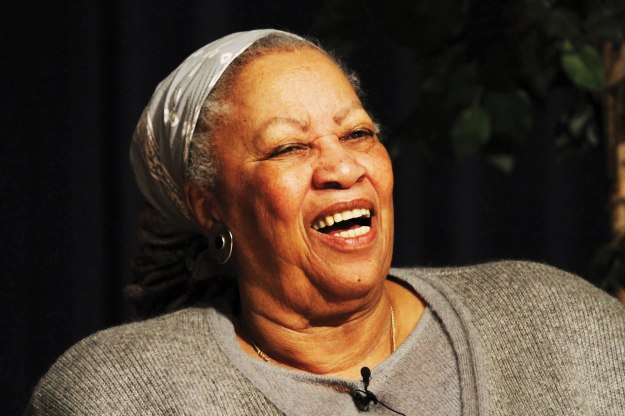
Nobel laureate and Princeton University professor emeritus Toni Morrison passed away on Aug. 5, aged 88. Photo credit: Mike Strasser

By Laila Nasher

Detroit, Mich.

Acclaimed author Toni Morrison passed away in a hospital in New York on Aug. 5. Over her career, she took readers on countless journeys—from the exploration of the devastating effects of racism and sexism in “The Bluest Eye” to the narration of the extreme psychological effects of slavery in “Beloved.” She won numerous honors and awards—the Nobel Prize in Literature, the Pulitzer Prize for Fiction, and Barack Obama’s Presidential Medal of Freedom—as well as the hearts and tears of millions across the world.

From 1989 to 2006, Morrison was a professor at Princeton University, and her classes were some of Princeton’s most sought-after courses. Students from all majors would compete to be selected.

One of these students was journalist Elena Sheppard, who graduated in 2009. Sheppard was ecstatic when she found out that Morrison, who had retired in 2006, decided to teach a class her senior year. “I was so bummed that I’d graduate without having been taught by her … I always loved her work. Even when I was 15 or 16,” Sheppard said, “she brought me into this enthralled mental space that I couldn’t get anywhere else, and she just made me want to be a writer.” The realities of that class, called “The Foreigner’s Home,” far exceeded her expectations. One of the biggest lessons Sheppard took away from the class was the importance of writing untold stories of your community, and that lesson has inspired her to begin writing her own book.

Sheppard also wrote her senior thesis on Morrison’s most famous book, “Beloved.” For her thesis, she had the opportunity to interview the authorherself. After building up the courage to ask her for an interview, Sheppard was surprised when Morrison agreed. “She didn’t have to teach the course or do the interview. Yet she still came to Princeton three times a week to pass on her knowledge. It was humbling to see someone of her status want to pass on that knowledge,” Sheppard said. Morrison gave Sheppard a solid half hour for questions. “Just sitting in the same room as her, hearing her knowledge and that she was willing to help me was amazing. It’s my favorite memory from Princeton. When I found out she died, it was just a gut-punching feeling.”

Dan-el Padilla Peralta, an associate professor of classics at Princeton who graduated in 2006, had the opportunity to be lectured by the iconic author during his freshman year. Peralta’s professor Cornel West invited Morrison to speak to his class in the spring of 2003. Before the discussion, Peralta wasn’t too fond of Morrison’s work. “At the time, I had these received ideas about what constituted rich, textured, novelistic writing. And these received ideas or ideas that have been formed by exposure to texts authored by white men—it was incredibly difficult for me, especially on an initial reading of ‘Beloved,’ ‘Sula’ and ‘Song of Solomon,’ to get myself in the kind of mental space that would enable me not just to read Morrison, generously, but to feel that she was truly speaking to the experiences of those communities of womenfolk and menfolk that have shaped my own life.” But his mind quickly changed when he listened to her speaking.

“I was mesmerized from beginning to end,” he said. As a person of color at majority-white Princeton, Peralta understands the hardships and self-doubt it can cause. Watching West and Morrison converse was an inspiration to him. “It was one of the first times where I saw two folks like me, who could take an academic space over by the force of their conversation, their dialogue and their sheer presence, and not feel in any way like I had to perform to some preconceived standard of white male academic status.”

Morrison’s name will forever be etched in the minds of readers across the world—and on a 181-year-old building central to Princeton’s campus: Morrison Hall, dedicated to the author in 2017.


Local Youth Undecided Among Dem Candidates

sjp-lead-dems-rgb.jpg

Photo illustration by SJP staff

By Audry Themen

Jersey City, N.J.

On a recent afternoon, reporters from The Princeton Summer Journal scoured the town for opinions on the current 2020 Democratic presidential candidates. Though the youth interviewed had varied opinions on which candidates appealed to them, many of the students also had a limited understanding of the candidates’ proposals.

Sophia, a rising senior from Bordentown, N.J., felt that Bernie Sanders was a promising candidate, citing his policies on free college and “Medicare for all” as compelling factors for her support. She likened Sanders to Trump in the sense that he “backed up his words with actions,” though she did not elaborate on the instances where Trump substantiated his words with policy.

Lauren, a rising senior from New Brunswick, New Jersey, also had Sanders as her candidate of choice. As an environmentally conscious democratic socialist, Sanders’ progressive policies, specifically his climate change proposals, appealed to her immensely. Lauren cited Joe Biden as her second choice based on his accomplishments as vice president under the Obama administration.

Grace Hutapea, a 16-year-old from Guam, liked Elizabeth Warren. As a citizen of an island territory, she advocated for action on climate change, especially since the coral reefs surrounding Guam are heavily impacted by global warming. Grace also believed that Biden would be a good presidential candidate because of his history, noting that in terms of political experience, he has a “strong foot in the door.”

Not every teenager advocated for a progressive candidate, however. Friends Shikar, Dean, and Siji, moderate Democrats from Texas, believed that Sanders was “too extreme” and impractical. “We can’t ‘Feel the Bern,’” Dean, a 16-year-old from Houston, said. He claimed that Bernie’s “Medicare for all” policies are “not feasible” and would take “too much time and legislation” to implement.

Siji, a Houstonian, admitted that he did not follow politics too closely, but he does favor Biden. “I just think he’s a fun guy,” Siji said. “I like him as a person.”

When asked which candidate has the best chance of winning the primaries, the three students agreed that the state of affairs were not settled. “All candidates, even the lower-tier candidates, have a shot,” Shikar said.

The other two boys agreed. “It’s really anyone’s game right now,” Dean added.

Local Princeton Residents Remain Unsure of 2020 Election Stance

By Jarlem Lopez Morel and JC Villon

New York, N.Y. and Brooklyn, N.Y.

Two sets of Democratic debates and countless candidate interviews have sought to clarify the candidates’ stances on various issues. Yet some Princeton residents interviewed this month said they are still unsure what the 2020 hopefuls believe and what their policies and plans are. Jason Green, 42, who is “very interested” in following the campaign, said voters are not “receiving authenticity from the Democratic candidates.”

Cynthia Medley, 24, said she’s still waiting to find out “what the candidates are really about,” adding that she wasn’t following the race very closely. “Nobody is completely wrong on anything,” she said.

The theatrics seen on all four nights of Democratic debates led some Princeton viewers to feel indifferent regarding the candidates’ policies. Residents said the contenders focused too much on attacking the other candidates rather than discussing their own plans.

Annemarie Porter, 58, followed the debates attentively. The candidates, she said, failed to stand out and provide the Democrats with a “strong enough candidate to beat [President Donald] Trump.”

Many residents said they believe that, because the candidates were aiming to capture independent votes, they were not proposing extreme policy positions. However, independent voters, such as Porter and Medley, said a candidate who can beat Trump is as important as a candidate who represents their beliefs.

The August debates, which drew more than 10 million viewers, did little to change the position of frontrunner Joe Biden. The poll numbers of the candidates below him, however, did fluctuate.

Biden is still at 32 percent in the Aug. 6 Quinnipiac University poll, with Elizabeth Warren at 21 percent (an increase of six points from before the debate) and Bernie Sanders at 14 percent. Kamala Harris’ approval rating, which after the first debate surged to 13 percent, fell to seven percent in the poll.