
Author Archives: princetonsjp

‘You can’t tell whose parents have money’: the story of first-generation students

By Angela Loyola
Stony Point, NY

There’s a minority group at Princeton that isn’t constrained to one gender, race or religion. They walk around campus unseen. The university claims their well-being is a significant priority—but some students say the school isn’t doing enough.

Low-income and first-generation students don’t fit the traditional definition of a minority, but many of these students still feel stigmatized on campus.

“When you walk around campus…you can’t tell whose parents have money,” said Melana Hammel, rising sophomore. Hammel is the co-chair and treasurer of the Princeton Hidden Minority Council, which aims to give this invisible minority a voice. Continue reading

Don’t let it bug you! A review of worm-covered ice cream

By Xuan Truong, Ashley Standafer and Tommie Robinson
Springfield, MA; Hyden, KY; Jonesboro, GA

On a recent Wednesday, a lone ice cream truck was parked in front of a side exit at New York’s bustling Chelsea Market. This wasn’t a typical Mister Softee truck playing jolly tunes and selling soft serve. There were no nuts or sprinkles—here, the topping options included grasshoppers, mealworms and other insects.

The local Van Leeuwen ice cream shop created the treats as part of a partnership with The Economist and distributed them for free to anyone brave enough to try them. At first, we thought the idea was crazy—and disgusting. What normal person would eat bugs? After speaking with the truck’s employees, however, we learned that these critters are a healthy source of protein.  Continue reading

Staff editorial: Ephemeral experience, lasting impact

By the SJP Class of 2016

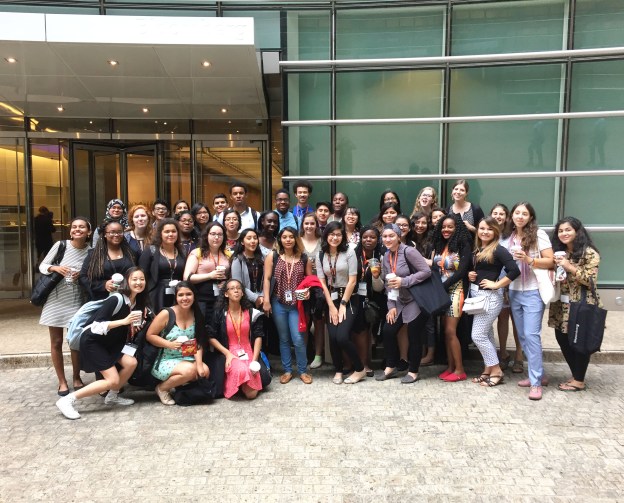
It’s like the beginning of any race: Before the starting gun goes off, you feel nervous, uncertain and a little bit overwhelmed about what lies ahead. That’s how many of us felt when we first arrived at Princeton University’s Summer Journalism Program, flying in from Massachusetts, Missouri, California and everywhere in between.

But over the course of 10 short days and 10 long nights, we hit our stride, all becoming part of a vibrant community of curious students and intellectuals who’ve overcome their circumstances to chase their dreams. Continue reading

A look inside Mudd Library, home of Princeton senior theses

By Amanda Koym
Madisonville, TX

Slightly brittle and yellowing with age, the pages of the 1916 edition of the Nassau Herald crinkle as they move. Within the century-old pages is a short blurb, six paragraphs long, and a photo of one of the Great American Authors, his face blank. It is F. Scott Fitzgerald, age 19.

The yearbook is stored in the Seeley G. Mudd Manuscript Library, a division of Princeton’s Department of Rare Books and Special Collections. Built in 1976, the library houses Princeton University’s 1748 charter, as well as the senior theses of politicians such as Ted Cruz and actors such as David Duchovny.  If you want to look at the files inside, however, there are some rules. Continue reading

Discussion of police relations with Princeton residents reveals racial divide

By Maria Gonzalez
Mattawa, WA

In Princeton, N.J., the conversation on police brutality falls along the same racial divides as the national one: White residents have more positive views of police, while for the most part, black residents say they have been unfairly targeted.

The uptick of attention to police brutality around the country concerns Princeton residents. In recent interviews, some said they’ve never had a run-in with police, while others claimed that cops are surveilling neighborhoods with more diverse populations. Continue reading

Dancers’ pay is nothing to cheer about

By Mirna Rodriguez
Mission, TX

The football stadium is deafening. It is a mixture of passionate screaming and songs melting together. In the midst of all this, keeping the pep alive, are the cheerleaders. Clothed in sparkling costumes and tossing impeccable show hair, they are a single unit, acting as one: dancing, smiling, enduring. They are on top of the world, inspiring countless little girls. With all the lights and glamour, it’s hard to imagine that the beautiful costumes, the iconic pompoms and all the hard work often add up to a paycheck lower than the wages of someone working at McDonald’s. Continue reading

Textbook history doesn’t tell the full story

By Amy Kim
Valencia, CA

We’ve been studying the world through a lens of deceit.

To what extent should George Washington’s and Thomas Jefferson’s attitudes toward slavery diminish their accomplishments? Why didn’t the U.S. intervene adequately in the Rwandan genocide of 1994? Why is the 1968 My Lai Massacre in Vietnam, in which women and children were brutally slaughtered by American soldiers, described in a single paragraph in many textbooks? Continue reading

Finding comfort in my identity

By Luis Ortiz
Chicago, IL

When I moved to the United States from Mexico, one of the things that surprised me the most was the locker rooms. In 2011, I came to Chicago from my home in Mexico City for a vacation with my family. After a week, my father went home, and I was told by my mother that we would not be returning with him. I had to learn to adapt to the United States as an immigrant and learn a new reality that would not include my father and his family.

To add to my personal confusion, I discovered something important in the locker room: I was attracted to guys. My dad raised me Catholic, which led me to believe that I was destined to go to hell. When I told my family, they were not pleased: my mother, a fundamentalist non-denominational Christian, took it very badly. We became distant, and we had several arguments that made my life very bitter. During the summer before freshman year of high school, I contemplated the idea of suicide or running away, but I never attempted to do anything about it.  Continue reading

Safe sex education protects teenagers

By Jadelyn Flores-Sierra
New Brunswick, NJ

You are only worth your virginity; once you lose it, no man will respect you,” my mother reminds me yet again. Though the phrase is familiar, I make it a point to look her in the eyes, and the longer I hold the stare, the more I am able to see centuries of female oppression that existed long before my mother was born.

The very idea that I am worth much more than one act in my life is not the result of some epiphany made during health education. Though that class didn’t teach me to respect myself—that was something I had to learn on my own—I was lucky to receive a health education that taught me about different forms of contraceptives. However, not all students in the United States have access to knowledge about safe sex. Sexual education, for some students, is reduced to abstinence-only. The danger in abstinence-only education is not only ignorance but also, and more significantly, the creation of a population at increased risk of sexually transmitted diseases and unwanted pregnancies.  Continue reading

Education is a right, not a privilege

By Breonna Reese
Gary, IN

Think for a second. Think of a land where life is better, richer and fuller for everyone. How about a land where there is an opportunity for each according to their abilities and what they want to achieve? Well, writer and historian James Truslow Adams came up with the idea of the American Dream. The American Dream is essentially defined as “The Land of Opportunity.” Has America truly fulfilled its name though? With access to education being limited, education has become a privilege and not a right, as it should be. Let’s dig a little deeper.

Education should be a right because not allowing someone to get an education will detach that person from society. If a child isn’t taught how to hold a conversation, express herself and become an intellectual, she won’t be able to carve out a better life — in fact, she may not be able to survive. Despite this, education has been made a privilege.  Continue reading