Category Archives: Arts

The Humor of Being Forgotten: Daniel Robbins’s “Bad Shabbos” Neglects The Middle Child 

By Clara T.

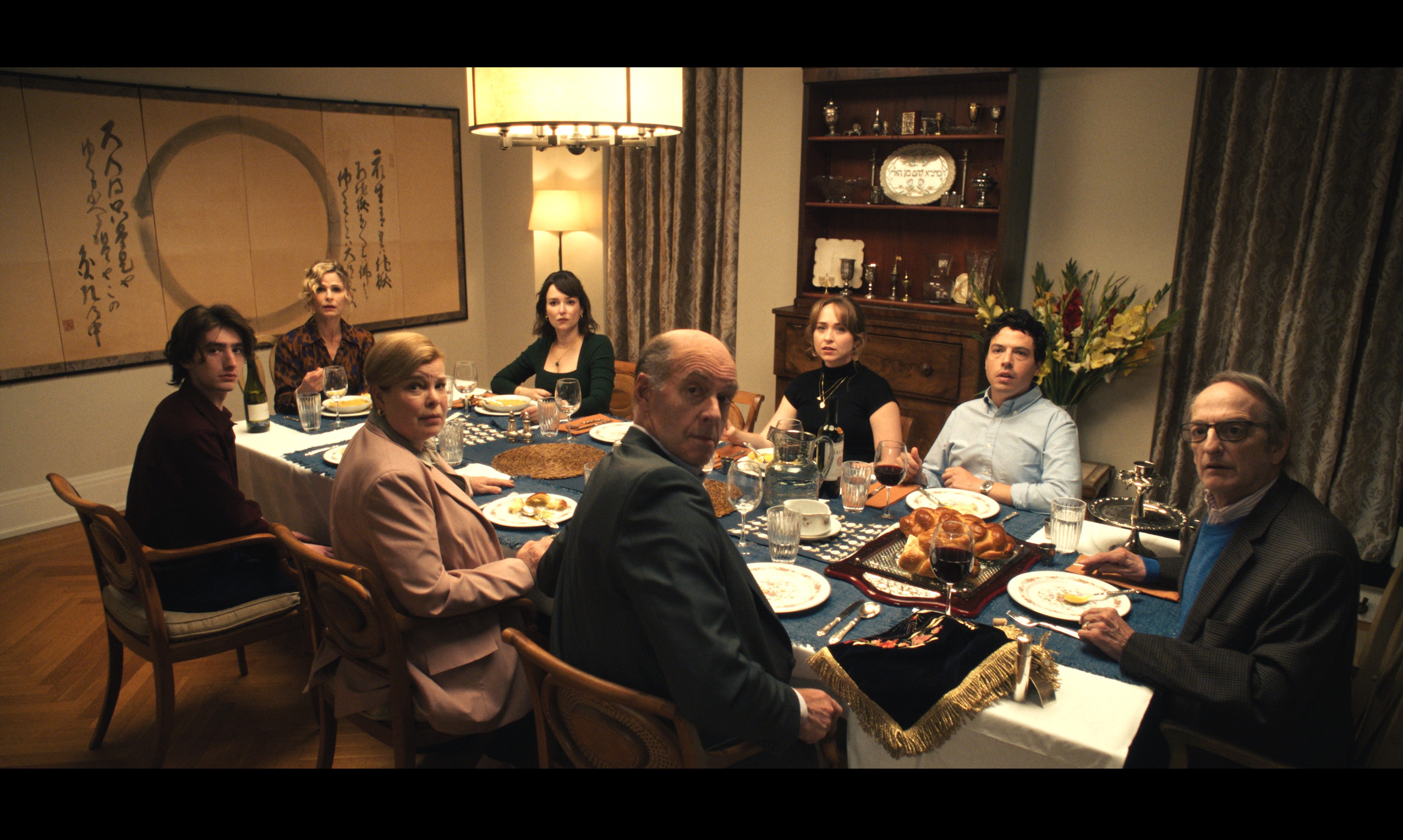
At threaded fingers comes the daybreak of David and Meg’s relationship, grasping each other in hope for an easy dinner when their Jewish and Catholic families collide at last—a prayer for the journey ahead. Scenes apart, the introduction of Abby and Benjamin is not as ginger. She urges him to go inside her parents’ apartment, becoming cordless when he distances himself for a smoke. Abby—the middle child in the family—is never given a fair shake in Daniel Robbins’s film Bad Shabbos. She is caught in the push and pull, never finding true support.

Daniel Robbins, a director known for the horror films Pledge and Uncaged, seems to be pivoting away from his usual terrain with Bad Shabbos, which partly opens in appearance as a Hallmark-esque film about a family gathering for a warm holiday dinner. Yet something is clearly off. Framed as an interreligious parable, Bad Shabbos attempts to say that familial strife can be resolved in the face of sin—even murder. Although Robbins blatantly implies there will be no “good shabbos” in this story, could it be too much to ask for good direction?

While Robbins presumably set out to make a Hanukkah family movie, it is in fact a murder comedy—one floating with offensiveness and thoughtlessness. Here, the tension is meant to lie between matriarch Ellen (Kyra Sedgwick), who sweetly condescends that Judaism is “a household plant” passed down through generations of women, and almost-daughter-in-law and laborious convert Meg, whose efforts to swing from the Catholicism she was raised with to her fiancé’s religion, Judaism, are likened to taking “online courses in gardening.” They interact as foils in symmetrical frames that capture the generational gap dilemma in religious communities—centered the way Wes Anderson might.

By contrast, the woman in this hereditary line—Ellen’s daughter Abby (Milana Vayntrub)—is largely neglected. Robbins overlooks the actual strain between mother and daughter, even though Abby is the girlfriend of the murdered man who cheated on her. While Abby’s older brother David, her younger brother Adam (Theo Taplitz), and her father Richard (David Paymer) grieve with her following the death, Robbins falls into the stereotype of ignoring the middle child.

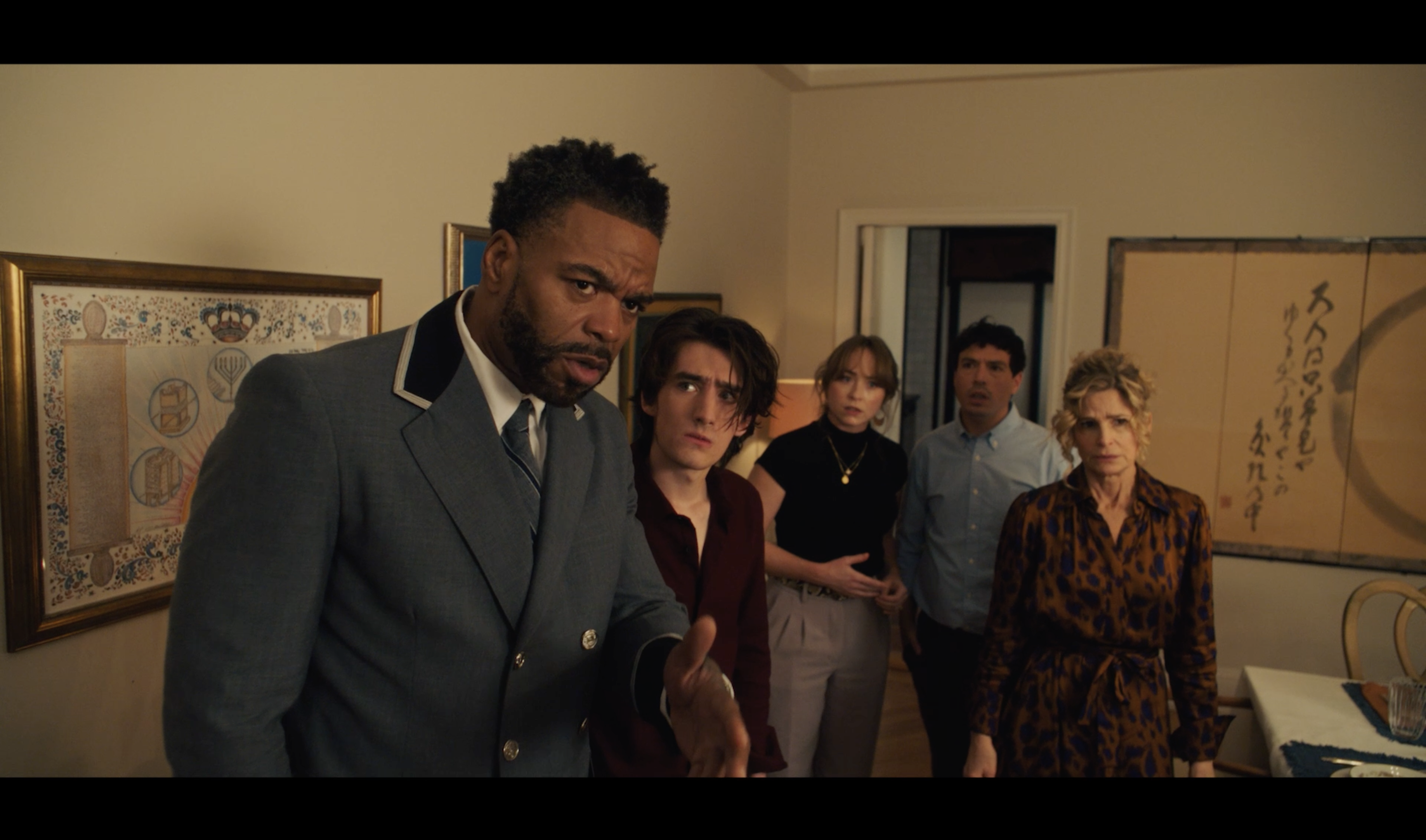
Abby is the true compass of the Bad Shabbos ensemble, even when Robbins makes heroes of everyone but her. Robbins turns the doorman Jordan (Method Man) into the concluding savior when he impersonates Abby’s dead boyfriend at the dinner table to avert suspicion—kissing Abby to increase believability, without her consent. One of the few tender moments is when Abby, wordless, conveys her sorrow, revealing she had known her boyfriend was cheating all along. That is the singular mystery revealed—if anyone came in expecting a murder mystery.

The family members are all losers in the end, but at least they are closer to one another—except Abby. While David supports Meg, Meg struggles for Ellen, Jordan aids David and Richard, and Richard and Ellen baby Adam—what kind of support is it if it takes a murder to realize Abby’s suffering?

Robbins’s rise in the comedy genre is positioned as a Messianic Age or a Second Coming of a directorial debut—but it is everything but. Much like Bad Shabbos unites everyone but Abby.
“Bad Shabbos” Is Actually Bad: A Comedy That Misses Its Mark

By Jiondae D.

The laws of Shabbat argue that if one is not bedridden, even minor medications should be prohibited. While this violates Shabbat rules, nothing is worse than betraying the Ten Commandments—arguably in the worst way: murder.

These conflicting ideas collide in Daniel Robbins’ film Bad Shabbos.

After joining his girlfriend’s family for Shabbat dinner, Benjamin’s fate is sealed the moment he reveals his colitis diagnosis—and makes a few offhand comments to his girlfriend’s brother, Adam. Soon after, Adam drugs him with laxatives.

Despite losing Benjamin early on, his death fails to create suspense. Instead, it becomes an excuse to launch into a series of underwhelming scenes that make the moment feel almost comedic.

The film takes place in an Upper West Side apartment in New York City, home to Mr. and Mrs. Gelfland and their youngest son, Adam. They invite their two older children and their partners to celebrate Shabbat dinner. Roughly 20 minutes in, Benjamin drinks laxatives. After a comical struggle with his pants and a race to the toilet, he slips, hits his head, and passes away—off-screen, in the bathroom.

Typically, a film’s climax occurs about 90% of the way through. But in Bad Shabbos, Benjamin’s death happens so quickly and chaotically that the rest of the film struggles to find purpose. Audiences don’t pay over twenty dollars to watch a twenty-minute movie, and unfortunately, the remaining runtime becomes a collection of scenes that are more mediocre than meaningful. The cat’s unhinged behavior and wasted food do little to elevate the tone.

Even more jarring is the hypocrisy on display. The Jewish parents mock their daughter for using a car during Shabbat while their son—who killed a guest—is shielded from consequences. This contradiction darkens the already uneven tone of the film.

And just when it seems the chaos is over, the future in-laws arrive. What should be an opportunity for dramatic tension turns into another shallow gag. Glaring looks from the mother and spilled soup are played for laughs, but it’s not as funny as the filmmakers may have hoped. Instead, it feels like filler—lacking imagination and failing to build on earlier scenes that had at least a little more personality.

Benjamin’s death becomes less important with every scene. What could’ve grounded the film in something dark and compelling instead becomes tasteless. This isn’t just an ordinary Shabbat.

It’s the epitome of carelessness.

“Bad Shabbos”, Good Movie: A Chaotic Dinner Worth Watching

By David R.

Director Daniel Robbins’ tour de force, Bad Shabbos begins with the end. Two elderly Jewish men stroll down a New York City street at night. One begins telling a joke. The punchline? A corpse plummets from a nearby building, landing in front of them. The film then rewinds to tell the story of the night preceding this event.

David and Meg, portrayed by Jon Bass and Meghan Leathers respectively, are an interfaith couple engaged to be married. Unfortunately, there are a few problems for the young lovers.

The first issue is Meg’s parents, conservative Catholics from Wisconsin, who—while never stating it outright—are clearly displeased with Meg’s conversion to Judaism. Another issue is David’s mother, whose passive-aggressive remarks toward Meg create tension in their relationship.

These concerns come to a head on the night of Shabbos—the weekly Jewish day of rest from Friday sunset to Saturday sunset. While Meg gives Judaism her best effort, David’s mother (played by Kyra Sedgwick) is slow to accept her. In spite of her better judgment, Meg invites her staunchly religious parents to Shabbos dinner.

Upon arriving at the apartment, the audience is introduced to David’s screw-up brother, Adam (Theo Taplitz). Taplitz’s performance is wickedly delightful. His character is sharply written, offering a thoughtful and provocative satire of toxic masculinity. Taplitz’s acting, combined with clever writing by Robbins and Zack Weiner, keeps the audience riveted whenever Adam appears.

Other notable characters include David’s sardonic sister Abby (Milana Vayntrub), Abby’s philandering boyfriend Benjamin (Ashley Zukerman), David’s eccentric father Richard (David Paymer), the charismatic doorman Jordan (played by rapper Cliff “Method Man” Smith Jr.), and Meg’s stiff parents (John Bedford Lloyd and Catherine Curtin). Every actor adds something memorable, with Lloyd and Curtin portraying unintentionally bigoted parents in a grounded yet hilarious way.

Early in the evening, Benjamin and Adam begin to clash. After enduring one too many sarcastic remarks, Adam slips laxatives into Benjamin’s drink—unaware that Benjamin has colitis. In a frantic attempt to reach the bathroom, Benjamin slips, fatally hitting his head. What follows is a hilarious scramble to hide the body, roping the entire family into an increasingly absurd cover-up.

My one complaint? The twist was a bit predictable. As soon as Benjamin was introduced, I suspected he was the corpse from the opening scene (no character that unlikable escapes punishment). Still, the execution was funny, and the moment remained an effective plot device.

Finally, what I appreciated most was the sincerity of the film. Many comedies that center on American subcultures tend to satirize or undermine the communities they depict. Bad Shabbos, however, is better described as a celebration of Jewish-American life. From the reprise of “Bum Biddy” from Adam Sandler’s Eight Crazy Nights to the heartfelt speech by David’s sister Abby, the film honors Jewish culture and finds humor in the most unlikely places.

In “Bad Shabbos,” Daniel Robbins Paints Gritty Family without the Tropes

By Ashanty R.

In apartment 10B on the Upper West Side, wingback chairs and towering bookshelves decorate the living room. Untouched plates set the stage for an orderly Friday Sabbath banquet. The audience is immediately pulled into the world of an upper-middle-class family putting on their brightest smiles.

Caught up by the highbrow decorum, it wouldn’t cross a viewer’s mind to check the bathroom for a body. 

Director Daniel Robbins delivers a dark comedy that upends the “dysfunctional family” trope by leaning all the way in. Bad Shabbos follows an interfaith couple, Meg and David, attending a Shabbat dinner with David’s family; hyper-observant matriarch Ellen; mild-mannered patriarch Richard; wisecracking sister Abby, her philandering boyfriend, Benjamin, who has unfortunate digestive problems; and Adam, the socially awkward younger brother known for impulsive pranks. 

Then Adam kills Benjamin.

To be fair, it was an accident. A subtle wrist flicking crushed laxative pills into a cocktail sends Benjamin rushing down the hall with a gurgling gut. Futile attempts to pull down his pants cause him to crack his head on the bathroom sink, and from there, he’s a goner.

While there was some finger-pointing in the beginning – because who wouldn’t blame a murderer for murder? –  they make a choice: protect their own.

Was it morally wrong? Absolutely. 

But Bad Shabbos couldn’t care less about moralizing, and they never said they did. It’s alluring because of the messy, contradicting truths about family that lie under each dynamic, each decision, and each quip.

The biggest one?

They fight like feral dogs, nipping at each other’s wounds and beaming when the other bites back. But they would pull their teeth before turning one of their own in. 

“We’re not good people,” Abby mutters as she begrudgingly drags Benjamin’s body toward the fire escape, “but we’re our people.”

Robbins refreshingly rejects the posterboard Hollywood route to family. Trading in the estrangements and disownments, he brings a murkier take to the table. These characters do more than skip hand-in-hand into the horizon. They snap, snark, and plot just like we do – but when a crisis hits, they become one..

It’s especially clear in a scene when Adam, once the black sheep of the family, is herded by his siblings through the decently-competent clean up posed by their lobbyist, Jordan, who his siblings managed to pull into the coverup. Adam’s parents are fully complicit, too. Ellen’s well-timed “kitchen mishap” delays all talks of dinner and deflects suspicion from the incriminating hallway, while Richard hosts “Shabbat hymns” at the table with closed eyes – buying David enough time to turn his bloody cuff inside-out.

Admittedly, Bad Shabbos plays some scenes for laughs. But emotional residue sticks to the audience even as they leave the screening. 

The film holds up a mirror, calling to mind every subtle elbowing and quick-whipped insult that burns tongues at home. But it also brings to mind also every caring hand wiping away tears and every smothering bear hug. It’s every eye roll and painstakingly grunted, “I love you,” followed-up with a quick jab — because we can never get too comfortable with family, right?

While your misfit family may not lug around a body, scrub bathroom tiles, or trash damning lobby footage, Bad Shabbos makes it clear that even a disjointed herd still moves as one.

‘Tomorrow War’ is Decent War

By: Eunice Chae

Victorville, Calif.

The Tomorrow War an Amazon Original released in July, enjoyed mixed reviews from both audiences and critics alike. The film boasts Chris Pratt in its starring role as Dan Forester, a former U.S. Army soldier who now works as a high school biology teacher. After fail-ing to get a prestigious job at a science facility, Forester has a semi-midlife crisis and waxes poetic about his life aspirations to his nine-year-old daughter.

During the World Cup, a giant wormhole opens up above the soccer field. A group of soldiers comes through, announcing that they’re from the future. They explain that by the year 2051, aliens have attacked the planet and the human race is virtually extinct. The government sends soldiers into the future to fight, and Dan is drafted.

In the future, the aliens — dubbed the Whitespikes thanks to their sharp teeth, claws and spikes — have overrun the city. Meanwhile, the humans have regular guns and regular bullets which barely do anything to the aliens. You would think that if future engineers had the technology to build a time-traveling device from “chewing gum and chicken wire,” they could have created weapons that were a teensy bit more effective.

When Dan tries to rescue a fallen team-mate, the group is trapped and everyone is killed except for Dan, Charlie (Sam Richardson), and a man named Dorian (Edwin Hodge). Later, Dan meets an older version of his daughter, Muri (Yvonne Strahovski), who develops a toxin for the Whitespikes. Just as the toxin is perfected, the aliens attack the military base. 

Muri is injured, and even though the fate of the world depends on getting the toxin to safety, Dan refuses to leave her. When Muri falls toward a frenzy of Whitespikes, Dan again makes a selfish decision and leaps after her. However, he’s transported into the present in the nick of time.

The movie takes a slightly bizarre turn when Dan, Charlie, Dorian, and Dan’s estranged father, James (J.K. Simmons), find a crashed spaceship. Instead of alerting others at once when they find it, the group traipses in alone. To be clear, humanity depends on killing these aliens, and only they know their location. If they die in the spaceship, the knowledge to save the world dies too.

Whitespikes on board eventually attack, and Dorian sacrifices himself, blowing up the ship while Dan, Charlie, James, and a female Whitespike escape. There’s a pleas-antly subversive scene near the end, when James attempts a self-sacrifice. In a small twist, Dan rescues him before he actually can, and kills the last Whitespike himself.

All in all, if you’re looking for a decently fun action flick with above-average performances of a remarkably selfish protagonist and unfortunately two-dimensional characters, The Tomorrow War fits the bill. Just don’t start squinting too hard at the plot, though, because that’s when it starts to crack under the pressure.

‘Luca’ is Accidental Hit for Disney

By: Mariah Colon

Buffalo, NY

Disney’s Pixar is a controversial topic among film critics due to what many describe as the studio’s fall from grace.  Since the end of the company’s golden g age in 2010, its films have gotten less  traction and for good reason. Recently  the studio has been producing average  children’s films, not the masterpieces  they came to be known for. “Luca,”  their most recent project, is yet another example of this mediocrity. 

“Luca” undoubtedly has made an  impression, but it’s not due to the film being good. Many viewers got at- tached to the relationship between protagonist Luca and his newfound best friend Alberto and the subtle im- plications that the feelings between the two boys were more than platonic. 

Had fans of the film not jumped and made their own narratives about  Luca and Alberto, though, it’s incred- ibly likely that the movie would have  been thrown in the pile of modern,  mediocre Pixar films. The characters are forgettable and hardly fleshed out.  

Luca doesn’t have enough traits to be  considered three-dimensional. He’s a sea  monster in a world of humans—an outcast. We’ve seen this trope countless times, and the film does nothing special with it. Alberto has the basis for an interesting character, but there isn’t enough time given to properly flesh out what makes  him compelling. He’s a young sea creature who was abandoned by his father. The movie seemingly attempts to do the found family trope with him, but it’s so glossed over that it can hardly be considered an important part of the story. Then there’s Giulia, the third protagonist in the film who befriends Luca and Alberto. To be honest, before starting this article, I had to look up her name: that’s how forgettable she is. She’s really only used to develop Luca’s character and fuel some conflict.

Characters aside, the plot itself is boring and rushed. How it manages to be both is beyond me.

So how did “Luca” become so popular? Well, simply put, it was by accident. The idea of Luca and Alberto being outsiders while also being extremely close to each other touched the hearts of many LGBTQ+ viewers. Feeling out of place is common for queer youth, and that’s exactly how the boys felt in human society. On top of that, the way Alberto and Luca interact comes off as more than just a platonic relationship. For example, at one part of the film, Alberto gets so upset with Luca for spending time with Guilia that they get in a fight and Alberto ends up outing himself as a sea monster. Tell me that’s not dripping with metaphor and implications!

When asked about “Luca” possibly being a queer story, though, director Enrico Casarosa said, “I was really keen to talk about a friendship before girlfriends and boyfriends come in to complicate things.”

Essentially, “Luca” wasn’t intended to be an LGBTQ+ film, yet the movie’s queer subtext is the reason it got so popular, despite the movie itself being mediocre.

‘Quiet Place’ Surpassed Expectations

By: Jennifer Alvarado

Phoenix, Ariz.

A movie with nearly no dialogue. You’d be surprised at how your blood runs cold at the sight of it. With a well-known career as an actor, but not as a director, it was easy to be skeptical about John Krasinki’s abilities behind the camera. Nevertheless, he surpassed everyone’s expectations with the horror/thriller movie “A Quiet Place,”  and did it once again with the sequel. 

 In a film bound by the limitations  that come with not being able to make  a sound, it can become easy to rely 

 too heavily on other elements of film- making, but Krasinski uses the perfect  balance of sound, mise-en-scène and  narrative. This, of course, is supplemented by the incredible acting of Emily Blunt, Krasinski, Cillian Murphy,  Noah Jupe and Millicent Simmonds.

The movie, which takes place in a small town, starts with Krasinksi’s character, Lee Abbott, and his deaf  daughter, Regan (Simmonds), walking  to their truck after seeing an unknown  object making its way to Earth. Only  moments after that, we catch our first  glimpse of the terrors in this movie. 

 After some action-packed sequences  featuring the Abbott family struggling  to escape creatures with significantly enhanced hearing abilities and a great number of sharp teeth, we move for-ward in time to day 474, after the tragic events of the first movie transpired. 

Evelyn Abbott (Blunt), along with her three children, Regan, Marcus, and baby Abbott, were forced to continue moving in search of asylum somewhere safe, all while mourning the loss of Lee, who sacri-ficed himself at the end of the first movie.

With the knowledge that Regan’s cochlear implant could produce high-frequency audio that temporarily incapacitates the creatures, the family walks a path surrounded by greenery in every direction. Slow, steady camera movements add to the tension and the constant thought that any sudden noise could alert the creatures to their presence. 

Finally, Regan and a family friend arrive at an island safe from the creatures. Mean-while, Evelyn, Marcus and baby Abbott are at an abandoned steel mAill, trying to fend off the creatures that have made their way into their temporary hiding spot. 

With scenes that display the parallels in the situations the children are in, we see that this entire time, Krasinski was setting the film up to make the kids the heroes, the ones that ultimately use their courage and creative thinking to aid the adults in finding a haven. Whereas in the first movie Krasinski primarily directed his focus to the concept of parents risking and sacrificing everything for their children, he flipped that around and allowed for Simmonds and Jupe to be given the spotlight. 

‘Black Widow’ Pairs Action and Adventure with Family Drama

By: Esmeralda Garcia-Cisneros

La Grange, N.C.

WHEN “Black Widow” was released on July 9, 2021, it quickly was hailed as one of the best movies in theaters in the past few months. “Black Widow” is a positive return to the movies for Marvel, after months of shuttered theaters, and fans are loving it. Many feel that the movie is long overdue, saying that the Black Widow character should have had a movie ages ago. But it’s safe to say better late than never. 

The movie starts with a family moment with Natasha Romanoff (the Black Widow) and her little sister Yelena playing in the backyard, and it moves to a family dinner with their mom and dad. Then the dad says it is time—but time for what? Well, you then see a scene where the family is escaping from cops and getting into an airplane, which lands in Cuba. Soon, their family life is over, and the two sisters are separated.

Like all the other Marvel movies, “Black Widow” emphasizes family and adventure amid efforts to defeat the evil of the world. Natasha confronts the darker parts of her his-tory when she faces off with the cause of all her pain. Pursued by a force that will stop at nothing to bring her down, Natasha must deal with her broken relationships from long before she became an Avenger. 

This movie offers more understanding of how this character—popularized in previous Marvel films—got to be who she was. The character of Black Widow is mysterious and exciting, and this movie really summarized her perfectly.

Feminist Theory in Disney’s ‘Cruella’

By: Roxana Martinez

San Bernardino, Calif.

DISNEY

Modern-day Disney films have become more progressive. Disney’s newest films—“Luca” (2021), “Cruella” (2021), and “Black Widow” (2021)—all in some way make reference to the inequalities faced by women in leadership positions, whether it be in a friendly competition or in a role in the most elite government organizations. What is most interesting is the unusual yet traditional direction in which filmmaker Craig Gillespie decided to take his film “Cruella.”

Many viewers are divided on “Cruella.” The film, derived from the classic “101 Dalmatians,” contains significant  departures from the original story. Despite this, many have come to love and support Gillespie’s masterpiece by portray-ing both the protagonist and antagonist of his story as independent and self-reliant women. 

While older crime films like “Mildred Pierce” (1945) and “Bonnie and Clyde” (1967) follow a female lead through a three-act cinematic structure, Gillespie decided to use flashbacks to break away from the traditional structure. In doing so, we are able to understand the origin story of our main characters and how they got to be the person we are seeing on screen. 

Understanding who Estella Miller was as a child helps the audience understand the goals and ambitions of her alter ego, Cruella De Vil. In most films of this genre, when an evil female character is involved, they usually face a significant event that leads to their downfall while their male counterparts, in some cases, get away. Female villains are not often successful in their evil doings. Instead of letting Cruella’s image be completely destroyed, Gillespie decides to change the narrative and allow Cruella to have a setback that she will build off of to become a better criminal. 

Not only that, but he transformed a serious storyline into one filled with comic relief that made it enjoyable for the audience. The active involvement of queer theory to create a more inclusive film was a sign that film production companies like Disney are beginning to make changes for the better. 

Although Gillespie steered away from the usual crime genre narrative, he has remained traditional in many other ways. Key elements of the genre seen in the film include the committing and solving of crimes, law enforcement involvement, and a story arc familiar to consumers of other crime TV shows, books, and movies.

The film’s approach to feminist theory was a step in the right direction for the depiction of female leadership roles in crime films. Nonetheless, it did not challenge the representation of women as much as I had hoped going into the movie. But perhaps I should take comfort in some of the words Estella says in the movie: “Don’t worry, we’re just getting started. There’s lots more bad things coming. I promise.”

‘Old Guard’ Has Little New To Show

Untitled drawing (1)Maggie Salinas

By Tara Monastesse

Warwick, R.I.

Andromache, or Andy, played by Charlize Theron, is the battle-hardened leader of a group of immortal warriors who serve as de facto protectors of the planet. In “The Old Guard,” Andy finds her crew targeted by greedy scientists who plan to kidnap them, extract their biological data, and replicate their powers of regeneration. Directed by Gina Prince-Bythewood, the film brings impressive choreography and new concepts to the action genre. But it stops just short of transcending it.

Perhaps the biggest flaw with “The Old Guard” is the risks it doesn’t take. While the rogue group of scientists is clearly immoral, the movie never delves into the serious question posed by their attempt to create a drug that extends human life: What do we owe to the rest of humanity? Moral questions like this present themselves throughout the movie, but instead of exploring them further, Prince-Bythewood always swerves back to more traditional fight sequences.

There’s certainly nothing wrong with that—after all, who doesn’t love watching Charlize Theron bring a sword to a machine gun fight? For a movie that’s trying to bring new depth to the genre, however, the lack of commitment to challenging storytelling in favor of gunshots and bloodshed feels tiresome. When a new member of the immortals’ group, Nile Freeman, played by KiKi Layne, questions Andy about the lives she takes without hesitation, the film appears to be on the cusp of an engaging conversation about the nature of life and death. Instead, they part ways and return to their action-flick adventures.

The immortals in the film feel almost hollow, as if their centuries of life had no role in shaping the people they’ve become. While Andy has mastered multiple languages and fighting styles over the course of human history, she ultimately presents herself as any other 21st century woman would. This is understandable, since hiding her immortality is easier if she blends in. But Theron doesn’t quite convey the burden you might feel defending humanity over centuries; often, she just looks tired.

However, I enjoyed the dynamic between the immortals, their camaraderie and constant wise-cracks, as well as the compelling romantic relationship between immortals Joe (Marwan Kenzari) and Nicky (Luca Marinelli). Despite its shortcomings, “The Old Guard” is a fun addition to the world’s pandemic playlist. I just wish it were more than that.