Feminist Theory in Disney’s ‘Cruella’

By: Roxana Martinez

San Bernardino, Calif.

DISNEY

Modern-day Disney films have become more progressive. Disney’s newest films—“Luca” (2021), “Cruella” (2021), and “Black Widow” (2021)—all in some way make reference to the inequalities faced by women in leadership positions, whether it be in a friendly competition or in a role in the most elite government organizations. What is most interesting is the unusual yet traditional direction in which filmmaker Craig Gillespie decided to take his film “Cruella.”

Many viewers are divided on “Cruella.” The film, derived from the classic “101 Dalmatians,” contains significant  departures from the original story. Despite this, many have come to love and support Gillespie’s masterpiece by portray-ing both the protagonist and antagonist of his story as independent and self-reliant women. 

While older crime films like “Mildred Pierce” (1945) and “Bonnie and Clyde” (1967) follow a female lead through a three-act cinematic structure, Gillespie decided to use flashbacks to break away from the traditional structure. In doing so, we are able to understand the origin story of our main characters and how they got to be the person we are seeing on screen. 

Understanding who Estella Miller was as a child helps the audience understand the goals and ambitions of her alter ego, Cruella De Vil. In most films of this genre, when an evil female character is involved, they usually face a significant event that leads to their downfall while their male counterparts, in some cases, get away. Female villains are not often successful in their evil doings. Instead of letting Cruella’s image be completely destroyed, Gillespie decides to change the narrative and allow Cruella to have a setback that she will build off of to become a better criminal. 

Not only that, but he transformed a serious storyline into one filled with comic relief that made it enjoyable for the audience. The active involvement of queer theory to create a more inclusive film was a sign that film production companies like Disney are beginning to make changes for the better. 

Although Gillespie steered away from the usual crime genre narrative, he has remained traditional in many other ways. Key elements of the genre seen in the film include the committing and solving of crimes, law enforcement involvement, and a story arc familiar to consumers of other crime TV shows, books, and movies.

The film’s approach to feminist theory was a step in the right direction for the depiction of female leadership roles in crime films. Nonetheless, it did not challenge the representation of women as much as I had hoped going into the movie. But perhaps I should take comfort in some of the words Estella says in the movie: “Don’t worry, we’re just getting started. There’s lots more bad things coming. I promise.”

Mother’s Lost Dog Makes ‘Sluglexa’ A Viral Sensation

@sluglexa on Tik Tok

By Ebony Riley

Voorhes, NJ

Most young people obessively scroll through TikTok and send their friends an endless number of videos. For Alexa Walkowitz, though, that mundane hobby morphed into something much less common: creating content people loved to share, and a life as a TikTok influencer known as @sluglexa. 

It was 2019 when Alexa Walkowitz stumbled upon TikTok. Like any other teen, they would find themselves stuck in a continuous loop of sending and scrolling for hours at a time. It wasn’t until the summer of 2020, though, when they started to find fame of their own on the addictive app.

With bright green hair and a mind reeling with stress, Walkowitz planned a night full of thrill to take their mind off Covid and the rest of the world around them. They decided to log onto Randonautica, an app that sends users on a random adventure by generating geographic coordinates. 

Driving at night through the vast rural Lucerne Valley, part of the Mojave Desert in California, Walkowitz and a friend set off on a Randonautica quest. The app had become a popular trend on Tik-Tok, leading many users to unknown places by asking them to list objects or ideas they’d like to see and then point-ing them to a place on the map.

That night, Walkowitz was on the hunt to find their mother’s lost dog. “We chose an anomaly, and set our intention as my mom’s lost dog,” Walkowitz says in their video recap of the out-ing, which quickly went viral. 

The two continued their search, walking far into the desert, deeper into the wilder-ness where there were no other signs of human life. Scared and unsure of where the app would  lead them, they stumbled upon a dog walk- ing aimlessly through the desert. Curious but frightened about the app’s capabilities, they  approached the dog and realized that, although the dog was not the one they were seeking, it had friendly intentions. 

“We’ve never been out here before, and we’ve never seen this dog in our life, but he was so friendly to us and he kept leading us in the right direction towards our actual point,” Walkowitz says in their TikTok.

Following the dog further into the desert, the found three trees in a strange configuration. Before they knew it, the sky was almost pitch black and a low growl-ing sound came closer towards them. Capturing the whole experience on their phone, they ran quickly to their car—leaving the dog behind—and began driving home. 

What would’ve happened if they had stayed any longer? What was growling? Walkowitz  kept asking these questions, and it turned out TikTok viewers shared them. The video went viral. Soon enough, it had just over 4 million views. Today, Walkowitz’s TikTok account has nearly 61,000 followers. 

“It was kind of like, it was mostly shocking, because, I don’t know, you  never really expect that to happen,” Walkowitz says now. 

After the video went viral, Walkowitz spent most of their time posting videos about their obsession with rats and random videos with their friends. They describe their content as a “postmodern fever dream.” 

Walkowitz is currently on the hunt for jobs, and has seen their fame slowly dwindle without another huge viral hit. But regardless of how many people watch their videos, they say, “it’s just as fun to put the content out there as it is to watch.”

And just like that, the postmodern fever dream continues.

School Sports Put Students At COVID Risk

volleyballPxfuel

This story was reported by the staff of The Princeton Summer Journal and written by Kayla Bey, Jariel Christopher, Melanie Paredes, and Daniel Sanchez.

Summer F., 17, is a high school senior in West Baton Rouge, Louisiana, where she plays varsity volleyball. In March, Louisiana was stricken with one of the earliest and worst U.S. outbreaks of COVID-19, forcing the shutdown of classroom learning and youth sports. But months passed, cases subsided, and by early June the state had okayed the resumption of practices for fall sports. When Summer returned to volleyball practice, however, she felt her school, Port Allen High, might be courting disaster. “Most [athletes] decided to wear masks, but it didn’t last long,” she said. “It’s sometimes hot in the gym and with workouts it’s hard to breathe.”

Several regulations were in place, including prepractice temperature checks and a prohibition on locker room access. But the school, Summer suggested, was partly relying on students to police themselves, asking them to report any virus symptoms or contact with infected individuals. In July and August, cases again began to rise in Louisiana, which now has the highest per-capita infection rate in the country. Volleyball practice continued three times a week, as scheduled.

Port Allen High is following the re-opening guidelines set in June by the Louisiana High School Athletic Association (LHSAA). But the regulations may not be addressing major drivers of the virus. Cloth face masks are encouraged for coaches, but are not recommended for athletes engaging in “high-intensity aerobic activity.” Perhaps more troublingly, the LHSAA has has not prohibited teams from congregating in enclosed indoor facilities, from “meeting rooms” to gymnasiums. COVID-19 is thought to
spread primarily through airborne particles in poorly ventilated spaces.

According to Port Allen principal James Jackson, “two to three” student athletes have
recently tested positive for the novel coronavirus. But he defends the school’s protocols. “We never had an outbreak on any team,” he told The Princeton Summer Journal. This, he said, suggests the infections were “due to some type of gathering that they may have had outside of school.”

The situation at Port Allen High School is a microcosm of America’s unruly and improvised approach to safely resuming high school athletics.

In July, the Summer Journal conducted a survey of 33 school districts’ sports reopening plans, polling schools from California to Rhode Island. The results varied wildly.
Schools in Montgomery County, Maryland canceled summer practices and fall sports, as did the state of New Mexico. But in Chicago, Illinois, Orange City, Florida, and Tahlequah, Oklahoma, summer practices or conditioning drills continued. Some districts, such as Boston, Massachusetts, called off summer programming but pledged to resume competition in September. School districts were almost evenly split between those that held and cancelled summer practices—though districts in the Northeast,
where the virus hit early, tended to have more restrictions than elsewhere.

The survey may be most telling for what districts didn’t know. Many indicated that coaches would be wearing face coverings, but most were non-committal about how
athletes were meant to wear masks or socially-distance in team settings. The school district encompassing Orlando, Florida provided a detailed presentation about its summer practice protocol. Several weeks later, amid sharply rising coro-
navirus cases, the district postponed all practices until the end of August. Few districts stated with any clarity how fall competitions would be conducted safely, if at all. If anything, the survey reflected the Frankenstein monster that is America’s patchwork response to the pandemic.

While the COVID-19 fatality rate remains extremely low for minors, the resumption of classroom instruction and organized sports could spread the virus to coaches, teachers, and family members. Unlike professional sports teams, which have rigorous testing protocols, most high schools have virtually no way of detecting asymptomatic transmission between students.

For now, Summer is deciding to play volleyball, despite her anxieties. “I feel as if they do not care about our safety, even though there are some precautions put in place,” she said, citing her district’s decision to re-open.

“Most students who play sports are choosing to go to school in August because sports is all they have. For some, it’s their senior year. Who doesn’t want to play sports their senior year?”

On the night of July 16, the Gwinnett County Board of Education convened outside of Atlanta, Georgia. Though the county had the second-most COVID-19 infections in the state, the school district would resume in-person learning the following month. Just one board member, Everton Blair Jr., voiced his disapproval. After he spoke and as cameras continued to roll, Chairwoman Louise Radloff muttered, “I could strangle him.”

Radloff, who is white, later called her comment “out of order,” and apologized to Blair, who is Black. The subject of re-opening high school sports in Georgia, where football is close to a religion, has been no less charged.

Early in the summer, the Georgia High School Association released a strict re-opening protocol. Locker rooms were off-limits and group sizes were limited. But on July 22, with football season looming, the GHSA relaxed the rules. Locker rooms were opened and
athletes could huddle in unlimited number. Asked about the district’s latest protocols, Gwinnett County Assistant Superintendent Reuben Gresham told the Summer Journal, “It is not feasible for student athletes to social distance.”

As it turns out, it may not be feasible to relax standards either. On July 29, the Atlanta Journal-Constitution reported that 655 positive cases had been shared with the GHSA,
more than double the number on file two weeks earlier.

By August, Georgia had cancelled summer football scrimmages. It’s anyone’s guess if most districts will play football in September.

“The decisions necessitated by the current pandemic are literally changing almost daily,” said Steve Figueroa, Director of Media Relations for GHSA. “What we believed would be the case a month or even a week ago has often proven to be quite different in the present.”

As states scramble to re-start the school year, there appears to be an inverse correlation between high coronavirus rates and postponements.

Some of the states with the highest infection rates in the country, such as Georgia, Alabama, and Mississippi, say they are proceeding with fall sports.

Meanwhile, some of the states with the lowest rates, such as Oregon and Colorado, have postponed them until 2021. (Some of the hardest-hit states are also some of the most
enthusiastic about high school football.)

School districts committed to gridiron clashes under “Friday night lights” may consider heeding the Centers for Disease Control. Players are at especially high risk for transmission, the CDC warns, during “full competition between teams from different geographic areas.”

But for schools that play it safe, and postpone sports, will there be unintended consequences?

“Swimming has been my life,” said 17-year-old Michael F., a senior at West Boca Raton Community High School. Ranked 25th in the state of Florida and 422nd in the nation, he is one of the best at his craft. Last year, he started generating interest from recruiters from Georgia Tech, The College of Wooster, and a number of other schools.

But what will happen to that interest—and the scholarships that could come with it—if sports don’t resume?

The Florida High School Athletic Association has released three options for returning to
sports, but Palm Beach County has not specified which they will choose.

If sports don’t resume, “recruiting will be harder than ever,” said Monte Chapman, who coaches track and field at West Boca Raton. “There will be no way of approximating how much an athlete has or has not improved.”

In New York City, school officials have similar concerns. Ciana DeBellis is an assistant principal at the Fordham Leadership Academy in the Bronx. “We have students that were going to college on scholarships,” she told the Summer Journal. “I’m not really sure how that is going to work.”

On August 9, New York Governor Andrew Cuomo announced that New York City—like Chicago, Philadelphia, and other major cities—would be reopening its public schools for in-person instruction. But high school sports in the Big Apple, for better or for worse, would remain indefinitely postponed.

Candidate Partly Defends Trump ‘Kung Flu’ Remark

trump

President Trump’s repeated references to the coronavirus as the “kung flu” have drawn broad political backlash as a racist slur against Asian Americans. (Photo Credit: Sgt. Dana M. Clarke)

By Andrea Plascencia and Lia Opperman

Flower Mound, Tex. and Galloway, N.J.

Alan Swain, a Republican running to represent North Carolina’s 2nd Congressional District, tore into controversial issues including police brutality and immigration at a press conference with The Princeton Summer Journal.

Swain shared his views: shaming the abuse of power by many officers, such as the ones
who killed George Floyd, and calling for a “complete revamping” of police unions.

Although police unions are typically opposed to reform, he believes that it is necessary in
order to weed out the “bad apples” in the force.

“There needs to be a better process and a reset of what we’re allowing police unions to do,” Swain said.

However, Swain said he was opposed to completely dismantling current forces. “How do you restart a police force? We need the police force, and I, Alan Swain, fully support backing the blue,” Swain said. He advocated for a different tactic to combat police brutality, stating that police unions “should receive additional support and new funding that can be put towards training programs to make them better.”

Swain, who expressed concern about illegal immigration, spoke in opposition to sanctuary cities, chain migration, visa overstays and the Deferred Action for Childhood Arrivals (DACA) program.

“We’re long overdue for immigration reform,” Swain said. “That’s probably the biggest thing … You have to register in this country is all I’m saying.”

Although his philosophy of “trying to help” immigrants lead better lives in America was
a recurring theme, Swain’s position was unclear. At one point, he referenced a plan to dissolve DACA, but soon after voiced his desire to “bring them in [and] put them in the process” of legalization, possibly through the allocation of green cards.

Swain also expressed support for immigration reform. “We shouldn’t have [them] living in the shadows in sanctuary cities,” he said.

Swain added, though, that he was opposed to sanctuary cities and undocumented immigrants who don’t “follow federal law.”

Though Swain has never run for office before, he cited his 26 years of experience in the U.S. Army, including his service in leadership roles on the Army Staff and Joint Chiefs of Staff.

He also talked about his work in the White House under Presidents Bill Clinton and George W. Bush as executive officer to the White House Director of National Drug Control Policy.

Swain also expressed the urgency of the return of students to school this fall under the ongoing COVID-19 pandemic, indicating his dislike for digital learning.

“We’re not getting enough guidance,” Swain said. “Each state gets to decide how they want to [go back]. … Two months ago, [everyone said] ‘Oh, well, we’ll worry about that in the fall.’ [But] we have children starting [school] at the beginning of August here in the state of North Carolina.”

“They’re right around the corner,” Swain said. “We’ve got to do something.”

::::::::::::::::::::::::::::::::::::::::::::::::::::::::::::::::::::::::::::::::::::::::::::::::::::::::::::::::::::::::::::::::::::::

By Naziea Fruits, Sarah Furtado, and Kuftu Said

Cleveland, Ohio, Vero Beach, Fla. and Aurora, Colo.

swain

Army veteran Alan Swain is running to represent North Carolina’s 2nd District in Congress.

Republican congressional candidate Alan Swain—a Japanese American and president of the North Carolina Asian American Coalition—partially defended President Donald Trump’s description of COVID-19 as the “kung flu” and the “Chinese virus” at a press con-
ference with The Princeton Summer Journal.

“We don’t like the fact that he would probably use those kinds of words, but he was just talking about where the origin was,” Swain said. “I’ve actually called it the China flu, too, or the Wuhan flu.”

Trump’s characterization of the virus, the spread of which he blamed on the Chinese government, has been widely condemned as law enforcement and human rights officials report a surge in reports of harassment towards Asian Americans.

“A lot of people went crazy about it,” said Swain, an Army veteran who is running to rep-
resent North Carolina’s 2nd District. “There have been concerns that there could be repercussions against the Asian American community.

Being of Asian descent, I have not seen any around me.”

Swain’s campaign aligns with Trump in other areas, which may make his election an uphill battle in the majority-Democrat district.

In the wide-ranging press conference, Swain also discussed police funding and border control. His stances reflected his self-proclaimed “law and order” ideology. “I, Alan Swain, fully support backing the blue,” he said.

“Everybody wants to defund the police,” he continued. “But Alan Swain’s position is that
I don’t think we need to defund the police; I believe we need to fund it.” Swain said that training police to de-escalate tense and potentially dangerous situations would be more effective than sending social workers to them, as some reformers have suggested.

Swain’s politics on immigration were less reflective of the national party. Swain said he was in favor of helping people in the Deferred Action for Childhood Arrivals program, perhaps by giving them green cards. Otherwise, he generally supported stricter immigration controls, including building a border wall and cracking down on immigrants who have overstayed visas.

“That’s why President Trump says they come over the border and they think they’re coming to a picnic,” Swain said. “If you go to Iran and you overstay a visa, you know
what they do to you—they kill you.”

How a 17-year-old from South Jersey fought for racial justice

blm4Lia Opperman

By Lia Opperman

Galloway, N.J.

A mid nationwide Black Lives Matter protests after the tragic death of George Floyd, 17-year-old youth activist Sunrose Rousnee of Galloway, New Jersey, decided to take matters into her own hands.

A rising senior at Absegami High School and president of her school’s drama club and Gay Straight Alliance, Sunrose planned a local protest that took place on June 26. The protest was held in Galloway’s neighboring town, Absecon, New Jersey, where she was joined by around 50 people from the community.

When asked why she decided to start her own protest, Sunrose explained that there was a protest in her hometown, Galloway, but many people who lived in nearby towns were upset that there wasn’t a protest where they resided—and weren’t stepping up to host their own. That inspired Sunrose to spend weeks planning a location, speeches, and safety pre- cautions for citizens in Absecon to have their voices heard and be properly represented in their community.

Sunrose also spent a lot of time deciding on a name for her protest, but ultimately settled on “All Black Lives Matter” in order to be inclusive of all Black lives, including those in the LGBTQ+ community.

blm3

Lia Opperman

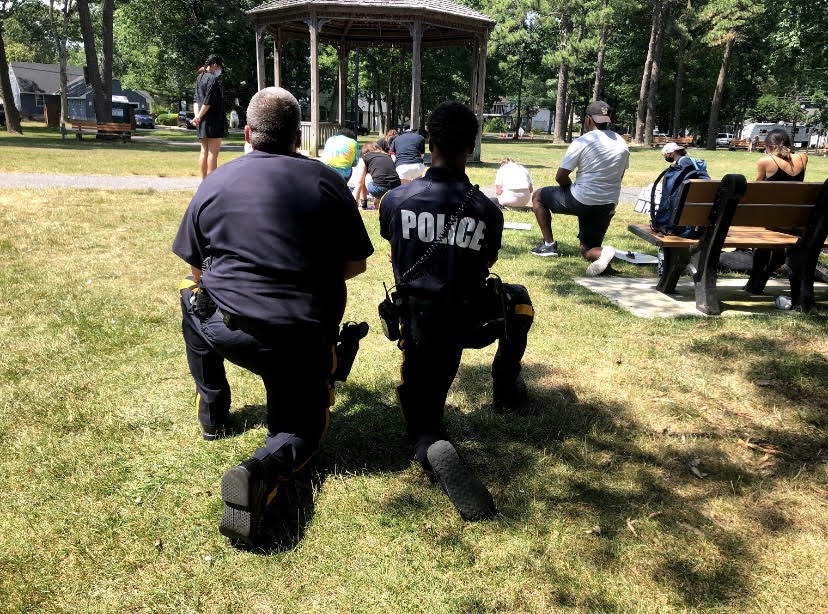
The protesters marched, spoke, listened to speeches, knelt in a moment of silence for George Floyd, and sang in Absecon’s Heritage Park, all in an effort to honor Black people who have en- countered police brutality and to advocate for change.

Eventually, the group departed from quaint Heritage Park and marched to busy and bustling Route 30, taking their posters and voices with them for all to see and hear.

Sunrose hopes that the protests that have been occurring in Atlantic County, including her own, will provoke change in the community.

unnamed (1)

Lia Opperman

Griffin Says Schools Should Reopen

By Anne Tchuindje, Myanna Nash, and Daniel Sanchez

Washington, D.C., Chicago, Ill. and Boca Raton, Fl.

At a recent press conference with The Princeton Summer Journal, Republican congressional candidate Sheila Griffin spoke to reporters from The Princeton Summer
Journalism Program.

Born and raised in Pinellas County, in Florida’s 13th Congressional District, Griffin became a Republican at age 18. In 2012, Griffin became involved with the Florida Bar’s Executive Committee for Labor and Employment. She found her life’s calling in politics. If she wins the Republican primary, she will face incumbent Charlie Crist, former governor of Florida.

Griffin spoke about some of the most controversial issues of the day: race, the coronavirus, and returning to in-person instruction in public schools.

Challenging students’ questions about systemic racism in America, Griffin—who is Black—instead advocated for a “color-blind” approach to race.

“There’s only one race and that is the human race,” she said, when asked about ways to reduce systemic racism against people of color.

The candidate also dismissed racism’s role in the increased prevalence of COVID-19 among African Americans in the district where she is running. Though Pinellas County
is overwhelmingly white, Black residents account for approximately 17 percent of the reported COVID-19 cases in the county.

Griffin attributed this to the recent increase in testing in Black communities. “When COVID first hit Pinellas County, it was in all-white neighborhoods. Right now, most of the testing is done in African American neighborhoods,” she said.

Passionate about education, Griffin spent considerable time talking about coronavirus-related school closures. “Elementary schools should never have closed in the first place,”
said Griffin, adding that “there simply isn’t enough science that proves that younger children could be affected by the virus.”

Although health officials are still researching how children are impacted, the Centers for Disease Control and Prevention have said that children can indeed become infected
and spread the virus.

With summer slowly coming to an end, school officials are now struggling to find a safe way to reopen schools and hold classes in person. Griffin said not reopening schools will do more harm than good, but that parents should be able to make their own decisions.

“It should be up to the parents, not local officials, to decide whether their child goes back to school or not,” she said. “Parents know their child best.”

An immigrant’s story

Credit Maggie SalinasMaggie Salinas

By Maggie Salinas

Sunland Park, N.M.

My father, Carmelo Salinas, immigrated to the U.S. in the 1970s after he couldn’t find work in Mexico. He was only 17, and he supported himself by picking pears in Southern California. We recently discussed how hard those early years in America were after he kept his experiences silent from everyone for years. Why did you find it necessary to immigrate for work?

“Mexico was corrupt and they didn’t want gente like me working. Everyone needed the money and was out to get you en Mexico. My dad used to be a bracero when he was young too, and he introduced my mom to American money.” What exactly did you work as?

“A lot of us usually worked in barracas de comunidad, and we would go up the mountains en Tehachapi [a city in California] to trim pear trees. Las barracas looked like prison cells. There [was] a two-in-one small bed, and we shared one toilet and a kitchen. Looking back, it was dangerous, but back then it was better than nothing.” Do you remember how much you earned?

“The owner would visit every quincena to pay us, 15 days. He would come up to you and go:

¿Cuantos arboles podaste, Carmelo?’

No pos’ que cien’

‘Bueno, son $150 por cien arboles’

He gave us about $150 per 100 trimmed trees every 15 days or a month algo así.” Did you face conflict with other workers?

“Sí, there were some old folk with us who didn’t want to go out and work with us because they had reumas, like arthritis, and they didn’t want to go out in the cold. Pero there were others who were just lazy. And they wanted us to split our earnings with them, or they would threaten to beat us. Some of us got into a fight with some of them. We didn’t want to pay them, and they tried stabbing me. I was able to take the knife away from him but your tío started punching him out of anger for threatening me. I remember telling him to stop so we wouldn’t get in trouble.” Was trimming pear trees the only way you earned money?

“No, after la temporada de piscar [harvesting] we would go to Bakersfield and lay down an irrigation system. We had to move pipes, and I remember when I had to supervise them at night, I would sleep under the water when they broke because the water was warmer. We needed to rent a place down in Bakersfield, and they paid me $3.25 per night. It was good money. We rented this house, and we had six Mexican guys, including your tío and me, and four girls. Some were American, and others were pochas, Mexican-American.” Did you have any encounters with deportation?

“Oh yeah. I used to have a girlfriend, her name was Suzy, but she was part of the pandillas, like gangs, in East LA, and I was really scared of the cholos. Fights would break down often when we went out to eat in her area, and I tried to get away, but one time la migra, immigration, came down and got us. They took us down to Tijuana. Sometimes they took [us] down to Calexico, Chula Vista, and Downtown LA for detainment. They would deport [us] in about 48 hours.” What did you do when you were deported?

Credit Maggie Salinas 1

Maggie Salinas


“I came back, por la familia.” Did you meet any interesting people?

“Cesar Chavez. I met him when he began his protests in Bakersfield, around 1973. Maybe it was just me, but I didn’t participate. To me, I felt there was no real gain in protesting other than attention, but I had more to lose. If I were older and had been educated past age 12, maybe I would have spoken to him more. A lot of us stayed away from the huelgas. We needed the money, our parents needed the money, and it was better than unemployment in Mexico. Uno tenia miedo de perderlo todo.”

“I was young, I only knew to survive. If I were educated, I think I would have appreciated the movement more. But I didn’t want to lose my progress in life. And he was famous, but I didn’t care to pay attention, but that was just me.” Today, Carmelo Salinas is a father of five children, all first-generation American citizens. He worked his way from being an immigrant in California to residing in Sunland Park, New Mexico. Born in 1955, he immigrated to California in the ’70s and learned English through pop culture. Though he didn’t receive his GED until 2014, along with his wife who was also an immigrant, he earned certification as a machinist and welder. He earned his American citizenship in the ’90s and helped his wife gain residency in 2007. To this day, he works endlessly to support his family, and contrary to harsh claims that date back to the ’70s, he never took advantage of welfare or the government’s re- sources without working. Although monetary wealth is not present in the family, love and moral values always are.

Griffin Says Pandemic Response Overblown

By Aigner Settles and Brianne LaBare

Pennsauken, N.J. and Orlando, FL.

As new COVID-19 cases in Florida topped 10,000 per day, 13th District congressional candidate Sheila Griffin argued in a press conference with The Princeton Summer
Journal that her state’s response to the pandemic has been overblown.

Despite the increase in coronavirus cases in her state, Griffin—one of five candidates competing for a spot on the ballot against incumbent Democrat Charlie Crist—told reporters she believes that schools should be reopened immediately.

“When you start saying that somehow or another there’s no transmission or
likelihood [of catching the virus] for those who are under the age of 12, then I
don’t understand why we even closed the schools,” Griffin said.

Griffin argued that school closures will affect underprivileged youth who don’t have access to the technology needed for remote learning. “The big impediment will not
be for those children who already have what they need,” she said. “The impediment will be for all the children who will be left behind because they do not [have the resources necessary to succeed].”

Current plans in Griffin’s district provide varying options for families. “Most of our communities here have three choices. Their children can work totally online. Their children can come to school for two days and still work online. Or they can come full-time. Those are parental decisions that are being [put] up by the school board,” she said.

Griffin also emphasized the importance of parents having the final say regarding their child’s education, despite the increasing number of cases and guidance from public health experts to keep schools closed. “I never transfer responsibility that belongs to parents to anyone in government unless the parents are abusive,” she said.

Palzewicz Rejects ‘Defunding’ Police

By Paola Ruiz and Kwanza Prince

East Boston, Mass. and New York, N.Y.

At a recent press conference, Wisconsin Democratic congressional candidate Tom Palzewicz said he does not believe in “defunding the police,” but instead supports what he called “investment and reinvestment” to other social services.

“I think a lot of the dollars need to be moved from our policing system and reinvested into our mental health and a whole bunch of other areas,” he said.

Palzewicz, who is running to replace the retiring Republican Rep. Jim Sensenbrenner of Wisconsin’s 5th District, said police are too often called to treat issues they are not trained to address. “The way I describe this is: Our police force shouldn’t have to be
the one that gets called for everything that happens in our society,” he said.

One in four deaths that result from police encounters are individuals with mental health conditions, according to a report from the Treatment Advocacy Center. If funds were in-
vested in programs well-versed in these issues, he said, that would provide callers with an alternative to the police, and the fatality rate would decrease.

Palzewicz, a Navy veteran, ran against and lost to longtime Rep. Sensenbrenner in 2018 with only 38 percent of the vote. With Sensenbrenner retiring, Palzewicz has a clearer path to office, though the district is reliably red.

In an effort not to alienate more conservative members of his district, Palzewicz objects to the terminology “defunding the police,” saying, “it doesn’t necessarily solve the problem.” Yet his strategy of “reinvestment” sounds similar to most calls for defunding, in that he would move money spent on police activities to other government services while stripping police departments of their military-grade weapons.

“I think mental health is a huge issue in this country that has absolutely no dollars dedicated to it,” Palzewicz said.

“In Wisconsin, we spend more money on prisons than on education, and that tells you about where our priorities are, and our priorities need to change on that,” he added.

My mother’s escape from civil war

By Saw Kay 

San Diego, Calif.

The Karen Conflict started in 1949 in Burma (Myanmar), when the Burmese government began ethnic cleansing by killing non-Burmese or expelling them from the country. This continues today, including the religious cleansing of non-Buddhists, and is the longest ongoing civil war in the world.

At least 50,000 people have been killed. Around 93,000 people live in the nine refugee camps along the border between Burma and Thailand. Most of them are of Karen ethnicity. There are at least 1.5 million Karen who left Burma due to this conflict. They now reside in various countries around the world: the United States, Australia, Canada, Korea, India and Sweden.

Among them is my mother. My mother’s name is Ma Aye Myint and she is 60. She had to flee through the jungles in Burma for many years just to settle in Mae La refugee camp, Thailand. She was around 10 years old when she escaped from the Burmese soldiers who attacked her village.

1920px-Flag_of_the_Karen_National_Union.svg

The Karen Flag

The village my mother came from is Chitturae, located in Burma. She lived in the village with her parents and siblings. In my mother’s village, every day was a repeat of working in the field picking plants, selling food to the community, hunting, and holding com- munity events. Everyone in the community viewed one another as family members. They all held a warm and welcoming space. It was a home that could never be replaced, as my mother told me in a recent interview.

The villagers were prepared to face the conflict given the fact that it started a few decades earlier. However, they would not know when they would be the next victims.

The village was attacked around 1970. They were given no mercy and had to quickly flee for survival. What once was a beautiful village was now torn apart due to the destruction of the conflict.

When the Thailand refugee camps opened in October 1979, my people feared entering the camps since they might have been a trap. This influenced my mother’s family and caused them to constantly flee in the jungles between Burma and Thailand. In order to make it out alive, people would have to be mobile and not settle in one spot for too long. She would tell me that she had to flee barefoot because there were no such things as shoes where she came from.

As the years continued, my mother’s parents passed away and there were no safe villages to re- turn to. She could not depend on anyone for help and eventually sought refuge in the Thai camps at her own risk. She was between 20 and 30 years old at the time of arriving at one of the camps.

Life in the camp was very different from the village she came from. It was bordered off and you were prohibited from entering the city. Despite the protection she received, she remembers having to flee again from Burmese soldiers. To make things worse, she was pregnant with my older brother. We were born in the Mae La refugee camp. He was born in 1999 and I was born in 2002.

I am the youngest in my family and I was born with a disorder that influenced my parents to enter the U.S. I had to use a colostomy bag because my digestive system did not function normally. This was a disability I struggled with. The whole camp knew about me and believed that I would not make it. However, this would not stop my mother from reaching out to doctors to help me. Most professional doctors and nurses gave up on giving me treatment and doubted my chance of living. My mother’s love was too strong to give up on me and so she continued. She did not want me to be another child neglected by an undeveloped medical system in a third-world country. Only one doctor said I would make it and gave my mom hope. After a few years, once our papers to enter the United States were approved, we were sent to the Bronx, New York.