Tag Archives: writing

The Princeton Lab That Can Read Your Mind

By Kaden Paz Leyva

The Princeton Social Neuroscience lab is tucked into the basement of the Peretsman Scully Hall.

Inside, the lab has enough space for two people to be scanned at the same time as they talk, argue and laugh about their moments together. On the other side of the room with a computer system, a researcher charts their brain activity over time, searching for the moments when the two minds move together and the moments when they become disconnected.

The intensity of this work is deserving of the lab’s unofficial motto: “Your brain is on my mind.”

The lab studies and specializes in how people understand their own minds and that of others. Their research includes guessing what a friend is thinking and the tension one feels with a stranger. But the researchers themselves say that the lab is not only trying to answer the neurosociological questions of the mind. It’s also trying to make their research reach beyond academia, in language and in papers that people beyond the field may be interested to read. This makes the lab one-of-a-kind. 

The goal of their distinctive work, hyperscanning, lies at the center of the lab. It works by placing two people in the MRI machine simultaneously. There, these two people have a conversation and talk about issues in their relationship. Meanwhile, their brains are being measured mid-conversation. Princeton’s building layout allows researchers to run both MRIs simultaneously.

Graduate student Yeaju Kim said the hyperscanning is what drew her to work on the lab in the first place. “I was interested in human social interaction because I thought that the most human thing we could do was talk to each other,” said Kim. “We have our own language and I think that’s a really unique characteristic of our lives.” Watching two people’s brain’s activity align, she said, reveals things much deeper than physical mimicry. It is the moment of synchronization that goes beyond simply moving or speaking the same way. According to Kim, the lab examines “the way to understand the way you think and how others think.”

The research divides the brain scans into roughly 8,000 tiny 3D units called voxels and compares them across two people to see where brain activity overlaps. When researchers overlap the two scans on a 3D scan, it creates zones using different shades of red. Areas of the brain that appear darker means that the two people share similar patterns in their brains. That’s usually seen more between friends than between strangers. 

The process is slow and exacting. Researchers need around 100 hours of running code with the data before beginning to analyze it. Since the lab’s coding platform is prone to breaking down, those in the lab have to learn code from scratch to be able to continue with analysis. 

Through having to monitor simultaneous MRIs, keeping participants still through the scan and making participants comfortable even though they can not see each other’s faces, it’s an intricate process. Kim still said watching the data come together makes the work rewarding. This gives her a rare and thorough window into how people connect. 

Lab manager Amy Nguyen came to the lab with experience largely in developmental and clinical psychology. Nguyen’s outside perspective has shaped how she will communicate and publish the lab’s findings in a language that will be understandable both to people who aren’t already a genius in the field and to those who are an expert.

Researchers in the lab are careful to note that basic science like this isn’t exactly designed to produce immediate applications in the real world. But Nguyen said the couple’s research could eventually help bring different approaches to relationships.

The willingness to explain and look into a more iterative side of research alongside the big findings of a lab is part of what researchers say sets the lab apart. As Nguyen put it, most people seem to picture a wet lab for dissection when they think of neuroscience, not realizing how much of the work is coding, math and careful design.

As the lab continues to study how two minds can be studied at once, the researchers say the bigger goal hasn’t changed: understanding not just how people think but how they think about each other, and making sure that understanding doesn’t stay locked inside a lab.

Small Businesses Hold Princeton’s Hearts

By Ximena Garcia

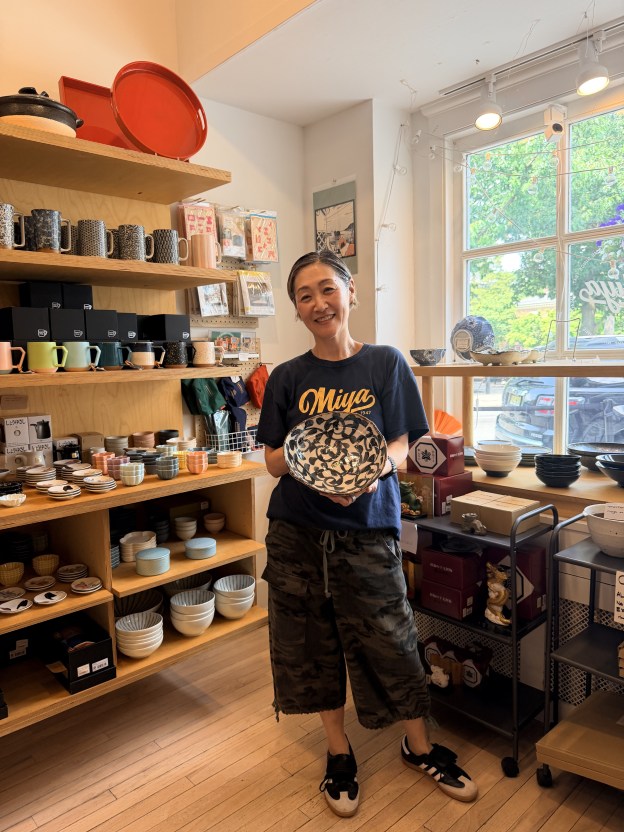
A temple-like wooden structure decorated with fairy lights hangs over neatly placed, color-coded goods: candles, books, bowls and plates. A white cat sits in the center, greeting each customer with a cheeky smile beneath a sign that reads: MIYA TABLE & HOME.

“It’s so pretty,” said Heidi Moon, the owner of Miya Table & Home, pointing out the structure. “We thought that it looked very much like a temple, and the Chinese character for Miya actually means shrine or temple.”

Miya Table & Home is a local business in Princeton, New Jersey, selling Japanese tableware and gifts. After introducing their goods to Princeton with a pop-up shop, Miya Table & Home opened a permanent store in April 2018. Through their struggles, the store remained consistent with what made Princeton fall in love with them in the first place: their authenticity. 

95% of Miya Table & Home’s products are imported from Japan. With the help of an agent, they select the items best catered to their tastes. It is crucial for them to select products based on what they genuinely enjoy instead of what is popular in Japan.   

“I think over the years we’ve kind of developed a certain eye for it and we have a certain aesthetic and we never get anything we don’t like,” Moon said. “We don’t get pressured into getting something that we don’t like just because somebody says it does well.” 

This philosophy extends to other businesses in Princeton. French restaurant Kristine’s prioritizes granting their clients a true taste of French dining. Founding chef Nicolas Démurgé upholds this mission by ensuring that every aspect of the restaurant, especially the menu, adds to the culinary experience. 

“When you open a French restaurant abroad, you know if you have a burger on your menu, you are going to sell more burgers than classic Frenchies. You don’t want to go too much into this direction because at one point you are going to lose your identity,” he said. “At one point, I took off, for example, the burger on the menu because I was selling it way too much. That’s not the experience we want. You can get a burger everywhere.” 

Named after Démurgé’s daughter and mother, Kristine’s opened in November 2019, offering an assortment of French-influenced dishes such as jambalaya. At Kristine’s, prepping these dishes requires the chefs to look beyond the seasonings and craft an impactful moment for the client. 

“Food, it’s about culture more than about skills. It’s about memories. You have awesome dishes from your grandmother, your mom, and your friends. It’s a part of yourself because it’s some strong memories of flavors. And you can remember some flavor forever. It’s so impressive,” said Démurgé. 

JaZams, a toy and book store in Princeton, values nostalgia, too. Customers are greeted by a wall of endless LEGO sets, the fluffy stuffed animals and vibrant assortment of toys. Co-owner Joanne Farrugia smiles wide as she explains the process that goes into choosing the toys they sell. Analogous to Miya Table & Home, Farrugia states that they are intentional with each toy and book they place on their shelves. Their care has continuously rewarded them by placing them ahead of consumer trends, allowing them to serve Princeton with a reliable stock for in-demand products. 

For example, when Sonny Angels gained popularity, other retailers struggled to carry them. This wasn’t the case for JaZams. 

“When it became really, really hot, we had all these great connections with our manufacturers, so that we were able to still carry it,” Farrugia said. “When a new store would come in and say ‘We want that because it’s hot and it’s selling,’ they would be like, ‘No, we don’t have enough.’ So in these cases, that really served us well.” 

Each of these businesses’ efforts to deliver quality goods and experiences to Princeton has undoubtedly won them many fans. The love is reciprocated through community collaboration and engagement. 

Miya Table & Home has hosted events with the Arts Council of Princeton, including a New Year’s social in which the community painted figures that held cultural significance. 

Kristine’s partners with non-profits. They currently have an upcoming event with The Blue Bears Special Meals, a non-profit for individuals with special needs. Supporting local organizations he aligns with is one of Démurgé’s favorite parts of the job.

JaZams has also given back to the community in various ways. Most recently, they celebrated their thirty-year anniversary with the Princeton community by providing a carousel and free carnival games. 

“Our mission is always to make everything accessible, for all families, no matter their economic status,” said Farrugia. “That way, they can come with a whole bunch of kids and they can play.” 

Pank-a-Squith Shows the Never-ending Nature of Suffrage

By Yaretzi Cobian

Rolling dice and moving pawns as a medium of learning about suffrage may sound unusual, especially if the game has origins from an entirely different country. Yet one such game has found its place in the archives of Princeton University. 

Pank-a-Squith, a table-top board game created in 1909 by the Women’s Social and Political Union (WSPU), was named after Emmilene Pankhurst and Herbert Asquith, prominent figures in the suffragist movement in England during the early 1900s. The premise of the game: You do not win until you reach the last square, granting you the right to vote. To achieve this is nearly impossible. Only setbacks are guaranteed.

The WSPU was formed in the early 1900s in England and primarily focused on helping women win the right to vote. The union, solely run by women, created the board game as a fundraiser for their foundation, as well as a means of illustrating the common obstacles suffragists encountered in their fight for voting rights.

The combination of the names Pankhurst and Asquith represent a dichotomy between suffragists and opposing government bodies. Emmilene Pankhurst founded the WSPU in 1903 and played an element in the union and in the British suffrage movement. For his part, Herbert Asquith, England’s Prime Minister from 1908 to 1916, was a leader in the anti-suffrage movement. The two were such polar opposites that in 1910, a group of suffragettes attacked Herbert outside the House of Commons. 

The rules of Pank-a-Squith are similar to those of Candyland or Snakes and Ladders: Roll the dice and move across the board accordingly. Pank-a-Squith comes with unique consequences, depicting prejudice in game board illustrations. Each square on Pank-a-Squith has a distinctive image of a barrier faced by suffragettes. Square 36, for example, depicts the government’s actions using an icon of a policeman in addition to jail bars and handcuffs, reminds players that the British government used incarceration as a tactic to silence women.

Out of the 50 total squares that compose Pank-a-Squith, 16 have an added consequence when a player lands on them, including missing a multitude of turns or having to return to a previous square. The final square makes you roll the dice again to cast the exact number needed. If not, you count back by what you are over by, adding another obstacle to winning. These repercussions make Pank-a-Squith a never-ending game.

Although some groups of women gained suffrage over a century ago, the Brennan Center for Justice suggests threats to women’s voting rights have not gone away. Just like Pank-a-Squith, the fight for women’s suffrage may never end. 

Red Bull New York’s Defensive Drought Continues

By Yeisbel Peña

Charlotte FC needed just twelve minutes to decide their July 25 match at Sports Illustrated Stadium, beating Red Bull New York, 2-0, in a match decided not by sustained pressure, but by consistent defensive lapses. 

Both goals came in the opening stretch of the game, with Charlotte’s Pep Biel striking in the seventh minute and Ashley Westwood scoring another in the twelfth. On the other end of the field, Charlotte Keeper Kristijan Kahlina finished with five saves to close out the shutout in front of a home crowd that had barely settled in their seats before the deficit hit two. 

The early Red Bull collapse reflected a season-long struggle for the team’s back line. Dylan Nealis, Justin Che, Julián Bazán and Matthew Dos Santos have rotated through the defense amid injuries and inconsistent form. Neither of the team’s centerbacks closed in on Biel in time to stop his opener. Charlotte worked the ball through the midfield unchallenged, landing a low finish from just inside the box. Westwood found even more room on the second goal, arriving at the back post without a Red Bull defender in sight. 

Charlotte’s defense had its shaky stretches, too. The visiting team conceded chances late in first-half stoppage time and again after the break as New York’s Cade Cowell, Emil Forsberg and Adri Mehmeti pushed forward, looking for a way back into the match. Mehmeti forced a save in the closing minutes of the game, but Charlotte’s back line, marshaled by Kahlina’s five stops, held on comfortably enough that the outcome was rarely in doubt. 

The loss dropped the Red Bulls to 6-4-7 on the season, 22 points, while Charlotte improved to 7-4-6, 25 points, tightening the race in a crowded Eastern Conference table. Neither club sits comfortably in its conference standing, a detail that fits a broader trend across the league this year. MLS teams have generally found it easier to score than to stop opponents from scoring.

Roster turnover, congested fixture lists tied to international windows, and league-wide spending that favors attackers over centerbacks have left many clubs cycling through back-line combinations without ever settling on a consistent unit. Saturday’s match compressed that trend into a dozen minutes, as two early defensive breakdowns decided a game that otherwise stayed competitive from end to end.

For Red Bull New York, the result renews questions about whether the roster has kept pace with a division growing more direct in the final third at a time when reliable defensive options remain difficult to find across the MLS.

Clean Up on the BULLevard

By Kamiyah Hill

As thousands of fans took their seats at Sports Illustrated Stadium, Red Bull New York was not the only focus of the crowd. The stadium, which holds over 20,000 people, leaves a lasting impression on anyone who has ever stepped inside. During Saturday’s game against Charlotte FC, fans filled the stadium hoping to see a win. But would that excitement hold? 

One reason for the excitement: Game day, July 25, was the birthday of the team’s mascot, REDD. A party for REDD was held at a fan event called The BULLevard, where the well-known cast of Sesame Street welcomed young Red Bull fans to celebrate with meet-and-greets with Elmo, coloring stations, face painting, and games. The Red Bull logo was everywhere. Fans were encouraged to arrive early to receive a limited edition REDD bobble head.

After making it past security, the majority of the crowd went up a large staircase to the stadium’s concourse, where food vendors lined the walkway. The smell of the greasy chicken tenders, fries and pizzas was striking. Fans searched for their seats in sections labeled above staircases, which made the area easy to navigate. 

The stadium appeared to be freshly cleaned; the floors were wet and shiny, presumably mopped and pedestrians navigated the paths without much foot traffic. In a women’s bathroom near third story Section 224, the floor was clear save for a few tiny ants marching between the stalls. The bathroom was accessible, fully stocked and welcoming to all, with many stalls and sinks available. 

The rows in the upper stands were close together, forcing fans to stand from their seats to allow others to pass or turn vertically to slip through, which made it hard for others to get to their seats. The stands were trash-free and the seats left no residue.

Fireworks went off before the game began, leaving behind a thick grey smoke that made it hard to see the action. As the smoke cleared, children and adults walked onto the pitch holding a New York Red Bull banner during the national anthem, which was followed by another firework display. The game began shortly after. 

At halftime, youth teams took the field while Elmo helped REDD celebrate his birthday with a cake. If the environment was supposed to be family friendly, many fans did not receive the message. Older fans yelled out profanities and degrading chants, disappointed by their team’s poor performance in a 0-2 loss to Charlotte FC. 

Despite the loss and the inconsiderate behavior of some of those present, the fans had fun and the stands were clean. For some, that’s enough. But for others, the bathroom conditions, lingering fireworks smoke and lack of space in the stands might be a dealbreaker. 

‘Sesame Street’ After Dark

By Emma Gaskill

Red Bull New York’s first home game after the World Cup on Saturday was supposed to be a welcoming, kid-friendly environment because of its “Sesame Street” theme, but rowdy adults got in the way.

New York fans were excited to finally see their team back in action as red and yellow filled the stadium. Red Bull’s mascot, Redd, was even celebrating his second birthday with fellow sports mascots from around the country, and special guest Elmo.

Although the night was meant to be special, New York fans were quickly disappointed as Charlotte scored two quick goals before the tenth minute. Naturally, the adults in the stadium became angry with the performance of their team. 

Not everyone felt the same amount of anger. A few rows into section 225, there were kids no older than ten or eleven enjoying their night. But the emotions of frustrated grown-up fans caused those kids to move seats, leaving the yelling adults behind. 

 This highlighted a key divide between fans in this game: Kids versus adults.

Both groups handled Saturday’s game differently, specifically the losing, and their reactions weren’t necessarily mixing. 

In a game centered around kids, there were adults who clearly disregarded the audience around them. They shouted at refs about calls, or the lack thereof, that they didn’t agree with. For instance, they shouted when Adri Mehmeti was sent off with a red card. The general play by the athletes also caused an uproar among fans. 

In the same 225 section, a little kid that was no older than eight or nine was simply cheering for New York, hoping that they would score goals and win the game. 

New York’s Emil Forsberg, the team captain, talked about how he liked the energy of the fans and how it brought a good feeling to the team. That same energy didn’t have a similar impact on the children in the crowd. Parents of those children now have to think about the environment they are putting their kids into at Red Bulls games. Sports games are fun, but parents also have a responsibility to their children.

Adults are going to get angry when their teams lose a game and kids are always going to be at sports games. Should these adults have reigned in their vulgarities at a game specifically marketed to kids? Maybe. But should parents know that their kids might hear some bad words at a Red Bull game? 

Definitely.