Tag Archives: Family

“Bad Shabbos” Is Actually Bad: A Comedy That Misses Its Mark

By Jiondae D.

The laws of Shabbat argue that if one is not bedridden, even minor medications should be prohibited. While this violates Shabbat rules, nothing is worse than betraying the Ten Commandments—arguably in the worst way: murder.

These conflicting ideas collide in Daniel Robbins’ film Bad Shabbos.

After joining his girlfriend’s family for Shabbat dinner, Benjamin’s fate is sealed the moment he reveals his colitis diagnosis—and makes a few offhand comments to his girlfriend’s brother, Adam. Soon after, Adam drugs him with laxatives.

Despite losing Benjamin early on, his death fails to create suspense. Instead, it becomes an excuse to launch into a series of underwhelming scenes that make the moment feel almost comedic.

The film takes place in an Upper West Side apartment in New York City, home to Mr. and Mrs. Gelfland and their youngest son, Adam. They invite their two older children and their partners to celebrate Shabbat dinner. Roughly 20 minutes in, Benjamin drinks laxatives. After a comical struggle with his pants and a race to the toilet, he slips, hits his head, and passes away—off-screen, in the bathroom.

Typically, a film’s climax occurs about 90% of the way through. But in Bad Shabbos, Benjamin’s death happens so quickly and chaotically that the rest of the film struggles to find purpose. Audiences don’t pay over twenty dollars to watch a twenty-minute movie, and unfortunately, the remaining runtime becomes a collection of scenes that are more mediocre than meaningful. The cat’s unhinged behavior and wasted food do little to elevate the tone.

Even more jarring is the hypocrisy on display. The Jewish parents mock their daughter for using a car during Shabbat while their son—who killed a guest—is shielded from consequences. This contradiction darkens the already uneven tone of the film.

And just when it seems the chaos is over, the future in-laws arrive. What should be an opportunity for dramatic tension turns into another shallow gag. Glaring looks from the mother and spilled soup are played for laughs, but it’s not as funny as the filmmakers may have hoped. Instead, it feels like filler—lacking imagination and failing to build on earlier scenes that had at least a little more personality.

Benjamin’s death becomes less important with every scene. What could’ve grounded the film in something dark and compelling instead becomes tasteless. This isn’t just an ordinary Shabbat.

It’s the epitome of carelessness.
In “Bad Shabbos,” Daniel Robbins Paints Gritty Family without the Tropes

By Ashanty R.

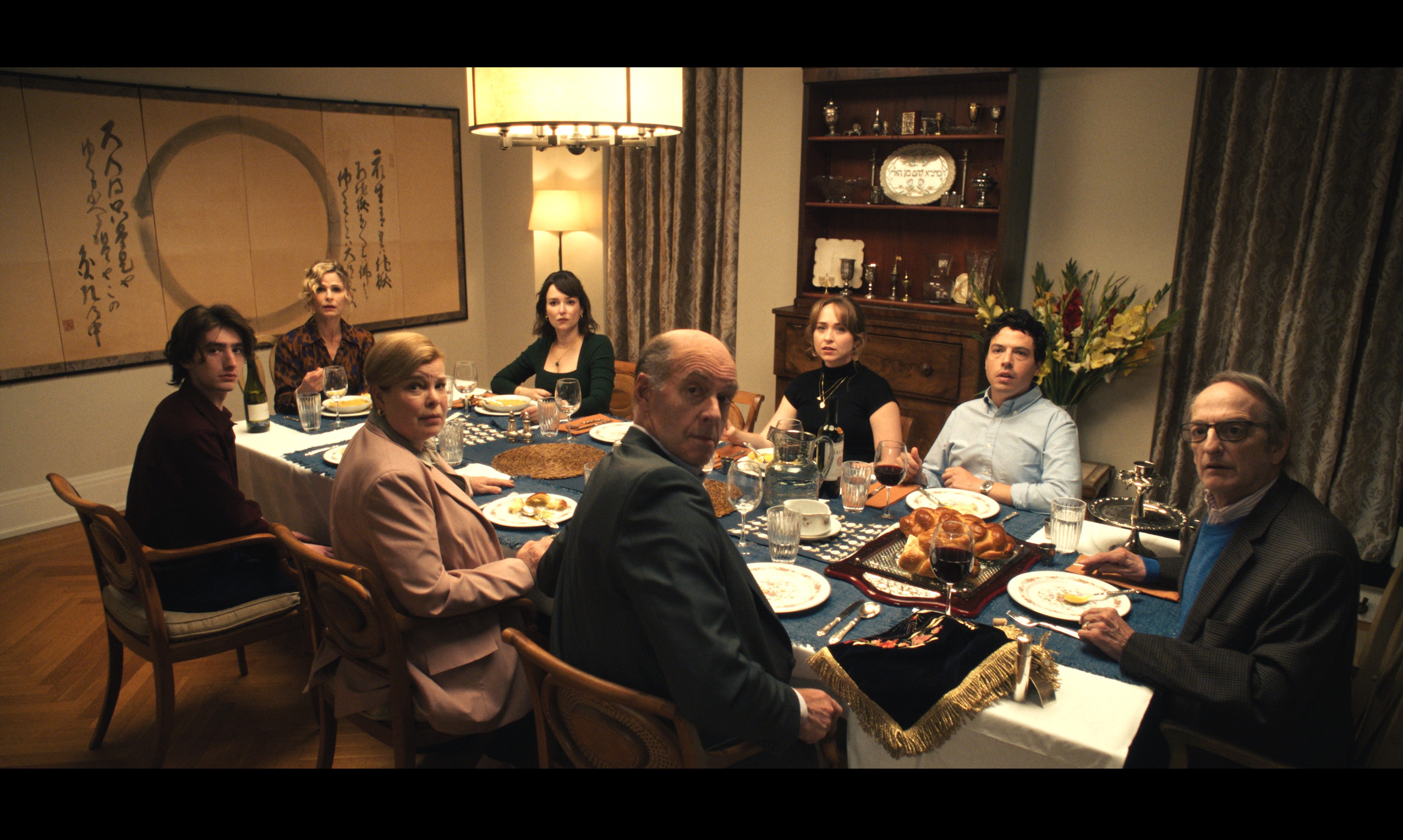
In apartment 10B on the Upper West Side, wingback chairs and towering bookshelves decorate the living room. Untouched plates set the stage for an orderly Friday Sabbath banquet. The audience is immediately pulled into the world of an upper-middle-class family putting on their brightest smiles.

Caught up by the highbrow decorum, it wouldn’t cross a viewer’s mind to check the bathroom for a body. 

Director Daniel Robbins delivers a dark comedy that upends the “dysfunctional family” trope by leaning all the way in. Bad Shabbos follows an interfaith couple, Meg and David, attending a Shabbat dinner with David’s family; hyper-observant matriarch Ellen; mild-mannered patriarch Richard; wisecracking sister Abby, her philandering boyfriend, Benjamin, who has unfortunate digestive problems; and Adam, the socially awkward younger brother known for impulsive pranks. 

Then Adam kills Benjamin.

To be fair, it was an accident. A subtle wrist flicking crushed laxative pills into a cocktail sends Benjamin rushing down the hall with a gurgling gut. Futile attempts to pull down his pants cause him to crack his head on the bathroom sink, and from there, he’s a goner.

While there was some finger-pointing in the beginning – because who wouldn’t blame a murderer for murder? –  they make a choice: protect their own.

Was it morally wrong? Absolutely. 

But Bad Shabbos couldn’t care less about moralizing, and they never said they did. It’s alluring because of the messy, contradicting truths about family that lie under each dynamic, each decision, and each quip.

The biggest one?

They fight like feral dogs, nipping at each other’s wounds and beaming when the other bites back. But they would pull their teeth before turning one of their own in. 

“We’re not good people,” Abby mutters as she begrudgingly drags Benjamin’s body toward the fire escape, “but we’re our people.”

Robbins refreshingly rejects the posterboard Hollywood route to family. Trading in the estrangements and disownments, he brings a murkier take to the table. These characters do more than skip hand-in-hand into the horizon. They snap, snark, and plot just like we do – but when a crisis hits, they become one..

It’s especially clear in a scene when Adam, once the black sheep of the family, is herded by his siblings through the decently-competent clean up posed by their lobbyist, Jordan, who his siblings managed to pull into the coverup. Adam’s parents are fully complicit, too. Ellen’s well-timed “kitchen mishap” delays all talks of dinner and deflects suspicion from the incriminating hallway, while Richard hosts “Shabbat hymns” at the table with closed eyes – buying David enough time to turn his bloody cuff inside-out.

Admittedly, Bad Shabbos plays some scenes for laughs. But emotional residue sticks to the audience even as they leave the screening. 

The film holds up a mirror, calling to mind every subtle elbowing and quick-whipped insult that burns tongues at home. But it also brings to mind also every caring hand wiping away tears and every smothering bear hug. It’s every eye roll and painstakingly grunted, “I love you,” followed-up with a quick jab — because we can never get too comfortable with family, right?

While your misfit family may not lug around a body, scrub bathroom tiles, or trash damning lobby footage, Bad Shabbos makes it clear that even a disjointed herd still moves as one.

“Bad Shabbos”, Good Movie: A Chaotic Dinner Worth Watching

By David R.

Director Daniel Robbins’ tour de force, Bad Shabbos begins with the end. Two elderly Jewish men stroll down a New York City street at night. One begins telling a joke. The punchline? A corpse plummets from a nearby building, landing in front of them. The film then rewinds to tell the story of the night preceding this event.

David and Meg, portrayed by Jon Bass and Meghan Leathers respectively, are an interfaith couple engaged to be married. Unfortunately, there are a few problems for the young lovers.

The first issue is Meg’s parents, conservative Catholics from Wisconsin, who—while never stating it outright—are clearly displeased with Meg’s conversion to Judaism. Another issue is David’s mother, whose passive-aggressive remarks toward Meg create tension in their relationship.

These concerns come to a head on the night of Shabbos—the weekly Jewish day of rest from Friday sunset to Saturday sunset. While Meg gives Judaism her best effort, David’s mother (played by Kyra Sedgwick) is slow to accept her. In spite of her better judgment, Meg invites her staunchly religious parents to Shabbos dinner.

Upon arriving at the apartment, the audience is introduced to David’s screw-up brother, Adam (Theo Taplitz). Taplitz’s performance is wickedly delightful. His character is sharply written, offering a thoughtful and provocative satire of toxic masculinity. Taplitz’s acting, combined with clever writing by Robbins and Zack Weiner, keeps the audience riveted whenever Adam appears.

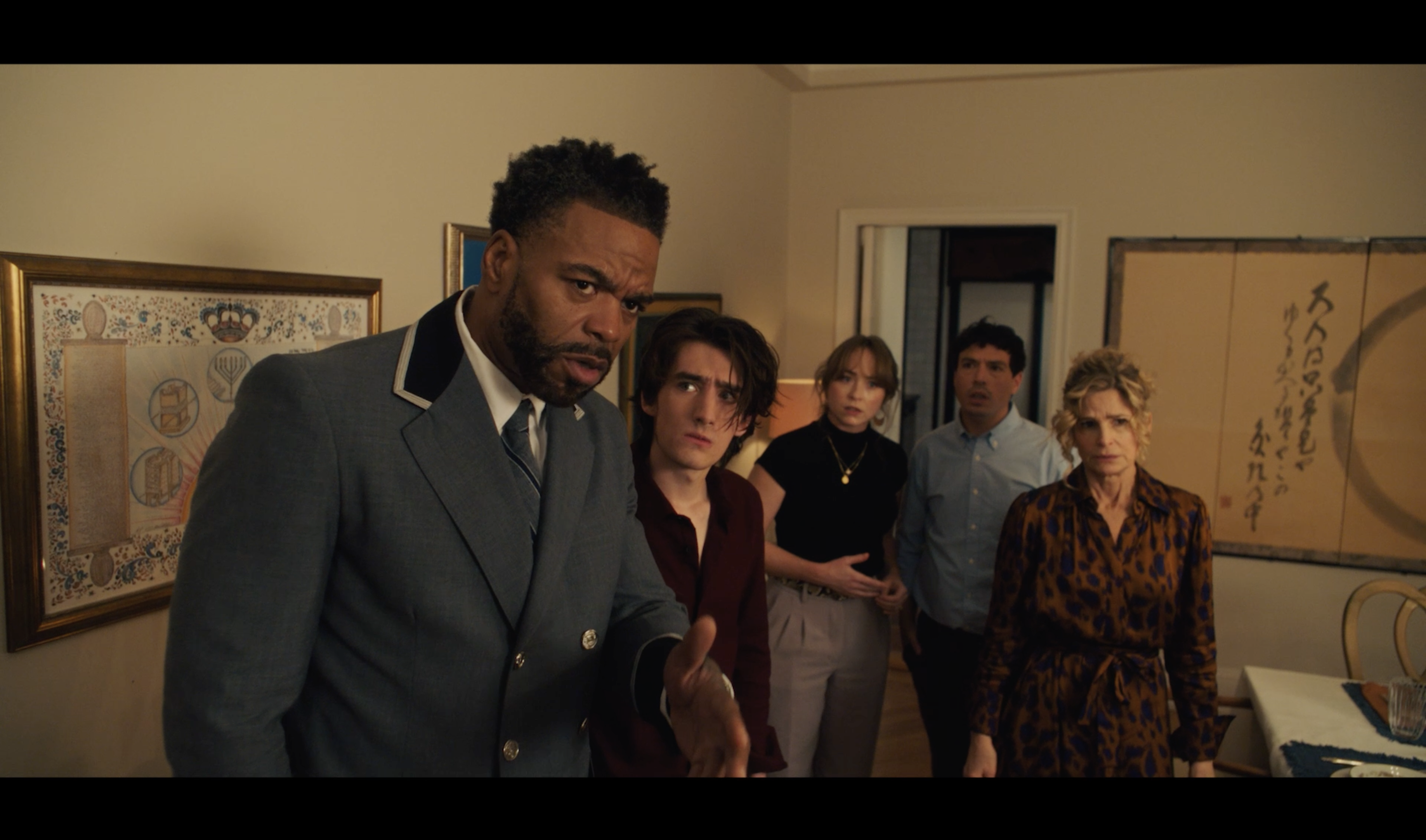
Other notable characters include David’s sardonic sister Abby (Milana Vayntrub), Abby’s philandering boyfriend Benjamin (Ashley Zukerman), David’s eccentric father Richard (David Paymer), the charismatic doorman Jordan (played by rapper Cliff “Method Man” Smith Jr.), and Meg’s stiff parents (John Bedford Lloyd and Catherine Curtin). Every actor adds something memorable, with Lloyd and Curtin portraying unintentionally bigoted parents in a grounded yet hilarious way.

Early in the evening, Benjamin and Adam begin to clash. After enduring one too many sarcastic remarks, Adam slips laxatives into Benjamin’s drink—unaware that Benjamin has colitis. In a frantic attempt to reach the bathroom, Benjamin slips, fatally hitting his head. What follows is a hilarious scramble to hide the body, roping the entire family into an increasingly absurd cover-up.

My one complaint? The twist was a bit predictable. As soon as Benjamin was introduced, I suspected he was the corpse from the opening scene (no character that unlikable escapes punishment). Still, the execution was funny, and the moment remained an effective plot device.

Finally, what I appreciated most was the sincerity of the film. Many comedies that center on American subcultures tend to satirize or undermine the communities they depict. Bad Shabbos, however, is better described as a celebration of Jewish-American life. From the reprise of “Bum Biddy” from Adam Sandler’s Eight Crazy Nights to the heartfelt speech by David’s sister Abby, the film honors Jewish culture and finds humor in the most unlikely places.

An immigrant’s story

Credit Maggie SalinasMaggie Salinas

By Maggie Salinas

Sunland Park, N.M.

My father, Carmelo Salinas, immigrated to the U.S. in the 1970s after he couldn’t find work in Mexico. He was only 17, and he supported himself by picking pears in Southern California. We recently discussed how hard those early years in America were after he kept his experiences silent from everyone for years. Why did you find it necessary to immigrate for work?

“Mexico was corrupt and they didn’t want gente like me working. Everyone needed the money and was out to get you en Mexico. My dad used to be a bracero when he was young too, and he introduced my mom to American money.” What exactly did you work as?

“A lot of us usually worked in barracas de comunidad, and we would go up the mountains en Tehachapi [a city in California] to trim pear trees. Las barracas looked like prison cells. There [was] a two-in-one small bed, and we shared one toilet and a kitchen. Looking back, it was dangerous, but back then it was better than nothing.” Do you remember how much you earned?

“The owner would visit every quincena to pay us, 15 days. He would come up to you and go:

¿Cuantos arboles podaste, Carmelo?’

No pos’ que cien’

‘Bueno, son $150 por cien arboles’

He gave us about $150 per 100 trimmed trees every 15 days or a month algo así.” Did you face conflict with other workers?

“Sí, there were some old folk with us who didn’t want to go out and work with us because they had reumas, like arthritis, and they didn’t want to go out in the cold. Pero there were others who were just lazy. And they wanted us to split our earnings with them, or they would threaten to beat us. Some of us got into a fight with some of them. We didn’t want to pay them, and they tried stabbing me. I was able to take the knife away from him but your tío started punching him out of anger for threatening me. I remember telling him to stop so we wouldn’t get in trouble.” Was trimming pear trees the only way you earned money?

“No, after la temporada de piscar [harvesting] we would go to Bakersfield and lay down an irrigation system. We had to move pipes, and I remember when I had to supervise them at night, I would sleep under the water when they broke because the water was warmer. We needed to rent a place down in Bakersfield, and they paid me $3.25 per night. It was good money. We rented this house, and we had six Mexican guys, including your tío and me, and four girls. Some were American, and others were pochas, Mexican-American.” Did you have any encounters with deportation?

“Oh yeah. I used to have a girlfriend, her name was Suzy, but she was part of the pandillas, like gangs, in East LA, and I was really scared of the cholos. Fights would break down often when we went out to eat in her area, and I tried to get away, but one time la migra, immigration, came down and got us. They took us down to Tijuana. Sometimes they took [us] down to Calexico, Chula Vista, and Downtown LA for detainment. They would deport [us] in about 48 hours.” What did you do when you were deported?

Credit Maggie Salinas 1

Maggie Salinas


“I came back, por la familia.” Did you meet any interesting people?

“Cesar Chavez. I met him when he began his protests in Bakersfield, around 1973. Maybe it was just me, but I didn’t participate. To me, I felt there was no real gain in protesting other than attention, but I had more to lose. If I were older and had been educated past age 12, maybe I would have spoken to him more. A lot of us stayed away from the huelgas. We needed the money, our parents needed the money, and it was better than unemployment in Mexico. Uno tenia miedo de perderlo todo.”

“I was young, I only knew to survive. If I were educated, I think I would have appreciated the movement more. But I didn’t want to lose my progress in life. And he was famous, but I didn’t care to pay attention, but that was just me.” Today, Carmelo Salinas is a father of five children, all first-generation American citizens. He worked his way from being an immigrant in California to residing in Sunland Park, New Mexico. Born in 1955, he immigrated to California in the ’70s and learned English through pop culture. Though he didn’t receive his GED until 2014, along with his wife who was also an immigrant, he earned certification as a machinist and welder. He earned his American citizenship in the ’90s and helped his wife gain residency in 2007. To this day, he works endlessly to support his family, and contrary to harsh claims that date back to the ’70s, he never took advantage of welfare or the government’s re- sources without working. Although monetary wealth is not present in the family, love and moral values always are.

My mother’s escape from civil war

By Saw Kay 

San Diego, Calif.

The Karen Conflict started in 1949 in Burma (Myanmar), when the Burmese government began ethnic cleansing by killing non-Burmese or expelling them from the country. This continues today, including the religious cleansing of non-Buddhists, and is the longest ongoing civil war in the world.

At least 50,000 people have been killed. Around 93,000 people live in the nine refugee camps along the border between Burma and Thailand. Most of them are of Karen ethnicity. There are at least 1.5 million Karen who left Burma due to this conflict. They now reside in various countries around the world: the United States, Australia, Canada, Korea, India and Sweden.

Among them is my mother. My mother’s name is Ma Aye Myint and she is 60. She had to flee through the jungles in Burma for many years just to settle in Mae La refugee camp, Thailand. She was around 10 years old when she escaped from the Burmese soldiers who attacked her village.

1920px-Flag_of_the_Karen_National_Union.svg

The Karen Flag

The village my mother came from is Chitturae, located in Burma. She lived in the village with her parents and siblings. In my mother’s village, every day was a repeat of working in the field picking plants, selling food to the community, hunting, and holding com- munity events. Everyone in the community viewed one another as family members. They all held a warm and welcoming space. It was a home that could never be replaced, as my mother told me in a recent interview.

The villagers were prepared to face the conflict given the fact that it started a few decades earlier. However, they would not know when they would be the next victims.

The village was attacked around 1970. They were given no mercy and had to quickly flee for survival. What once was a beautiful village was now torn apart due to the destruction of the conflict.

When the Thailand refugee camps opened in October 1979, my people feared entering the camps since they might have been a trap. This influenced my mother’s family and caused them to constantly flee in the jungles between Burma and Thailand. In order to make it out alive, people would have to be mobile and not settle in one spot for too long. She would tell me that she had to flee barefoot because there were no such things as shoes where she came from.

As the years continued, my mother’s parents passed away and there were no safe villages to re- turn to. She could not depend on anyone for help and eventually sought refuge in the Thai camps at her own risk. She was between 20 and 30 years old at the time of arriving at one of the camps.

Life in the camp was very different from the village she came from. It was bordered off and you were prohibited from entering the city. Despite the protection she received, she remembers having to flee again from Burmese soldiers. To make things worse, she was pregnant with my older brother. We were born in the Mae La refugee camp. He was born in 1999 and I was born in 2002.

I am the youngest in my family and I was born with a disorder that influenced my parents to enter the U.S. I had to use a colostomy bag because my digestive system did not function normally. This was a disability I struggled with. The whole camp knew about me and believed that I would not make it. However, this would not stop my mother from reaching out to doctors to help me. Most professional doctors and nurses gave up on giving me treatment and doubted my chance of living. My mother’s love was too strong to give up on me and so she continued. She did not want me to be another child neglected by an undeveloped medical system in a third-world country. Only one doctor said I would make it and gave my mom hope. After a few years, once our papers to enter the United States were approved, we were sent to the Bronx, New York.

Growing up after my mother’s death

By Kina Carney
Philadelphia, Pa.

The afternoon before she died, I stood at my mother’s hospital bedside with my grandma. I looked at all the tubes and machines that enveloped her body. I heard the ringing of the feeding machine. I saw the paleness of her face. The smell of the IVs made me run from the room, into the waiting arms of my grandma. That night, I heard my older brother crying. I ran to the top of the stairs to see what was wrong. I’d never seen him cry before. Continue reading