
Tag Archives: restaurants

Small Businesses Hold Princeton’s Hearts

By Ximena Garcia

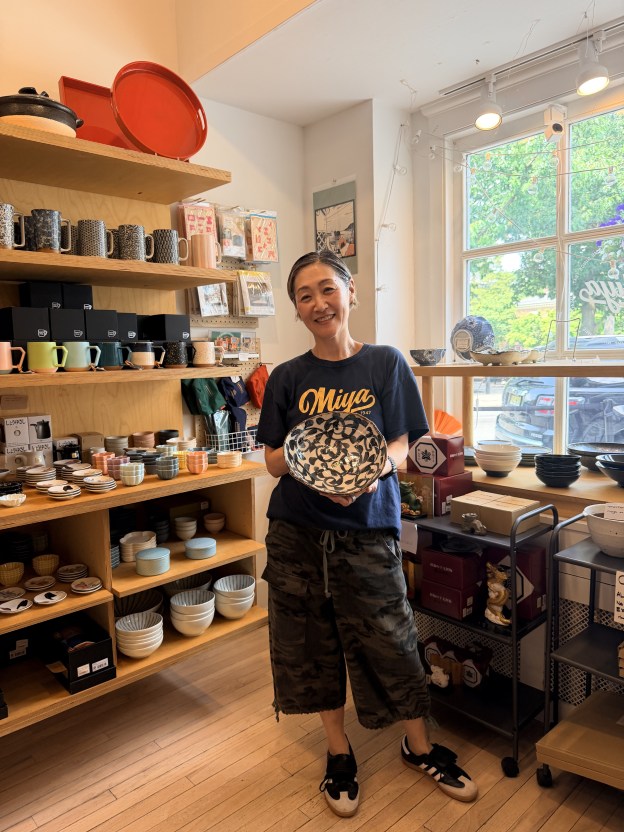
A temple-like wooden structure decorated with fairy lights hangs over neatly placed, color-coded goods: candles, books, bowls and plates. A white cat sits in the center, greeting each customer with a cheeky smile beneath a sign that reads: MIYA TABLE & HOME.

“It’s so pretty,” said Heidi Moon, the owner of Miya Table & Home, pointing out the structure. “We thought that it looked very much like a temple, and the Chinese character for Miya actually means shrine or temple.”

Miya Table & Home is a local business in Princeton, New Jersey, selling Japanese tableware and gifts. After introducing their goods to Princeton with a pop-up shop, Miya Table & Home opened a permanent store in April 2018. Through their struggles, the store remained consistent with what made Princeton fall in love with them in the first place: their authenticity. 

95% of Miya Table & Home’s products are imported from Japan. With the help of an agent, they select the items best catered to their tastes. It is crucial for them to select products based on what they genuinely enjoy instead of what is popular in Japan.   

“I think over the years we’ve kind of developed a certain eye for it and we have a certain aesthetic and we never get anything we don’t like,” Moon said. “We don’t get pressured into getting something that we don’t like just because somebody says it does well.” 

This philosophy extends to other businesses in Princeton. French restaurant Kristine’s prioritizes granting their clients a true taste of French dining. Founding chef Nicolas Démurgé upholds this mission by ensuring that every aspect of the restaurant, especially the menu, adds to the culinary experience. 

“When you open a French restaurant abroad, you know if you have a burger on your menu, you are going to sell more burgers than classic Frenchies. You don’t want to go too much into this direction because at one point you are going to lose your identity,” he said. “At one point, I took off, for example, the burger on the menu because I was selling it way too much. That’s not the experience we want. You can get a burger everywhere.” 

Named after Démurgé’s daughter and mother, Kristine’s opened in November 2019, offering an assortment of French-influenced dishes such as jambalaya. At Kristine’s, prepping these dishes requires the chefs to look beyond the seasonings and craft an impactful moment for the client. 

“Food, it’s about culture more than about skills. It’s about memories. You have awesome dishes from your grandmother, your mom, and your friends. It’s a part of yourself because it’s some strong memories of flavors. And you can remember some flavor forever. It’s so impressive,” said Démurgé. 

JaZams, a toy and book store in Princeton, values nostalgia, too. Customers are greeted by a wall of endless LEGO sets, the fluffy stuffed animals and vibrant assortment of toys. Co-owner Joanne Farrugia smiles wide as she explains the process that goes into choosing the toys they sell. Analogous to Miya Table & Home, Farrugia states that they are intentional with each toy and book they place on their shelves. Their care has continuously rewarded them by placing them ahead of consumer trends, allowing them to serve Princeton with a reliable stock for in-demand products. 

For example, when Sonny Angels gained popularity, other retailers struggled to carry them. This wasn’t the case for JaZams. 

“When it became really, really hot, we had all these great connections with our manufacturers, so that we were able to still carry it,” Farrugia said. “When a new store would come in and say ‘We want that because it’s hot and it’s selling,’ they would be like, ‘No, we don’t have enough.’ So in these cases, that really served us well.” 

Each of these businesses’ efforts to deliver quality goods and experiences to Princeton has undoubtedly won them many fans. The love is reciprocated through community collaboration and engagement. 

Miya Table & Home has hosted events with the Arts Council of Princeton, including a New Year’s social in which the community painted figures that held cultural significance. 

Kristine’s partners with non-profits. They currently have an upcoming event with The Blue Bears Special Meals, a non-profit for individuals with special needs. Supporting local organizations he aligns with is one of Démurgé’s favorite parts of the job.

JaZams has also given back to the community in various ways. Most recently, they celebrated their thirty-year anniversary with the Princeton community by providing a carousel and free carnival games. 

“Our mission is always to make everything accessible, for all families, no matter their economic status,” said Farrugia. “That way, they can come with a whole bunch of kids and they can play.” 

Small World, Big Heart

By Hazel Foster

In a world of Amazon ads, Target consumerism and cycles of planned obsolescence, small businesses may seem few and far between. A quick stroll through Princeton, New Jersey shows the opposite. 

In Miya Table & Home, located on Palmer Square W, a wooden, temple-shaped structure in the center of the store holds delicate glassware in shades of navy and cream. The small shop is the single brick and mortar location of Miya Inc., a family-owned wholesale business founded in 1947. The store tested the waters with a holiday pop-up in 2017 before opening their doors in a permanent location in Princeton the following April. It didn’t take much to draw people in. “It was a lot of word of mouth,” said Heidi Moon, the store’s director of sales, marketing and retail. From matcha bowls and tableware painted with cats to sleek notebooks, each item has been carefully selected and displayed by Moon herself. “We make buying trips to Japan twice a year and we go visit factories or we go to different ceramic shows and we curate,” she said. “We select the items that we think would be able to sell well in the U.S.” The result is a retail experience that perfectly encapsulates the intentionality of Japanese design. 

Just a couple blocks over on Witherspoon Street, another establishment seeks to transport its visitors (or at least their taste buds) abroad. At Kristine’s, founding and executive chef Nicholas Démurgé has curated a menu that brings French cuisine to New Jersey. Démurgé earned a degree in engineering and went to business school before becoming a chef. When it came to Kristine’s, he was in the right place at the right time. “The owner wanted to open a French restaurant for years and years and years. It’s hard to build a restaurant without a chef,” he said. “I was hired one year before we opened.” Thankfully, the construction took so long that he had time to work on the menu. Démurgé’s menu is diverse, but he stays true to his roots. If a non-French dish is selling too much, they remove it from the menu. You can get a burger anywhere, but an authentic croque-ratatouille is a little harder to find. 

Travel back to Palmer Square and take a trip down memory lane to a world of words and fun from the bygone days of Toys R Us. But unlike Toys R Us, jaZams is still here. Founder and co-owner Joanne Farrugia is celebrating the thirtieth anniversary of the eclectic toy store, which sells trendy toys at a fair price. Farrugia initially intended to become a teacher before changing course. A trip to a friend’s aunt’s toy and bookstore in 1990 inspired her to open a store of her own in 1996. Like the home goods at Miya Table & Home and the menu at Kristine’s, jaZams has been thoughtfully curated. “Every picture book we carry, we read,” she said. They read advance copies, galleys, and e-books, and visit trade shows. For Farrugia, there’s no real sense of competition between businesses in Princeton. “Most of us who are in business together are very, very close,” she said. 

Whether it’s a Japanese zodiac dragon figurine, a French affogato, or a whimsical lava lamp disco ball on the shelf or the table, community is what drives business and brings Princeton together. 

Whether or not you’re interested in revisiting your childhood memories of colorful toy stores, expanding your heart and home to the Japanese culture or giving yourself a taste of France, community is what drives business and brings Princeton together.

Teresa’s is a Well-Olive-Oiled Machine

By Andres Martinez

Pizza ovens rumble and servers haul orders back and forth while a cloud of whole-wheat flour engulfs the tables, staining employees’ and customers’ clothes with a chalky finish. Hidden in busy Palmer Square, Teresa’s sits in an alcove that draws in consumers with its quaint patio area and hospitable service, emanating a simplicity so often forgotten in today’s dining and food culture.

Teresa Azario and her husband Raul Momo’s desire for a romantic and practical cafe led to Teresa’s inception. Teresa’s serves as an intimate space for their customers and a bridge to share their culinary vision of fresh Mediterranean dishes. Teresa’s has been serving the Princeton community since 1987, opening first on Nassau Street before relocating to its current home in Palmer Square.

In the present day, Azario’s grandson, Luke Momo, has taken up the mantle of the Theresa’s brand. The restaurant operates as a subsidiary of the Terra Momo Restaurant Group, an organization founded by the family that owns several other restaurants, including Mediterra, Eno Terra and the Terra Momo Bread Company. 

Momo stresses that Teresa’s love for ambiance and giving guests a great meal helps them “build those meaningful life moments.” He emphasizes the efforts put into maintaining a cordial, welcoming ecosystem and a high standard of etiquette among all staff. The clean, modern pizzeria aesthetic is dressed up in a slightly chic style with 1960s Hollywood actresses lining the walls, their faces ranging from stoic to playful. Sparse, art new deco Italian graphic advertisements compete for the space as well, but cannot outshine the sheer radiance of Sophia Loren’s glistening cheekbones. Though the shoddy, plastic tomatoes that lined the table are a bit tacky, the overall ambiance (supported by the gentle sounds of salsa music like El Gran Combo de Puerto Rico and Marc Anthony) kept visitor expectations as optimistic as can be.

Being an Italian restaurant, Teresa’s is cursed with the affliction of the mandatory margherita pizza, a fixture on the menu of any successful Italian red-sauce joint. Yet servers delivered a dish that was earthy and fresh, as if each ingredient was grown in fertile volcanic soil, bringing its petrichor with it. Also fresh were the restaurant’s two celebrated pasta dishes: balsamico and lumache alla vodka. The former is a fusion of grilled chicken, balsamic vinegar and rigatoni, the product of a chef’s experiments, while the latter consists of the pancetta, lumache and melty grana that make up Teresa’s unique take on vodka sauce. 

The service and hospitality, though not tailored to any single customer’s specifications, had the warmth of a mom-and-pop restaurant with a staff dynamic pulled from sitcoms, featuring chatty, bright-eyed servers and a resolute executive chef barking orders. This dynamic is crucial to keeping Teresa’s running. 

“You actually want to serve everyone on your crew so they feel like you’re not telling them what to do,” Momo said. “You want to be in there with them and have a lot of empathy for their situation.” Though not revolutionary, it is an effective strategy, delivered with enough sincerity and commitment over the years to grow this once small family-owned pizzeria into a Princetonian staple, employing and keeping far more staff than Teresa could ever have imagined. 

In an increasingly trend-focused dining culture, Teresa’s is a local legend. Its simplicity comes with trade-offs: It doesn’t try to innovate in the ways of HeyTea or La La Land Café, but by veering away from the latest niche pick and refining its widely loved classics, the restaurant permits chefs to dabble in Mediterranean twists. 

Resisting the temptation to trendiness is a highlight of Teresa’s. It demonstrates cognizance of their brand and customer base. Their reach is primarily local, and they understand their position in the Princeton dining ecosystem. Teresa’s is a local centerpiece, stringent not about presentation, speediness or exquisite cuisine, but rather the beauty of their craft, inside and outside the kitchen.

At Teresa’s, the Tomato Doesn’t Fall Far From the Vine

By Aeryn Bautista

Tale padre, tale figlio.

This is Italy’s version of “like father, like son,” a saying that Luke Momo lives by. As the leader of Teresa’s Pizza and Wine Bar, a trattoria nestled in the heart of Princeton, New Jersey, Momo carries on his grandmother’s legacy of serving Italian cuisine at a place that welcomes newcomers and keeps regulars coming back. 

“It is definitely an honor and a privilege, something I enjoy a lot,” Momo said. “I’m so grateful for the staff — incredible staff — we have to execute this vision.”

In the mid 1970s, Teresa Azario and her husband, Raul Momo, established the first Teresa’s Caffé in New York. Their children Raoul, Carlo, Anthony, Caroline and Venanzio, who represent the five spoons in the business logo, expanded it in the following decades to locations throughout New Jersey. 

Luke, Raoul’s son, grew up eating his grandmother’s traditional Italian dishes and visiting diverse eateries alongside his father. These experiences became second nature to him. “It’s sort of like… how the goldfish doesn’t know that they’re in water,” he said, referring to his relationship with food. “It was just so saturated within my experience.”

Teresa’s serves beloved entrées, including margherita pizza, balsamico pasta and shell-shaped lumache alla vodka. At the Palmer Square location, photos of Italian celebrities, such as actress Sophia Loren and director Federico Fellini, line the cool white walls. 

Teresa’s black and white portrait joins them, greeting customers as soon as they enter.

“She has a very big personality,” Momo said. “So we thought it would be a funny joke to put her with all these other movie stars.”

Momo speaks as fondly about his grandmother as he does the trattoria he leads. Although he once pursued filmmaking, he ultimately took up the family restaurant mantle.

Luke shares his grandmother’s dedication to delivering exceptional service to his community and beyond. He encourages his management team to read Danny Meyer’s Setting the Table, a book that emphasizes how cordiality gives way to a thriving restaurant.

“Hospitality is the feeling that you have — a warm and welcome feeling in a restaurant,” he said. “This is the experience we try to give people from the time they walk in to the time that they leave.”

Along with marketing, monitoring customer preferences through food-tasting events and keeping track of finances, Momo is responsible for conducting the “orchestra” of customers and staff in his diner, ensuring that “everyone’s on the same note at the same moment.”

He takes his position as seriously as the king of Ithaca did in The Odyssey.

“The whole thing that Odysseus goes through — I was like, that’s actually somewhat like being a leader,” he said. “Like [director Christopher Nolan] actually accurately showed you really care about all the people who work for you and you’re trying to make sure they’re all doing well.”

Momo’s privy to movies like Nolan’s every day, he argues. They happen “here in this space.” 

“Teresa’s is a great spot for the communal aspect,” he said. “We have the bar — people can come to socialize there, they come to the tables, they bring their friends and family and there’s this magic moment that happens when you seek the whole dining room and you see all these little worlds. They are all little islands unto themselves.”

The kitchen tells its own tale. At its head is Terrance Strong, Teresa’s executive chef. 

“It doesn’t have to be glamorous, but whatever it is, it needs to be consistent,” Strong said. “Because that’s what people are coming here for. They’re coming here for the food.”

Strong conducts a different song than Momo’s, adjusting the tune depending on his staff’s needs. Having worked at Teresa’s for almost three decades, he considers the team a second family.

“You know the old story of [how] you’ve never worked a day in your life, right?” he said, reminiscing on his 28-year career. 

Strong puts honesty, accountability and flexibility at the forefront of his work. From clocking in at 7 a.m. to check equipment and start the dough — the “lifeblood” of the pizzas — to clocking out after a long day of cooking, Strong fosters a positive environment for his junior chefs and customers.

“We’re always trying to put our footprint or fingerprint on the restaurant that we’re currently in,” Strong said. “And we’re always trying to make it better.”

Teresa’s encourages the community to continue enjoying its Italian cuisine while creating their own stories — spending time with lovers, strangers and everyone in between.

“We can’t be great without the greatness of others,” Momo said. “I really think the love and care that our people show for each other, hopefully that speaks to itself and the love that Teresa herself has for giving people good food and a place to enjoy themselves and have a nice time and build those meaningful life moments, meaningful memories.”