Category Archives: Uncategorized

Finding The Silver Lining In A Global Pandemic

photo-1588612005960-a382b1eca714Image created by Daniel Barreto

By Alyssa Ultreras

Oakland, Calif.

Late in March, COVID-19 abruptly stopped everyone’s schedules, plans, and events across the nation. The global pandemic put families through struggles regarding finance, access, and opportunity. Through this pandemic, the media has also shed light on the disproportionate hardships faced by people of color.

Yet despite all the turmoil people have faced during this time, many have been inspired. Some have started a small business, become more educated, become advocates, or taken other action to help people in their communities.

Living through this time, and witnessing all the tragedy as well as the glory that has risen through it, I have been inspired to reevaluate the way I spend my time.

Before quarantine, I worked non-stop with my school schedule, extracurriculars, jobs, and household responsibilities. I was exhausted, unable to realize that I was devoting time to people and commitments that did not make me happy anymore. I was a lit flame burning myself to ashes, taking on too much out of a feeling of obligation that’s common among high school juniors.

Now when I look back on those pre-pandemic times, I know why I thought this way. Like a college freshman, a person transitioning to find a job, or a person seeking a higher position in their field, I was suffering from a lack of balance.

As I was burning out at the end of the first semester, I watched a Ted Talk by Shonda Rhimes. She explained how she felt burned out because massive production and success led to a loss of family time. I could only relate from afar because I did not have a daughter as she does. However, I do have a family. I do have a younger sibling who looked up to me as an older sister, only to see me come home after a long day too tired to play with her.

As Rhimes says, “Work doesn’t work without play.”

Rhimes argues for spending more time with who or what brings balance to work. And so, once quarantine came and my entire life was put on pause, I had time to reconnect with myself and find the balance to my work.

It took a global pandemic to allow the world around me to stop and give me a chance to realize this. As young advocates are helping to change the world, seizing the moment and rising in this dark time, we all must strive to find the balance between work and play if we want to persevere during this pandemic and come out the other side stronger.

White Teachers: Stop Saying ‘Negro’

By Kuftu Said

Aurora, Colo.

As a Black student who has attended diverse schools my whole life, I’ve seen my fair share of racial microaggressions. Racism in the classroom is particularly aggravating. It’s embarrassing enough that we are taught whitewashed history, are shut out of AP classes, perform lower on standardized tests because of a lack of support systems, and learn from very few teachers of color. I’m tired of hearing my non-Black teachers tell me they can say “negro” for educational purposes.

Whether it’s classmates who tell me not to play the “race, religion, or woman card” in debates, or people who warn me not to perpetuate the “angry Black woman” stereotype, I have let many a bigoted remark go. National statistics show how Black students graduate at lower rates and experience harsher and longer disciplinary actions than their white counterparts, but there are none that show how many Black students experience racism at school. Racist educators have the ability to determine how racist acts are punished, much like how police essentially police themselves.

Some of these facts I have learned from the same teachers who use “negro” or other racial slurs for “educational purposes.” I shouldn’t have to educate my teachers; we can be “educated” just as well by reading around the word ‘negro.’

I had a white teacher who justified her use of the word in a classroom with three Black students by showing us an article that explained how “negro” was used to describe Black people on the census until 2013, so it was an objectively descriptive word. I had a white teacher who announced that he was the only person allowed to say “negro” in the classroom. I had a white administrator who said an even more offensive n-word when disciplining a group of Black boys; he justified it by saying he was repeating what he heard from the group. None of these teachers was punished.

When I talk to my fellow classmates, especially my Black peers, we whisper about the ignorant use of the word. I could never say my feelings out loud before, but in a time of moral revolution, when Twitter has the ability to hold people accountable for hate speech more than schools do, we must normalize calling out what’s ethically backward.

At a time when Black students from Ivy League universities post anonymously on social media about their terrible experiences (check #BlackIvyStories and wince), let’s make sure white teachers stop saying “negro.”

Cutting Weight Can Wait; Teens’ Health Can’t

Aigner Settles (left) and Sofia Barnett (right) powerlifting for their high school teams.

By Sofia Barnett

Frisco, Tex.

I didn’t understand the toxicity of high school sports until I had to lose 11 pounds in 36 hours for varsity powerlifting.

On weigh-in day, I rose before the sun. Having completely deprived myself of food the day before, I immediately sank back down as fireworks of red, blue, and green interrupted my blurred vision—my body’s way of warning me that I needed help. I put on five sweat- shirts and six pairs of sweatpants, hot-flashing already as I struggled to tie my sneakers. Still, I made it to my high school track just before the first wave of runners started their early morning jogs.

Twenty sprints, 100 meters, 16-second average. Ready, go.

My heavy exhalation lingered in clouds of vapor in the cold December air. I wasn’t sweating enough. The chill was preventing me from expelling every remaining drop of water my body had clung to. It became too much. I threw up on the side of the track just as the sun began to rise: a ceremony honoring the fact that my stomach had forced out the last of its contents.

For thousands of student athletes nationwide, the demands of weight-cut culture are a tragic reality. In order to compete, lifters and wrestlers must make a designated weight class, often by gaining or losing weight rapidly, forcing them to choose between their health and their athletic performance. With added pressures from coaches and teammates, it’s not an easy choice to make. At what point does an athlete say no?

As weight-cut culture continues to grow, the increasing number of athletes resorting to physical harm in order to make weight is not only normalized, but praised within the sports community. During my time as a powerlifter, I have heard locker-room horror stories of coaches buying students laxatives, glorifying eating disorders and unjustly punishing athletes who were unlucky enough to miss weight by even the slightest fraction of a pound.

As teenagers, we are highly susceptible to internalizing the beliefs we are exposed to, whether good or bad. Young athletes, told often of the virtues of rapid weight fluctuation, start to believe that the harm they are causing their bodies is just another inconvenience they have to overcome rather than a potentially life-threatening compulsion.

We are minors. This isn’t the Olympics, it’s high-school competition. The only thing at stake here is a cheap, bulk-produced aluminum medal that will eventually end up collecting dust in a grandmother’s moldy basement—well, that and our health. The detrimental impacts of weight-cut culture—immune system deterioration, development of unhealthy habits, and life-long trauma—far outweigh any momentary competitive advantage.

That boy spitting ounces of saliva into a jug on meet day deserves better. That girl sticking two fingers down her throat because she accidentally forgot she couldn’t have breakfast deserves better. My teammates, my competitors, and I deserve better.

Get The Police Out Of Schools

Opinion art by AbedAbednego Togas

By Vanessa Zepeda

Chicago, Ill.

There is a consensus among students of color that we must act more “normal”—meaning white—when we’re around student resource officers (SROs) compared to our white counterparts. We wonder: Will they consider us suspects due to our differing features? Will our efforts to capture a white society’s concept of normalcy be enough as we scurry past?

“Why are you afraid of the police?” supporters of SROs ask, bewildered. But bewilderment is the child of ignorance. The question suggests apathy, ignorance, and disregard for students who have faced encounters with the brutality of SROs.

To ask such a question in a time of an uprising against systems of oppression requires the ability to turn away from something others have been forced to face their entire lives—it requires privilege. It’s easy to get entangled in a rose-colored world, oblivious to the way our fears heighten around SROs, because this obliviousness is not a new problem.

To understand why the SRO system disproportionately impacts students of color, we must address its origins. According to the ACLU, SROs first appeared in the wake of school desegregation, after “white community members argued that … a lack of discipline among Black children would bring disorder to white schools.” After the Columbine school shooting, more schools began to assign SROs in hopes of preventing similar tragedies. However, police in schools became concentrated in low-income neighborhoods of color, letting minority students face higher rates of punishment.

Police provide protection, but they are not the protectors of minorities. They protect the systems that harm us. Schools where SROs enforce zero-tolerance policies criminalize trivial behaviors, pushing students towards the school-to-prison pipeline.

Who are the children most impacted by the school-to-prison pipeline? Students with learning disabilities or histories of poverty, abuse, or neglect. As low-income neighborhoods of color continue to use SROs, schools rely more on police. In a way, student resource officers become walking gateways to the pipeline as schools begin to give up on students.

Supporters of SRO programs often bring up a fear of school shootings to justify police presence in schools. However, there is no substantial research that proves SROs improve the safety of schools. What the data have shown is the disproportionate impact of SROs on students of color.

Safety does not come from armed individuals working for a historically racist system. If you believe that, re-evaluate what you perceive as safety. I can assure you that safety for you does not mean safety for all.

How Racism Leads To Anime’s Stigma

photo-1581833971358-2c8b550f87b3Credit: Tim Mossholder

By Crystyna Barnes

Elm City, N.C.

Have you ever heard of anime?” asked a student at the front of the class. My teacher looked at the kid, confused. “It’s like those weird cartoons from Japan or something,” the student added. “Don’t watch them. They’re really gross and weird.”

The students, and even the teacher himself, laughed. I sat in the back of the class beside my friend, a fellow fan of anime. We slowly turned to look at each other, puzzled. The last anime I’d watched was about a middle school boy rediscovering his love for piano. What’s so gross about that?

Cartoons are a staple of most childhoods. No one bats an eye when asked about their favorite Disney film. Why is it any different when the content originates in a foreign country? The watered-down reasoning is that it’s simply racism. But the bigger culprit is social conditioning that teaches us to think of something outside of the norm as “weird.”

What people don’t know is that they’ve probably already consumed western content inspired by anime. Ever watch “Avatar: The Last Airbender”? “Powerpuff Girls”? “Teen Titans”? All of these childhood favorites took notes from anime: exaggerated facial expressions, big eyes and mouths, and a color- ful palette for character designs. We’ve been enjoying cartoons based on anime all along.

Whenever I’ve asked someone why they don’t like anime, the answer is short: “It’s weird” or “I just don’t get it.” I have even heard people say that anime all seem per- verted. I don’t necessarily believe that the average person who says these things is outright racist, but continued anti-Asian stigma and a lack of edu- cation contribute to this pointless opposition. If all someone hears about anime is that it’s strange and distasteful, a cycle of indoctrination has been created where no one questions or denies this out of fear of being viewed as weird as well.

In the scheme of things, the only noticeable difference between the cartoons we know and love and anime is the place of origin. Anime is not just one genre or one style. Just like cartoons, there is one out there for everyone.

If we want to end the stereotypes around Asian culture, change starts with the individual. Go on Netflix, find an anime with a plot that piques your interest, and start watching it. Suggest it to friends. Normalizing content that is viewed as abnormal will only create more open-minded people and more shows and movies to enjoy.

Asians Face Growing Racism

nicholas wu sjpNicholas Wu (l.), a reporter with USA Today, was accosted while running on the National Mall.
By Stephen Kim

Los Angeles, Calif.

Nicholas Wu was on a morning run on the National Mall when a woman started shouting at him. “Stay away, stay away, stay away,” Wu recalled her yelling. But when a
white person ran by her—much closer than Wu had—she made no similar comments.

These days, Wu said, he gets weird looks and people moving away on the subway. Other Asian Americans have experienced even worse treatment amid the COVID-19 pandemic: physical altercations, racist slurs, and other racially motivated, hateful incidents.

“COVID has acted as an accelerant on existing inequities in American life,” said Wu, a 24-year-old congressional reporter for USA Today. He attributes it to the “forever foreigner” phenomenon: Even if Asian Americans were born in the United States, they will always be considered an “other,” a foreigner, in this country. No matter the hard work they may do, the amazing accomplishments and successes they may achieve, Asians in this country will never be identified as “real Americans.”

Growing up in Grosse Pointe, Michigan, a suburb of Detroit, Wu was one of few Asians in a predominantly white part of town. “Teach us kung fu,” kids would say to him. They chanted “ching chong ching ling” when imitating speaking Mandarin. Wu was even asked if he was adopted because the only other Asian kids his classmates knew were adopted into white families.

Racism against Asians in both explicit and implicit forms has been present in this country ever since the first Chinese immigrants came across the Pacific to build the
railroads.

Mos Neammanee commutes to class at Rutgers by public transportation. But in the wake of COVID-19, he has sensed a difference in the treatment from fellow students. As he entered the bus, and tried to find a seat on his way to class, he overheard a fellow pas-
senger saying, “Why are they letting these people into the country?” People routinely seemed uncomfortable with the presence of Neammanee on public transport, he says.

He chuckled as he recounted these memories in a Zoom call, but he acknowledges that they put great strain on him. Neammanee is an active member of an organization called RAISE that advocates for young Asians who are undocumented and trying to apply for DACA status, and a DACA recipient himself. When he encounters people like the man on the bus on his way to school, it adds additional insecurity and anxiety on top of his undocumented status, which has been the subject of controversy under the Trump administration.

Twenty-three-year-old community organizer Audrey Pan works with Neammanee at RAISE. While Pan said she doesn’t experience explicit racism, she does feel “hyper-visible,” she said. She experiences the “feeling of people watching” when she goes outside. If she wears a face mask, people stare at her. If she doesn’t, the same thing
happens.

Pan agreed that the “accelerant” of COVID-19 has accentuated the feeling of otherness experienced by Asian Americans.

Students Face Abrupt Trips Home After Virus Strikes

By Lia Opperman

Galloway, N.J.

Over the past five months, COVID-19 has disrupted millions of American lives. But college students were hit especially hard: They were forced to rush out of their dorms and adapt to a new, virtual experience. Low-income students, even those at Harvard University, scrambled to find affordable flights, housing, and storage with little notice.

On March 10, Ryan Morillo, a Harvard freshman and Princeton Summer
Journalism Program alum, was about to walk to class when he received the email
that brought his short-lived time on campus to a halt. Harvard was canceling in-
person classes. “Everything was kind of rushed,” he said. “We were kicked out
on a Tuesday, and they said that by Sunday, everybody had to leave.”

Harvard’s spring break was scheduled a week after in-person classes were canceled, so Morillo already had a flight booked home to Miami. He still felt that the university’s last-minute message was irresponsible. “It was very abrupt the way they did it. And it was just kind of scary.”

Daniel Lobo, president of the group First Generation Harvard Alumni, said that the pandemic has put campus inequalities in sharp relief. “This whole experience is just a
reminder that low-income students don’t have as many resources and the form of disposable income to get through this sort of crisis,” he said.

In response to the Harvard campus emptying out, the group launched a relief grant program for low-income, first-generation undergraduates. Lobo realized that many
students didn’t have a safe home to go to and needed alternate accommodations. He also knew that some needed to store their belongings, but couldn’t afford to pay for storage.

“We had alumni volunteering to open up their homes to students to let them stay with them until they could figure out more permanent accommodations,” he said.

Eventually, the university began providing students with storage, boxes, and alternate lodging, arranging for some to remain on campus if they had no other option.

“The school was generous enough to cover the cost of storage,” Morillo said. “They took care of a lot of expenses and then eventually gave the students a partial refund on room and board [and] tuition.”

For the fall, Morillo has decided to accept a $5,000 stipend that Harvard is offering to students who choose not to move back to campus in the fall.

“To me, as a very low-income student, it’s a lot of money,” he said. “It kind of incentivizes me to stay home, even though that’s really damaging to education.”

As Virus Rages, Essential Workers Seek Protection

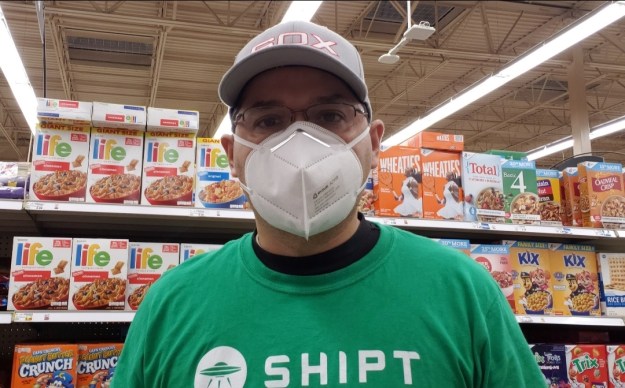
willy solis essential workersWilly Solis has spearheaded the Gig Workers Collective, which seeks to organize Shipt, Instacart, Lyft, and other gig platforms.
By Brianne LaBare

Orlando, Fla.

Every morning, Willy Solis, a worker for Target’s Shipt delivery app, wipes down his dashboard and steering wheel with disinfectant wipes and slips on his gloves and mask, which he bought himself.

Then Solis drives to the grocery store, discards his used gloves in a garbage bag, and heads inside to begin filling orders.

At a time when essential workers are going above and beyond to serve the public, Solis can’t help but think about the hardships working for Shipt has brought upon him. Or the trash bag of used gloves sitting in his backseat.

Because of this, Solis has spearheaded the Gig Workers Collective, which includes workers for Shipt, Instacart, Lyft, and other gig platforms. Their main demand is that corporations provide personal protective equipment, such as masks and gloves, to help keep them safe.

“The major thing that shoppers try to do is make sure that they wear the proper PPE and have it at all times,” Solis said. “We have been providing that for ourselves for the most part during the pandemic, and a large majority of shoppers do express concern about spreading it to customers or to their families. That’s a major concern for us.”

In a statement to The Princeton Summer Journal, a Shipt spokesperson disputed this, saying shoppers can pick up face masks and gloves from their local Target store for free.

Concerns about safety span many essential jobs. Ada Fuentes is a senior membership organizer from Jobs with Justice, a nonprofit that advocates for worker rights. She
said Uber drivers were informed via email that they would get PPE. But many drivers were unable to access the equipment because Uber’s in-person driver help centers were closed due to the pandemic.

Uber said in a statement that drivers could request masks and sanitizer by mail or pick them up at reopened Greenlight Hubs. The company added that it had distributed more than 9 million masks, wipes, and containers of hand sanitizer, and that it had “never run
out of supplies.”

Still, through social media coverage, blog posts, and advocacy efforts, stories about mis-
treated essential workers abound. Solis of the Gig Workers Collective said that, during the pandemic, Shipt even made a temporary pay cut permanent. (The company said that, under its “updated pay model,” shopper base pay in most metro areas has remained the same, or even increased.)

“The CEOs of these companies are definitely not the ones out there doing this job on a daily basis and exposing themselves and their families to this,” Solis said. As for their treatment of the people who are: “to put it bluntly, it’s despicable.”

Gen. Z Gives Biden’s Run Tepid Support

By Angie Cisneros and Daniel Sanchez

Minneapolis, Minn. and Boca Raton, Fla.

Most teenagers may not be eligible to vote, but Generation Z has increasing influence on the policies of both parties, especially those of Democrats. In interviews with four high school students who are part of the Princeton Summer Journalism Program, the clear consensus was that young people are putting their support behind Joe Biden for one major reason: He is not Donald Trump.

Sitting in her home in Boston, 17-year-old Paola Ruiz put it simply: “We have to vote for the lesser of two evils.” Ruiz called Biden “chemotherapy” for the “cancer” caused by the current administration.

Other teenagers had similar views of Biden, both as an individual and as a candidate. Sofia Barnett, a 17-year-old from Frisco, Texas, rattled off what she finds distasteful about Biden, from his 1994 crime bill to the sexual assault allegations made against him. However, when asked who she would vote for, she stood by the Democratic nominee.

Kayla Bey, a 17-year-old from Lilburn, Georgia, said Biden alienated her when he said on a radio program that if you vote for Trump, you “ain’t Black.”

“I just feel like the Black community has gone through so much; I think it was entitled
for him to say that,” Bey said, suggesting such comments may have dampened enthusiasm for Biden.

The teenagers were adamant about their desire to elect more progressive figures. “I was a big Bernie supporter,” said 17-year-old Andrea Plascencia from Flower Mound, Texas—a view echoed by her peers.

Bey mentioned Beto O’Rourke, a Democrat known for supporting the legalization of marijuana and raising the minimum wage.

But after their preferred candidates dropped out of the primary, students have tried to find the same ideals in the presumptive nominee. Bey suggested that Biden would be more palatable if he more strongly advocated for expansion in health care. Ruiz, meanwhile, called on Biden to offer free college for all and debt relief, while Plascencia said she hoped he “can advocate for equality” through policies that benefit people from low-income backgrounds.

All of the students interviewed viewed Biden as an “intermediate” president, one who would work to bring the country back to a normality present before the Trump era.

Jariel Christopher, an 18-year-old from Port Allen, Louisiana, summed it up by saying the strongest argument she saw for Biden is that she foresees more chaos in the country if Trump is reelected.

De Blasio Run Lacks Support in N.Y. Survey

20190801_034949152_iOS

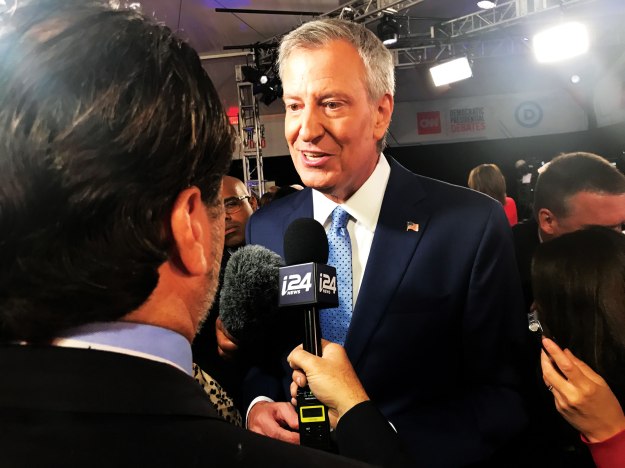
New York Mayor Bill de Blasio takes questions at the second Democratic debate on July 31. Photo Credit: Brian Rokus

By the Staff of the Princeton Summer Journal and written by Jhoana Flores, Jarlem Lopez Morel, and JC Villon. 

New Yorkers don’t want their mayor running for president in 2020. In a survey of 154 New Yorkers, nearly three out of four voters said they are not happy Bill de Blasio is participating in the presidential election.

The survey results contradict de Blasio’s claims that his time running the biggest city in America means he should be elevated to the White House. De Blasio, who announced his campaign in May, is one of two dozen Democrats in the race. He has been polling at one percent or lower nationwide. Many New Yorkers told The Princeton Summer Journal they disapprove of not just his presidential campaign, but also his work as mayor of New York City.

“He isn’t worried about New York because he’s too concerned about his campaign for president,” said Kristie Summers, 20, from the Bronx. “If he can’t be a mayor, how can he be president?” She was one of many New Yorkers who said de Blasio has neglected his mayoral responsibilities to the city and as a result cannot rise to the challenges of the 2020 presidential race.

New Yorkers of both political parties disapprove of de Blasio. When asked if they approve of the job he is doing as mayor, slightly over half of both Democrats and Republicans responded “no,” as did nearly two-thirds of people who identified as a different political party. Three-quarters of both Democrats and Republicans also said they are not happy de Blasio is running for President.

When it came to the prospect of voting for de Blasio for President, New Yorkers were inclined to vote “no.” More than 80 percent of both Democrats and Republicans surveyed said they would not vote for him.

Not all New Yorkers are turning their backs on the mayor, however. “He is do-
ing his job correctly, eliminated crime from the city, got day care and made a
universal pre-K system,” said Steve Pastor, 68, a Queens resident.

Some New Yorkers cited not only de Blasio’s policy achievements, but also the community he is building within New York City. “I feel like he’s making the city better for both genders,” said Sandra Acuna, 30, of Manhattan. However, others have a dark outlook on de Blasio. Jason Woody, 35, from Brooklyn, criticized de Blasio’s pedestrian safety record. “He ran on a platform highlighting Vision Zero, but … I’ve had two friends killed on bikes by drivers, no one has been arrested,” Woody said.

Shawn Haz, a 28-year-old from Brooklyn, said he is frustrated with city zoning issues. “He rezoned everything…I’ve been rezoned, kicked out, and everything,” he said. “Gentrification is messing it all up. It doesn’t really help anything but the rich and white.” Phupinder Singh, 29, from Queens said, “He is not eligible to run for president, no qualification, no experience and not intelligent. He is a comedian.”

While New Yorkers largely do not approve of de Blasio running, many of them were willing to offer advice. “If you want to connect with people, you have to be authentic,” said Matthew Louis, a 29-year-old from Manhattan.

As the mayor tries to win votes across the country to earn the Democratic nomination for president, he is struggling at home.

Despite his efforts to use his title as a mayor of a huge and diverse city to boost his campaign, he appears to lack support from the residents of that city. Many New Yorkers, like Jason Kayne, a 24-year-old from Queens, have a sarcastic message for his campaign:

“Good luck.”

_--approve-bill-as-mayor

Do you approve of the job de Blasio is doing as mayor?

_--Are-you-happy-bill-diblasio-is-running.png

Are you happy de Blasio is running for president?

_--do-you-approve-of-bill-job.png

Would you vote for de Blasio for president?

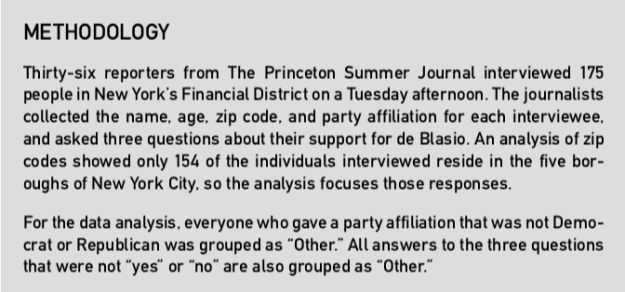
Screen Shot 2019-08-16 at 9.42.09 AM