By Mohamed Omer
From the mind that brought you the genre-bending Inception, existentially terrifying Interstellar, and cult classic The Dark Knight, director, writer, and producer Christopher Nolan spearheads a feature film reimagination of a centuries-old tale: The Odyssey. The movie’s main cast includes Tom Holland as Telemachus, son of Odysseus; Robert Pattinson as Antinous, a hard-headed suitor looking to challenge the throne; and Oscar winners Anne Hathaway and Matt Damon as Penelope and Odysseus, Queen and King of Ithaca, respectively.
In his undertaking of The Odyssey — a Greek epic that is notoriously controversial to translate and adapt — Nolan forgoes consistency and character development to devote ample screentime to Odysseus’ voyage, producing a movie that fails the Bechdel test with flying colors.
Nolan’s Odyssey begins: A bard, played by Travis Scott, delivers an ambiguous warning about a man, a king, a son, a war. Penelope reveals that her husband Odysseus has been missing since his army ambushed the kingdom of Troy. In his absence, her suitors have made themselves comfortable in the castle’s basement, feasting ceaselessly on her food. However, the introduction to this movie is littered with mismatched cuts, unconvincing fight scenes, and dispassionate line delivery. The film spends its first act fighting against immersion — until Odysseus embarks on his journey.
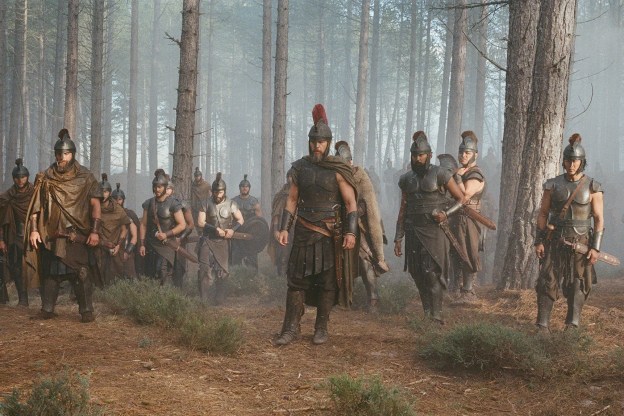
Suddenly, Nolan can do nuanced cinematography. He is thorough in following the all-male crew led by Odysseus and the details of the trials they endure. The B plot follows Telemachus as he reckons with the absence of his father, but unfortunately, Telemachus comes off less as a hopeful son and more as a rookie broadcaster reading off a teleprompter. Despite this fact, the Ithaca storyline centers him and resigns Penelope to the C plot, where her entire arc is built upon her suffering.
Penelope spends twenty years loyal to the King while he rampages land, gods and myth. Her characterization is not historical accuracy as much as it is objectification. She does not live outside of being an accessory to the suitors, to Telemachus, to Odysseus. Her personhood is acknowledged briefly by Antinous, when he reveals to the viewer that Penelope weaves thread in the morning and unravels it at night, so as to delay her marriage to a suitor.
Here is her savior! Nolan couldn’t sacrifice thirty extra seconds of screentime for the cause of showing Penelope’s nightly unraveling, but he had time to write up a monologue for Pattinson to deliver. A similar phenomena occurs with Circe, a witch who transforms Odysseus’ men into pigs; her story is told to her by Odysseus, in a moment meant to display infinite male wisdom.
The Odyssey gives its male characters the privilege of intelligence, delegating their female counterparts the roles of damsel, villain or servant. There is no instance — save for one contested dialogue between Penelope and Melantho — where the women in this film conversate without centering men. In spinning The Odyssey for modern times, Nolan neglects the fact that women are people, insteading pushing Odysseus’ story to the forefront — making what could’ve been a great film a disappointment.