Tag Archives: SJP2016

Princetonians discuss Christie and Trump

By Ashley Standafer and Xuan Truong
Hyden, KY and Springfield, MA

New Jersey Gov. Chris Christie is a polarizing politician who inspired both outright anger and respect among those interviewed on a recent Saturday night in Princeton, N.J.

“He’s a bully and it shows who he really is as a person,” said Robert Delanty, 47. He believes that Christie “sold himself out on the Trump endorsement,” referring to the governor’s support of the Republican presidential candidate.   Continue reading

Calmness and continuity: the story of Princeton mayor Liz Lempert

By Jamal Burns
St. Louis, MO

Liz Lempert sits in a beige conference room in Princeton’s municipal complex. The room is utterly silent, besides the faint hum of central air conditioning. But the calmness of the room belies persistent tension in the Princeton community, whether about the environment, the cost of housing, or racial prejudices on Princeton University’s campus.

Lempert, 46, is the first mayor of the newly consolidated Princeton Township. But she hasn’t always been in politics. She started her unconventional journey in journalism, as an editor for the Stanford Daily, and later, as a graduate student at Boston University. “I thought I was going to go into print [journalism] because you gravitate to what comes easy to you, and I always loved writing,” she said. Continue reading

First-generation Princeton students speak out

By Anahi Figueroa and Jesus Lino
Commerce City, CO and Los Angeles, CA

At the country’s most selective colleges, all first year students commence their college experience in the same way. Armed with over-packed suitcases, they stroll through a manicured lawn passing a medieval Harry Potter-style library to arrive at their empty dorm. After sliding their freshly minted I.D’s, they open the door to new faces with differing backgrounds. They all arrive to the room in the same fashion, yet the subtext of their past experiences shapes their new ones. Whether you’re the daughter of a farmer or the son of a Wall Street shark, your upbringing shapes how you navigate in a new environment. For first-generation and low-income students at Princeton University, their backgrounds can present unique obstacles for maneuvering their education, especially without support from family or the administration.

While administrators believe that Princeton University is doing a marvelous job in assisting first-generation students, some students say that a lot of work still needs to be done. Continue reading

Construction on $300m arts and transit complex moves along

By Hector Gutierrez
McFarland, CA

Through the glass walls of Princeton’s new arts complex, viewers can see rooms hanging from the ceiling, as though they are waiting to be secured into the rest of the building. But the rooms will remain where they are, held by strings attached to the ceiling. The unique structure is designed to isolate the rooms from each other so musical vibrations do not travel.

The beauty of the building cannot conceal the fact that Princeton has not always emphasized arts in this way. As the Princeton campus prepares to welcome the $300 million architectural marvel that will house the production of myriad masterpieces as well as a new Dinky station, it marks a transition from the period when arts weren’t integrated as an important component of the curriculum.  Continue reading

Residents discuss police-community relations

By Aracely Chavez
Pacoima, CA

Because of the violent, often fatal, acts police have committed toward people of color—such as the killings of Philando Castile, Alton Sterling, Eric Garner and Michael Brown—some Americans currently have a negative perception of police. But recent interviews with people in the John Street neighborhood—a historically low-income neighborhood of Princeton—suggest that this is not the case here.

“I think they treat us better” because now “they even greet [us],” said 40-year-old Juan Orellana. Similarly, 35-year-old Consuelo Retanalo said that police help a lot and “do a good job.” According to local resident Joanne Rice Parker, “I respect the police…They look out for us.” Many of the sources, such as 44-year-old Oliverio Sanchez, had never had an interaction with police, but made sure to clarify that “not all” police officers are racist and sometimes need to use force on those that resist them. “To tell you the truth, they’re awesome…They don’t bother me,” said Winston McFarlane. Continue reading

Bridging the gap: Princeton’s Hidden Minority Council

By Trapetas McGill
Philadelphia, PA

To Princeton Sophomore David Lopera, Princeton University’s manicured campus seemed such a world away from his native East Boston that he almost didn’t apply. “I was obviously scared. Nervous. I had my doubts. I anticipated wealth,” he said. Little did this 19-year-old son of migrant Colombians know, he wasn’t alone. When he got to New Jersey last fall, he joined a  growing number of Princeton students with exactly the same worries.

Now, Lopera is a member of Princeton’s Hidden Minority Council (PHMC), a group founded in 2013 to raise awareness about first-generation college students on campus and the challenges they face. While Princeton covers students’ full financial aid, says PHMC treasurer Melana Hammel, “it doesn’t bridge the gap.” Socioeconomic status can have huge effects on low-income students’ experiences on campus. “[The PHMC is about] building an understanding,” Hammel says. And the group, which won Princeton’s 2016 Martin Luther King award for community service, is only getting started.  Continue reading

A moment in time: Princeton senior theses

By Skye An
Brooklyn, NY

For a moment, Ethan Coen was a person no one would recognize today. He was not in Minnesota where he was raised, nor in Hollywood where he ascended as a filmmaker with his brother Joel. He was a philosophy major at Princeton University. And like all Princetonians, he faced the university’s most daunting undergraduate task: the senior thesis.

For nearly a century, students who have gone on to find fame in politics, law, literature and entertainment have completed senior theses at Princeton. But is it fair to judge people by the theses they wrote decades ago?

Continue reading

‘You can’t tell whose parents have money’: the story of first-generation students

By Angela Loyola
Stony Point, NY

There’s a minority group at Princeton that isn’t constrained to one gender, race or religion. They walk around campus unseen. The university claims their well-being is a significant priority—but some students say the school isn’t doing enough.

Low-income and first-generation students don’t fit the traditional definition of a minority, but many of these students still feel stigmatized on campus.

“When you walk around campus…you can’t tell whose parents have money,” said Melana Hammel, rising sophomore. Hammel is the co-chair and treasurer of the Princeton Hidden Minority Council, which aims to give this invisible minority a voice. Continue reading

Don’t let it bug you! A review of worm-covered ice cream

By Xuan Truong, Ashley Standafer and Tommie Robinson
Springfield, MA; Hyden, KY; Jonesboro, GA

On a recent Wednesday, a lone ice cream truck was parked in front of a side exit at New York’s bustling Chelsea Market. This wasn’t a typical Mister Softee truck playing jolly tunes and selling soft serve. There were no nuts or sprinkles—here, the topping options included grasshoppers, mealworms and other insects.

The local Van Leeuwen ice cream shop created the treats as part of a partnership with The Economist and distributed them for free to anyone brave enough to try them. At first, we thought the idea was crazy—and disgusting. What normal person would eat bugs? After speaking with the truck’s employees, however, we learned that these critters are a healthy source of protein.  Continue reading

Staff editorial: Ephemeral experience, lasting impact

By the SJP Class of 2016

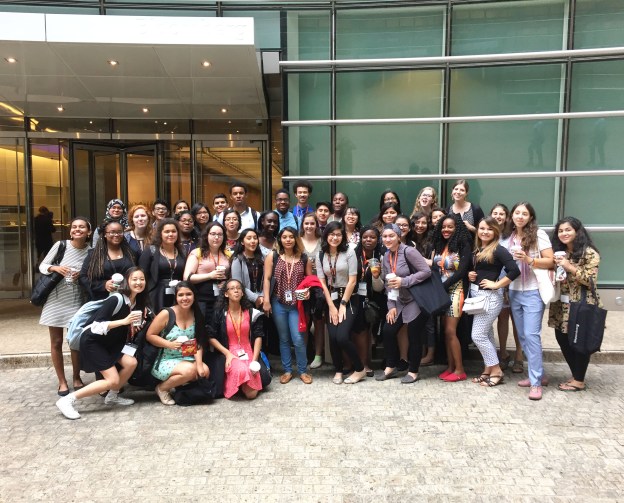
It’s like the beginning of any race: Before the starting gun goes off, you feel nervous, uncertain and a little bit overwhelmed about what lies ahead. That’s how many of us felt when we first arrived at Princeton University’s Summer Journalism Program, flying in from Massachusetts, Missouri, California and everywhere in between.

But over the course of 10 short days and 10 long nights, we hit our stride, all becoming part of a vibrant community of curious students and intellectuals who’ve overcome their circumstances to chase their dreams. Continue reading