Category Archives: Opinion

Hollywood’s Pervasive Color Problem


The book cover of “The Hate U Give” by Angie Thomas (on the left) featured a dark-skinned Black girl while the movie adaption stars a light-skinned actress (on the right).

By Anne Tchuindje

Washington, D.C.

The critically acclaimed movie “The Hate U Give” began as a book. It’s the story of Starr Carter, a young Black girl who tries to balance two worlds—her low-income Black neighborhood and her wealthy white prep school—while still fighting misogyny and racism. On the cover of the book, the illustrator draws Starr Carter as a Black girl with Afro-textured hair and brown skin. The actress who plays Starr in the movie, Amandla Stenberg, is a lighter-skinned Black girl with braids.

Stenberg’s casting is an example of a lack of diversity in Hollywood that new awareness about race and representation has yet to fix: colorism. The term means “prejudice or discrimination against individuals with a dark skin tone, including prejudice held by members of their own ethnic or racial group.”

People of color have slowly, but surely, made a significant impact on the big screen. Diversity, especially in Hollywood, allows people from different backgrounds to see themselves reflected in popular culture. But when it comes to the representation of darker-skinned Black people, the movies haven’t made much progress. Executives tend to hire lighter-skinned actors to play Black roles, or to consider darker-skinned actors only for roles that fulfill a specific stereotype. Until colorism is addressed within the filmmaking industry, there will never be true diversity.

The illustrator of “The Hate U Give,” Debra Cartwright, has said in interviews that she “wasn’t thrilled” about the choice of Stenberg to play Starr. In a meeting with Fox, executives told her that they’d have to lighten her illustration, and “change the hair.”

Author Angie Thomas also criticized the colorism infecting the film adaptation, which omits the references to colorism in the Black community expressed in her original book. “It’s disheartening, because I do feel like so much money was thrown behind the movie, and so much marketing was thrown behind it,” Thomas said. “You can tell who Hollywood is pushing to be in the limelight, and everybody knows it has a lot to do with appearance, but it also is still being driven a bit by colorism.”

“The Hate U Give” is far from the only example. Among others, actress Zendaya has spoken up about issues of colorism within Hollywood and admitted to having a privilege over her “dark skin brothers and sisters.” She vowed to continue to use her platform to bring attention to issues of colorism within the industry. “Guardians of the Galaxy” actress Zoe Saldana, cast in the role of singer and songwriter Nina Simone despite her lighter skin and looser hair texture, expressed great regret for playing the role.

“I should have never played Nina,” Saldana said. “I should have done everything in my power with the leverage that I had 10 years ago, which was a different leverage, but it was leverage nonetheless.”

Colorism is also apparent in animated movies. In recent Disney films, a variety of princesses from different backgrounds and cultures have been featured— and through each movie we witness the development of each princess as she embarks on an adventure that ultimately changes her life forever. But colorism remains.

In “The Princess and the Frog,” the first Disney film to depict an African American princess, main character Tiana was trapped in the form of an animal for over 80 percent of the movie. Disney’s decision to make this princess a frog throughout the movie is not only racist, but colorist, in the sense that this plot is only used in a movie containing a dark-skinned princess.

Issues of colorism within Hollywood do not only affect who is cast to play roles, but also how they tell the story of those they play. When Hollywood does cast dark-skinned actors, they are given less screen time or made to play demeaning characters; for instance, dark skin characters make frequent appearances as maids and servants. It’s important to cast actors and actresses of darker skin in order to show more diversity, be more inclusive, and break down these stereotypes.

We need stories that spotlight more people within the Black community. Actors and actresses with a platform and leverage should give other actors and actresses of darker skin tones more opportunities and voices within casting decisions. Representation within film builds character and identity for Black people.

How Can We Mitigate Bias In AI?

By Mahbuba Sumiya

Detroit, Mich.

Facial recognition software—used by millions—doesn’t properly identify people of color. This technology was meant to provide accurate results, but alarmingly, “nearly 40 percent of the false matches by Amazon’s tool … involved people of color,” according to Queenie Wong, a staff reporter for CNET News. Amazon’s face-ID system recognized Oprah as male, wrongly matched 28 members of Congress to a mugshot database, and detected a Brown University student as a Sri Lanka bombing suspect.

Algorithms are learning to adapt to society’s stance on racial biases. They’re programmed and trained by showing millions of human pictures; however, if the algorithms are trained with only white faces, they won’t be able to recognize any other types of faces. Artificial intelligence (AI) can only be smart if they are trained with fair data. If an AI is trained with millions of faces that are people of color, then it would not have a hard time recognizing those faces accurately.

Joy Buolamwini, founder of the Algorithmic Justice League, researches the social implication of artificial intelligence, and recognized the biases that companies like Microsoft, IBM, and Amazon have in place for AI services. While at MIT as an undergraduate, Buolamwini tried out an algorithm called Coded Gaze as part of an assignment. She learned that the system recognized her light-skinned friend’s face better than her own. When Buolamwini put on a white face mask, it was able to detect her face.

Racism exists in computer algorithms because of individual values. If people did not care about how the person next to them looked, racism would not still be America’s biggest problem. People being wrongly arrested because of false detection is not ethical. If people are fighting for justice, they must fight for justice in everything. Racial justice must equal algorithm justice.

Plus, even if algorithms are trained with antiracist databases, accuracy continues to be an issue. The National Institute of Standards and Technology (NIST) stated in May 2020 that Asians and African Americans had false positive rates even when they programmed computers with 8.49 million faces. Will AI ever be fair to people of color?

Growing up in a generation where algorithms are becoming more and more prevalent, it’s hard to recognize machine bias—a problem that will continue to amplify inequality in future generations, if left unchecked. We must train AI to be fair and neutral. But with the current state of the field, this may prove difficult. Computer science tends to attract more men than women—only about 25 percent of computer scientists in the United States are women. Minority racial groups are also not represented equally in tech industries. Having more diverse points of views in this field can prevent us from training computers with biased data. In society, a woman might be associated with teaching, childcare, or nursing, but we should not use these existing societal assumptions when building an algorithm.

Luckily, some businesses are taking small steps to measure and minimize bias, including IBM’s Fairness 360 (an open source allowing developers to examine, report, and mitigate bias within the machine learning model), according to Macy Bayern, as associate staff writer for TechRepublic.

After all, the only way we can eventually move forward with AI fairly is by allowing diverse people to be engaged with tech industries.

Bill de Blasio Has Failed Enough New Yorkers

By Aima Ali

Brooklyn, N.Y.

In late March, New York City Mayor Bill de Blasio and chancellor of education Richard Carranza announced that schools would close. Now, with 232,000 reported cases and more than 23,000 deaths in the city, the mayor is planning on reopening schools in the fall. Reopening schools with the proposed hybrid learning model will only result in more unnecessary death.

Though cases are decreasing in the city, allowing some businesses to reopen, people still die from the virus every day. Before schools closed, more than 60 Department of Education employees—including 25 teachers—contracted COVID-19 and eventually died. Opening schools will inevitably lead to more cases and will raise the risk of students being exposed to the virus. School students and staff often have to commute using trains or buses. Though the Metropolitan Transportation Authority, the city’s transit agency, has been cleaning trains nightly, those who use public transportation during rush hour know how crowded trains can be. Some MTA employees have even refused to come to work after their colleagues contracted and died from the virus. As a result, already unpredictable buses run on even more unreliable schedules and remain packed at all hours of the day.

The Department of Education released guidelines limiting the number of students per classroom, but keeping up with these requirements will be more difficult for schools with larger classroom sizes. Those are often schools serving low-income students. Low-income, Black, and Latino individuals are already more likely to both contract COVID-19 and die from the disease. Larger classroom sizes and fewer teachers will only increase these inequalities.

Those pushing for reopening claim that it will not affect death rates, as students are less likely to die from the virus. However, older students are still susceptible to becoming extremely sick and may suffer from other symptoms, such as loss of taste and smell. Students can be symptom-free carriers, infecting high-risk family members without even knowing. Older teachers will also go to work fearing for their safety each day. Teachers’ unions are predicting that teachers who can retire will, causing an even greater shortage of teachers and making it more difficult for class sizes to remain small.

Poor planning caused New York City to hesitate before closing schools when a COVID-19 case was first detected in Manhattan. Still, with months to plan, the best the mayor and his fellow politicians have been able to come up with is a plan that will ultimately result in the deaths of more New Yorkers. We cannot bring back those 63 DOE employees that were exposed early on, but we can make sure that no other teacher, school staff member, or student dies a preventable death.

Finding The Silver Lining In A Global Pandemic

photo-1588612005960-a382b1eca714Image created by Daniel Barreto

By Alyssa Ultreras

Oakland, Calif.

Late in March, COVID-19 abruptly stopped everyone’s schedules, plans, and events across the nation. The global pandemic put families through struggles regarding finance, access, and opportunity. Through this pandemic, the media has also shed light on the disproportionate hardships faced by people of color.

Yet despite all the turmoil people have faced during this time, many have been inspired. Some have started a small business, become more educated, become advocates, or taken other action to help people in their communities.

Living through this time, and witnessing all the tragedy as well as the glory that has risen through it, I have been inspired to reevaluate the way I spend my time.

Before quarantine, I worked non-stop with my school schedule, extracurriculars, jobs, and household responsibilities. I was exhausted, unable to realize that I was devoting time to people and commitments that did not make me happy anymore. I was a lit flame burning myself to ashes, taking on too much out of a feeling of obligation that’s common among high school juniors.

Now when I look back on those pre-pandemic times, I know why I thought this way. Like a college freshman, a person transitioning to find a job, or a person seeking a higher position in their field, I was suffering from a lack of balance.

As I was burning out at the end of the first semester, I watched a Ted Talk by Shonda Rhimes. She explained how she felt burned out because massive production and success led to a loss of family time. I could only relate from afar because I did not have a daughter as she does. However, I do have a family. I do have a younger sibling who looked up to me as an older sister, only to see me come home after a long day too tired to play with her.

As Rhimes says, “Work doesn’t work without play.”

Rhimes argues for spending more time with who or what brings balance to work. And so, once quarantine came and my entire life was put on pause, I had time to reconnect with myself and find the balance to my work.

It took a global pandemic to allow the world around me to stop and give me a chance to realize this. As young advocates are helping to change the world, seizing the moment and rising in this dark time, we all must strive to find the balance between work and play if we want to persevere during this pandemic and come out the other side stronger.

White Teachers: Stop Saying ‘Negro’

By Kuftu Said

Aurora, Colo.

As a Black student who has attended diverse schools my whole life, I’ve seen my fair share of racial microaggressions. Racism in the classroom is particularly aggravating. It’s embarrassing enough that we are taught whitewashed history, are shut out of AP classes, perform lower on standardized tests because of a lack of support systems, and learn from very few teachers of color. I’m tired of hearing my non-Black teachers tell me they can say “negro” for educational purposes.

Whether it’s classmates who tell me not to play the “race, religion, or woman card” in debates, or people who warn me not to perpetuate the “angry Black woman” stereotype, I have let many a bigoted remark go. National statistics show how Black students graduate at lower rates and experience harsher and longer disciplinary actions than their white counterparts, but there are none that show how many Black students experience racism at school. Racist educators have the ability to determine how racist acts are punished, much like how police essentially police themselves.

Some of these facts I have learned from the same teachers who use “negro” or other racial slurs for “educational purposes.” I shouldn’t have to educate my teachers; we can be “educated” just as well by reading around the word ‘negro.’

I had a white teacher who justified her use of the word in a classroom with three Black students by showing us an article that explained how “negro” was used to describe Black people on the census until 2013, so it was an objectively descriptive word. I had a white teacher who announced that he was the only person allowed to say “negro” in the classroom. I had a white administrator who said an even more offensive n-word when disciplining a group of Black boys; he justified it by saying he was repeating what he heard from the group. None of these teachers was punished.

When I talk to my fellow classmates, especially my Black peers, we whisper about the ignorant use of the word. I could never say my feelings out loud before, but in a time of moral revolution, when Twitter has the ability to hold people accountable for hate speech more than schools do, we must normalize calling out what’s ethically backward.

At a time when Black students from Ivy League universities post anonymously on social media about their terrible experiences (check #BlackIvyStories and wince), let’s make sure white teachers stop saying “negro.”

Cutting Weight Can Wait; Teens’ Health Can’t

Aigner Settles (left) and Sofia Barnett (right) powerlifting for their high school teams.

By Sofia Barnett

Frisco, Tex.

I didn’t understand the toxicity of high school sports until I had to lose 11 pounds in 36 hours for varsity powerlifting.

On weigh-in day, I rose before the sun. Having completely deprived myself of food the day before, I immediately sank back down as fireworks of red, blue, and green interrupted my blurred vision—my body’s way of warning me that I needed help. I put on five sweat- shirts and six pairs of sweatpants, hot-flashing already as I struggled to tie my sneakers. Still, I made it to my high school track just before the first wave of runners started their early morning jogs.

Twenty sprints, 100 meters, 16-second average. Ready, go.

My heavy exhalation lingered in clouds of vapor in the cold December air. I wasn’t sweating enough. The chill was preventing me from expelling every remaining drop of water my body had clung to. It became too much. I threw up on the side of the track just as the sun began to rise: a ceremony honoring the fact that my stomach had forced out the last of its contents.

For thousands of student athletes nationwide, the demands of weight-cut culture are a tragic reality. In order to compete, lifters and wrestlers must make a designated weight class, often by gaining or losing weight rapidly, forcing them to choose between their health and their athletic performance. With added pressures from coaches and teammates, it’s not an easy choice to make. At what point does an athlete say no?

As weight-cut culture continues to grow, the increasing number of athletes resorting to physical harm in order to make weight is not only normalized, but praised within the sports community. During my time as a powerlifter, I have heard locker-room horror stories of coaches buying students laxatives, glorifying eating disorders and unjustly punishing athletes who were unlucky enough to miss weight by even the slightest fraction of a pound.

As teenagers, we are highly susceptible to internalizing the beliefs we are exposed to, whether good or bad. Young athletes, told often of the virtues of rapid weight fluctuation, start to believe that the harm they are causing their bodies is just another inconvenience they have to overcome rather than a potentially life-threatening compulsion.

We are minors. This isn’t the Olympics, it’s high-school competition. The only thing at stake here is a cheap, bulk-produced aluminum medal that will eventually end up collecting dust in a grandmother’s moldy basement—well, that and our health. The detrimental impacts of weight-cut culture—immune system deterioration, development of unhealthy habits, and life-long trauma—far outweigh any momentary competitive advantage.

That boy spitting ounces of saliva into a jug on meet day deserves better. That girl sticking two fingers down her throat because she accidentally forgot she couldn’t have breakfast deserves better. My teammates, my competitors, and I deserve better.

Get The Police Out Of Schools

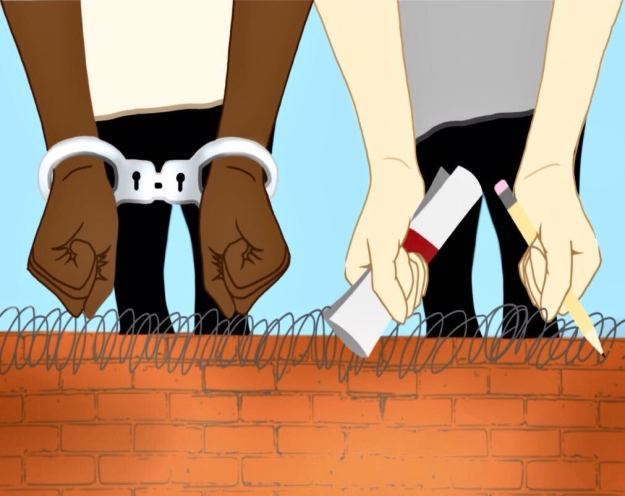
Opinion art by AbedAbednego Togas

By Vanessa Zepeda

Chicago, Ill.

There is a consensus among students of color that we must act more “normal”—meaning white—when we’re around student resource officers (SROs) compared to our white counterparts. We wonder: Will they consider us suspects due to our differing features? Will our efforts to capture a white society’s concept of normalcy be enough as we scurry past?

“Why are you afraid of the police?” supporters of SROs ask, bewildered. But bewilderment is the child of ignorance. The question suggests apathy, ignorance, and disregard for students who have faced encounters with the brutality of SROs.

To ask such a question in a time of an uprising against systems of oppression requires the ability to turn away from something others have been forced to face their entire lives—it requires privilege. It’s easy to get entangled in a rose-colored world, oblivious to the way our fears heighten around SROs, because this obliviousness is not a new problem.

To understand why the SRO system disproportionately impacts students of color, we must address its origins. According to the ACLU, SROs first appeared in the wake of school desegregation, after “white community members argued that … a lack of discipline among Black children would bring disorder to white schools.” After the Columbine school shooting, more schools began to assign SROs in hopes of preventing similar tragedies. However, police in schools became concentrated in low-income neighborhoods of color, letting minority students face higher rates of punishment.

Police provide protection, but they are not the protectors of minorities. They protect the systems that harm us. Schools where SROs enforce zero-tolerance policies criminalize trivial behaviors, pushing students towards the school-to-prison pipeline.

Who are the children most impacted by the school-to-prison pipeline? Students with learning disabilities or histories of poverty, abuse, or neglect. As low-income neighborhoods of color continue to use SROs, schools rely more on police. In a way, student resource officers become walking gateways to the pipeline as schools begin to give up on students.

Supporters of SRO programs often bring up a fear of school shootings to justify police presence in schools. However, there is no substantial research that proves SROs improve the safety of schools. What the data have shown is the disproportionate impact of SROs on students of color.

Safety does not come from armed individuals working for a historically racist system. If you believe that, re-evaluate what you perceive as safety. I can assure you that safety for you does not mean safety for all.

How Racism Leads To Anime’s Stigma

photo-1581833971358-2c8b550f87b3Credit: Tim Mossholder

By Crystyna Barnes

Elm City, N.C.

Have you ever heard of anime?” asked a student at the front of the class. My teacher looked at the kid, confused. “It’s like those weird cartoons from Japan or something,” the student added. “Don’t watch them. They’re really gross and weird.”

The students, and even the teacher himself, laughed. I sat in the back of the class beside my friend, a fellow fan of anime. We slowly turned to look at each other, puzzled. The last anime I’d watched was about a middle school boy rediscovering his love for piano. What’s so gross about that?

Cartoons are a staple of most childhoods. No one bats an eye when asked about their favorite Disney film. Why is it any different when the content originates in a foreign country? The watered-down reasoning is that it’s simply racism. But the bigger culprit is social conditioning that teaches us to think of something outside of the norm as “weird.”

What people don’t know is that they’ve probably already consumed western content inspired by anime. Ever watch “Avatar: The Last Airbender”? “Powerpuff Girls”? “Teen Titans”? All of these childhood favorites took notes from anime: exaggerated facial expressions, big eyes and mouths, and a color- ful palette for character designs. We’ve been enjoying cartoons based on anime all along.

Whenever I’ve asked someone why they don’t like anime, the answer is short: “It’s weird” or “I just don’t get it.” I have even heard people say that anime all seem per- verted. I don’t necessarily believe that the average person who says these things is outright racist, but continued anti-Asian stigma and a lack of edu- cation contribute to this pointless opposition. If all someone hears about anime is that it’s strange and distasteful, a cycle of indoctrination has been created where no one questions or denies this out of fear of being viewed as weird as well.

In the scheme of things, the only noticeable difference between the cartoons we know and love and anime is the place of origin. Anime is not just one genre or one style. Just like cartoons, there is one out there for everyone.

If we want to end the stereotypes around Asian culture, change starts with the individual. Go on Netflix, find an anime with a plot that piques your interest, and start watching it. Suggest it to friends. Normalizing content that is viewed as abnormal will only create more open-minded people and more shows and movies to enjoy.

Beyond platitudes, Ocasio-Cortez

By Aleina Dume

Richmond Hill, NY

When I first heard about Alexandria Ocasio-Cortez, the Democratic candidate for New York’s 14th Congressional District, I was excited. She has advocated for issues I care about, like abolishing the federal Immigrations and Customs Enforcement agency, reforming the prison system, and providing tuition-free public college nationwide. Like me, Ocasio-Cortez is a Latina who grew up in New York City. She embodies the demographics of my community. She looks more like a neighbor than a politician. Although I live in the 5th district, many of my family members live in the 14th. I was excited my community could vote for one of our own. 

With all of the media coverage surrounding her campaign, I tried to get more information on the specifics of her platform. On her website, Ocasio-Cortez advocates for things like a “Peace Economy,” and a national free public college tuition system. These are interesting ideas, but her website is light on details for how to finance or carry out these plans. 

In her proposal for higher education reform, for example, she references a “national education system,” which does not exist. She cites the University of California system as an example, but the system has struggled to remain affordable for many of its low-income students. The example also belies a broader problem with her plan, which is that tuition costs at public colleges are controlled by the state. She makes no explanation for how she would nationalize the system, which may not even be possible.

Similarly, she plans to turn America into a “Peace Economy” by bringing home our troops from engagements in Libya, Syria, Iraq, Afghanistan, Yemen, Pakistan, and Somalia. Though she is right to tap into America’s exhaustion with foreign wars, she does not lay out a plan for how to remove troops in a way that will maintain stability in the region.

A former community organizer and educator with real ties to her community, Ocasio-Cortez is qualified. But she is living in the world of ideas without providing specifics. It’s important that people feel demographically represented, however identity politics can only take a candidate so far. Their specific plans to address the issues on their platform is what should take them to Congress. 

Affirmative action debate requires nuance

By Jessica Fan

Oakland, CA

This fall, millions of seniors across the country will decide which colleges to apply to and await the letters that will decide their fate. However, for some students, college-related stress goes beyond just SAT scores and GPA. 

One of the biggest stories this application season is the affirmative action controversy at Harvard College over Asian-American students. The college has been accused in a lawsuit of incorporating anti-Asian policies, and court proceedings are due to begin in October. In response to the accusations, Harvard has accused the organizers of the lawsuit, the Students for Fair Admissions, of being complicit in an effort to repeal affirmative action altogether. 

Whether or not the allegations against Harvard are true, Asian-American students are right to be concerned about admissions policies. As an Asian-American who comes from a low-income background, I believe that affirmative action policies are important. But when it comes to college admissions, we need to treat racial categories with greater nuance.

Affirmative action policies that benefit students of color facilitate more diverse educational experiences for everyone and ensure that voices that have long been buried by elitist admission processes can finally be seen and heard. Higher education is the foundation of a successful career, and communities of color—especially Black and Latino communities —have historically been denied that opportunity. Affirmative action provides people of color with a fair chance at education. 

One of the biggest problems with affirmative action policies, though, is the broad grouping of Asian-Americans. Within the Asian diaspora, there are different cultures and ethnicities that lead to very distinct experiences. You can’t compare the experiences of a third-generation Japanese-American whose family lived through internment camps to a first-generation Filipino immigrant who graduated almost illiterate in an underfunded school.

Disappointingly, the focus of the affirmative action debate has been dominated by the voices of wealthy Asian-Americans. Groups like The Orange Club, which was founded in Irvine, Calif., by a group of Chinese-Americans, rally the support of their community behind one single goal: to end affirmative action. The often-fractured community is banding together for the chance to support local Republican candidates who vow to overturn affirmative action. They fail to recognize the obstacles faced by non-Asian minority groups, and they fail at addressing the systemic problems within other parts of the Asian community—such as the extremely low graduation rate among low-income Filipino high school students or the large number of under-resourced schools in California with high populations of Asian students. 

But wealthy Asians are not the only ones at fault in this situation. Institutional supporters of affirmative action need to take into account a broad range of diversity, and devise new ways to ensure that their policies are upheld within the Asian community, perhaps going so far as to dissolve the “Asian” category altogether in favor for a more complex breakdown of what it means to be Asian.